Published: 3 November 2026
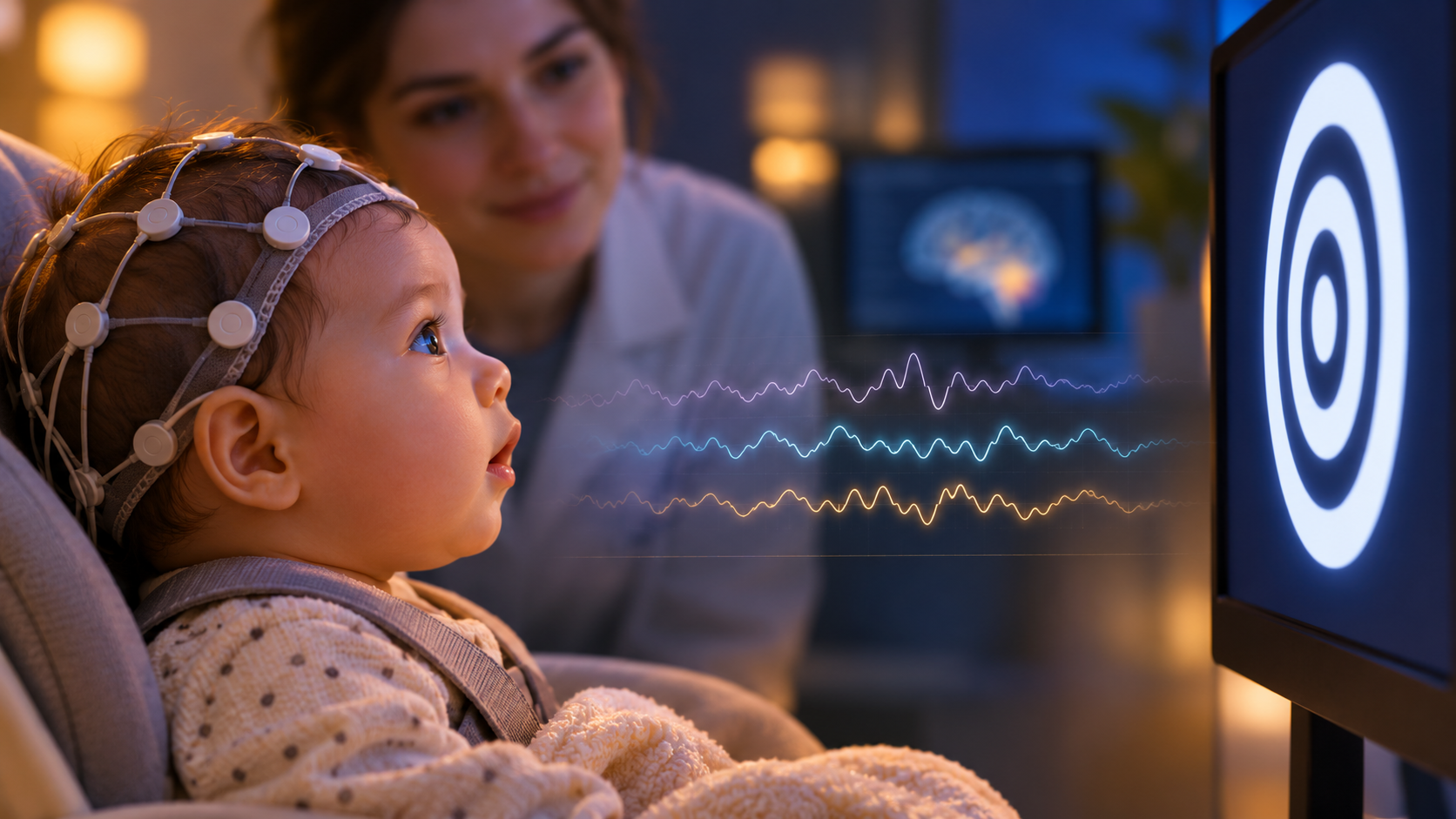
The no-report problem
Adults can say what they see and feel. Infants cannot. That makes infant consciousness a special version of the no-report problem: scientists must infer awareness from eye movements, learning, surprise, memory and brain activity while avoiding the assumption that any single response proves experience.
What researchers measure
Studies compare neural responses to visible and masked stimuli, track how information persists after a stimulus disappears, and test whether infants form expectations about bodies and objects. The aim is not to find a single consciousness switch, but to identify patterns that resemble the coordinated processing associated with awareness in older participants.
What is established
Infants discriminate faces, voices, bodies and changes in their environment. Developmental neuroscience also finds age-related changes in the timing and organization of cortical responses. These results show increasingly structured perception and learning, even when language is absent.
What remains uncertain
A neural marker correlated with adult report may have a different role in an infant brain. Motor responses can be limited, attention can fluctuate, and brain networks are still developing. For those reasons, responsible conclusions rely on several independent measures rather than treating one EEG pattern as direct access to an infant's experience.
A gradual beginning
The evidence fits better with a layered development than a single dramatic moment. Basic sensory awareness, body representation, memory monitoring and self-reflection may emerge on different schedules. This is a scientific model of development, not proof about the first instant at which experience exists.
Discussion question
If consciousness cannot be reported, which combination of behavior and brain activity should count as the strongest evidence for it?
Sources and further reading
Nature Reviews Neuroscience — Detecting consciousness in infants ↗Scientific Reports — Cortical signatures of visual body representation develop in human infancy ↗Nature Communications — Metamemory monitoring in toddlers ↗Share your answer
You must log in to reply.
Sign Up / Log InEstablished evidence, active research and philosophical interpretation are clearly separated.