Published: 23 October 2026
The report problem
Most consciousness experiments ask a participant to say what was seen or press a key. The report is useful evidence, but producing it recruits working memory, decision-making and motor preparation. A brain signal correlated with the answer may therefore reflect the act of reporting rather than the experience that preceded it.
How no-report paradigms work
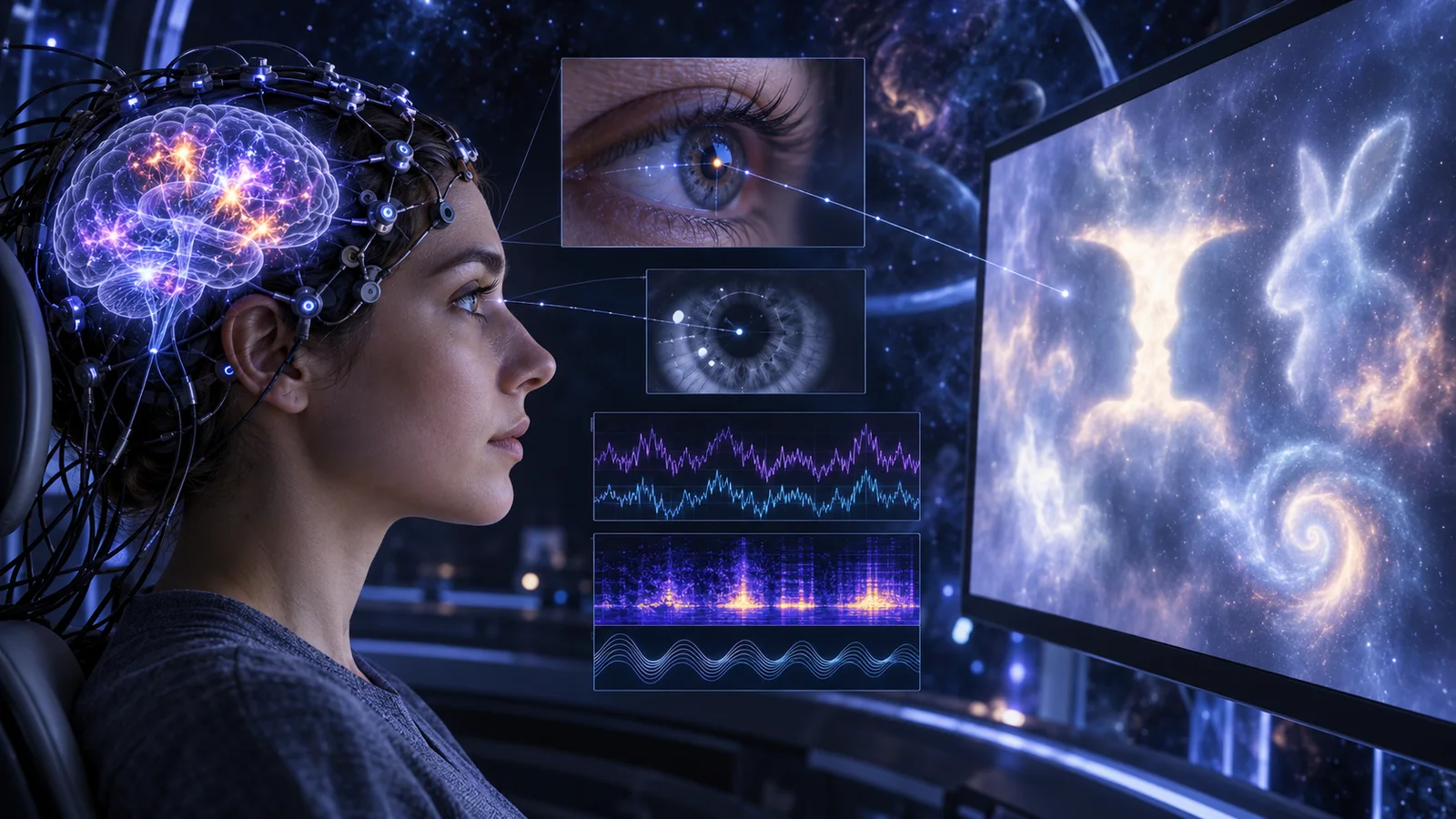
Researchers infer perception from signals such as eye movements, pupil size or optokinetic responses. In binocular rivalry, for example, different images compete for awareness while characteristic eye behavior can indicate which image dominates. Comparing reported and no-report conditions helps isolate processes that disappear when the explicit answer is removed.
What the comparisons suggest
Several studies find that some late frontal and parietal activity becomes smaller when reporting is unnecessary, while sensory and posterior signals continue to track the perceived content. This has weakened simple claims that every late frontoparietal signal is a direct signature of consciousness. It has not established one exclusive location for experience.
Inference never disappears
A no-report measure is still a report supplied by the body and interpreted by the experimenter. Eye movements may reflect attention, expectation or learned strategy. Researchers must first validate that the proxy follows experience in conditions where reports are available, then test whether the relationship survives new tasks and participants.
The best use is triangulation
No-report paradigms are strongest when combined with ordinary reports, behavior, brain stimulation and converging physiological measures. Agreement across methods can rule out specific confounds. The goal is not to silence participants, but to separate the experience, the decision and the communication as carefully as possible.
Discussion question
If a person's eyes and brain activity indicate perception while the person gives no answer, what would count as sufficient evidence that an experience occurred?
Sources and further reading
Tsuchiya et al. — No-report paradigms: extracting the true neural correlates of consciousness ↗Review — No-report paradigms and the search for neural correlates ↗Recent methodological analysis of no-report paradigms ↗Share your answer
You must log in to reply.
Sign Up / Log InEstablished evidence, active research and philosophical interpretation are clearly separated.