Published: 21 October 2026
The problem of a silent patient
A person may be unable to move, speak or reliably follow commands while some conscious experience remains. Behavioural diagnosis can therefore confuse lack of response with lack of awareness. Brain-based methods seek evidence that does not depend on a patient understanding instructions or producing an action.
Perturb, then listen
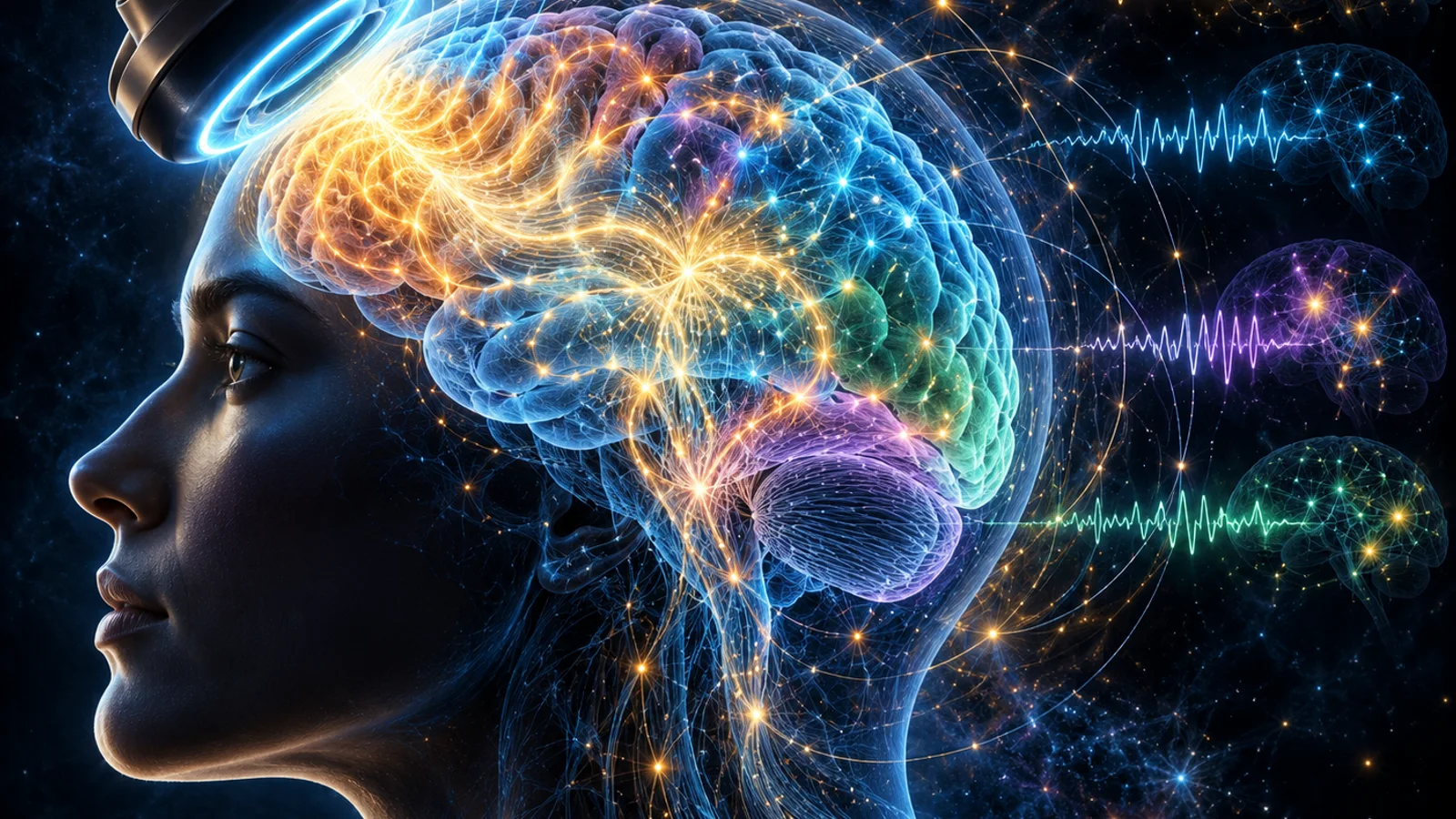
The perturbational complexity index combines transcranial magnetic stimulation with electroencephalography. A brief pulse disturbs a cortical region, and electrodes record how the response spreads and changes. Conscious brains tend to produce activity that is both widespread and differentiated; deeply unconscious brains often respond locally or stereotypically.
What validation has shown
A large benchmark study separated report-confirmed conscious conditions from unconscious conditions and then applied the threshold to unresponsive patients. Later independent work replicated strong sensitivity for minimally conscious patients. Some behaviourally unresponsive patients showed complex responses, raising the possibility of covert capacity for consciousness.
What the number cannot tell us
PCI does not reveal what a patient is experiencing, whether experience is rich, or whether a particular thought is present. Brain injury, stimulation location, medication and measurement quality can affect results. A high value is evidence about system-level capacity, not a transcript of a hidden mind.
Convergence is safer than a single test
Clinical decisions should combine repeated behavioural examination with imaging, electrophysiology and medical context. Agreement between PCI and metabolic measures strengthens interpretation; disagreement can be informative rather than simply dismissed. The ethical stakes favour careful repetition and transparent uncertainty.
Discussion question
When behaviour and brain complexity disagree, which evidence should carry more weight in decisions about care and communication?
Sources and further reading
Casarotto et al. — Stratification of unresponsive patients by an independently validated index of brain complexity ↗Bodart et al. — Measures of metabolism and complexity in disorders of consciousness ↗Sinitsyn et al. — Detecting the potential for consciousness using PCI ↗Share your answer
You must log in to reply.
Sign Up / Log InEstablished evidence, active research and philosophical interpretation are clearly separated.