Published: 21 October 2026
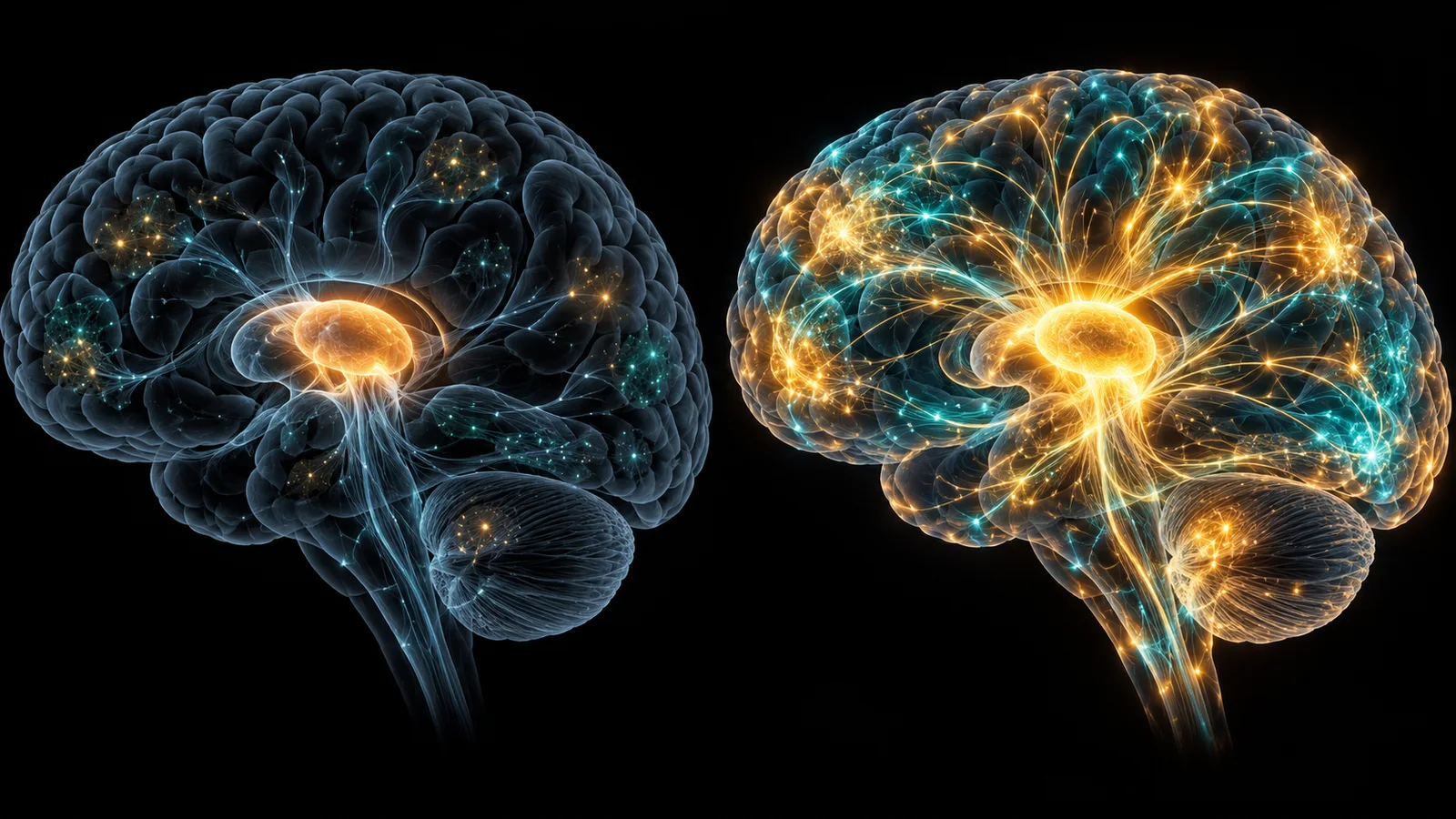
A hub deep in the brain
The thalamus connects with wide regions of cortex and participates in arousal, attention and sensory coordination. Its central nuclei are positioned to influence many networks at once, making them candidates for controlling the conditions under which consciousness is possible.
From correlation to intervention
Anaesthesia changes large-scale brain dynamics, but correlation does not show which structures are causally important. Deep-brain stimulation allows researchers to perturb a specific thalamic target and observe whether cortical organisation and behaviour recover.
What primate experiments found
A 2024 study reported that anaesthesia constrained distributed activity toward structural wiring and collapsed several dimensions of cortical hierarchy. Stimulation of the central thalamus reversed these signatures together with behavioural markers of arousal; a comparison target did not.
Arousal is not the whole experience
Opening the eyes or producing movement does not reveal the content or richness of experience. The findings support a causal role in restoring brain-wide organisation, while leaving open whether the animal's subjective experience fully returned.
Clinical promise and caution
Thalamic stimulation is being explored in disorders of consciousness, but translation requires careful target selection, individual anatomy and independent measures of awareness. Animal results define mechanisms and hypotheses rather than guaranteed treatments.
Discussion question
If stimulation restores integrated brain dynamics before a person can communicate, should clinicians treat that as evidence of returning consciousness?
Sources and further reading
Luppi et al. — Thalamic orchestration of conscious brain dynamics ↗Direct cortical stimulation and behavioural arousal ↗The nature of consciousness in anaesthesia ↗Share your answer
You must log in to reply.
Sign Up / Log InEstablished evidence, active research and philosophical interpretation are clearly separated.