Published: 13 October 2026
Two influential pictures
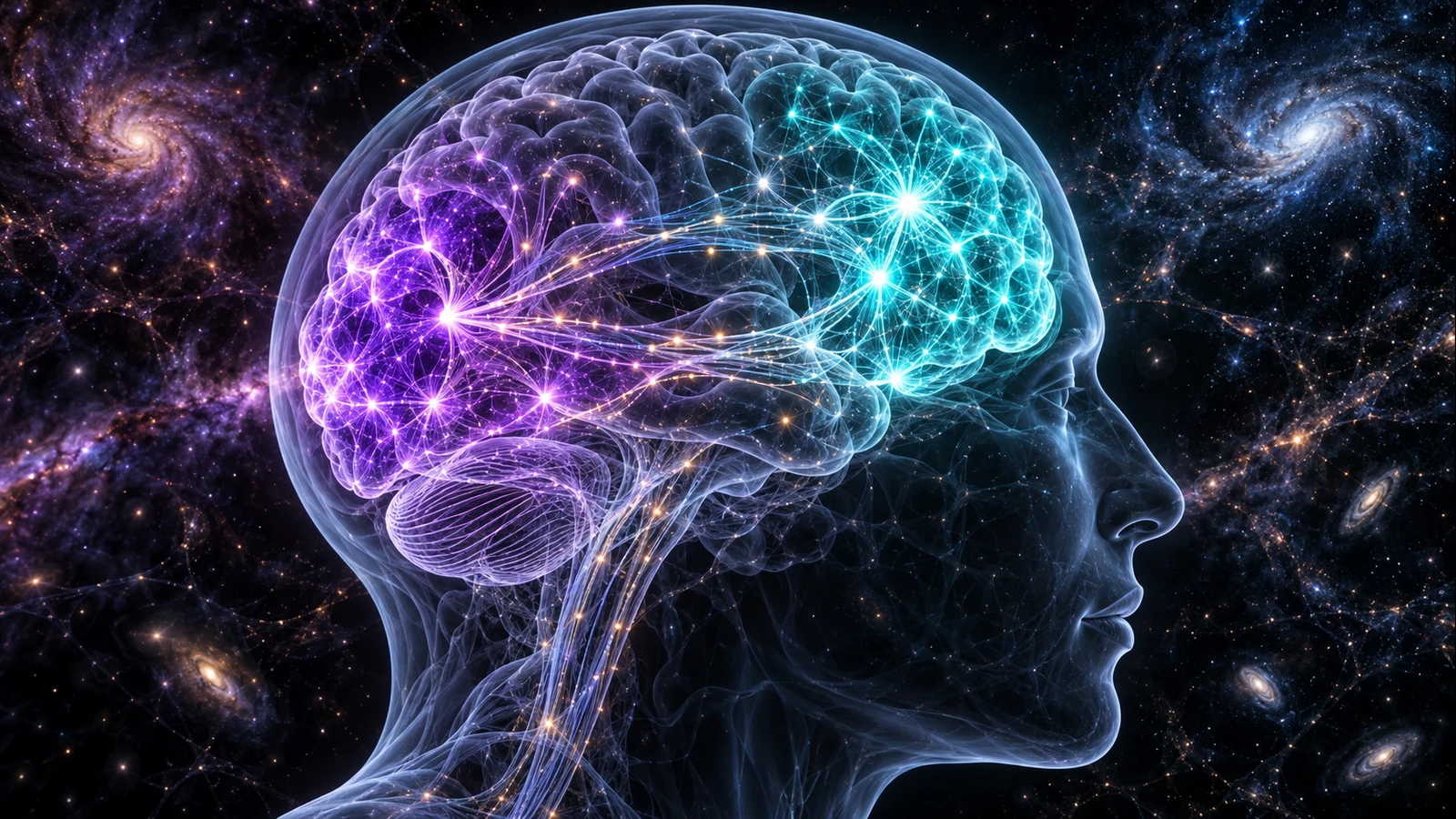
Integrated information theory emphasizes the intrinsic causal structure of a network and predicts an important role for a posterior cortical “hot zone.” Global neuronal workspace theory emphasizes information becoming widely available through brief ignition across distributed networks, especially involving prefrontal areas. Both accounts connect consciousness to measurable brain activity, but they disagree about location, timing and connectivity.
A test designed before the answer
In the Cogitate Consortium study, proponents and theory-neutral researchers agreed in advance on predictions and pass-or-fail criteria. Across 256 participants, conscious visual experiences were measured with functional MRI, magnetoencephalography and intracranial EEG. Combining methods mattered: fMRI offers spatial detail, MEG offers timing and intracranial recordings provide direct electrical measurements in selected regions.
What the experiment found
Information about conscious content appeared in visual, ventrotemporal and inferior frontal cortex. Sustained responses in occipital and lateral temporal regions tracked how long a stimulus remained visible, while some content-specific synchronization linked frontal and early visual areas. Yet the study did not find the sustained posterior synchronization expected by one key IIT prediction, and it found less of the prefrontal ignition pattern expected by GNWT.
Why there was no simple winner
A theory can contain a mathematical core, a biological implementation and auxiliary assumptions. Evidence may challenge one layer without eliminating every version of the idea. The study therefore did not crown a final theory. Its value lies in forcing precise predictions and exposing where familiar explanations need revision. Consciousness science advances when a difficult result cannot be dismissed merely by changing the test after seeing the data.
What “where” now means
The results discourage treating consciousness as a single spot that lights up. Content, duration, access, reporting and coordination may depend on partly different processes. Future theories must explain how these processes interact and which are necessary for experience itself. The emerging lesson is methodological: location matters, but timing, connectivity and causal intervention are equally important.
Discussion question
Should a theory be abandoned when a central prediction fails, or revised if its broader framework still explains other findings?
Sources and further reading
Cogitate Consortium — Adversarial testing of GNWT and IIT ↗Nature Reviews Neuroscience — Theories of consciousness ↗Share your answer
You must log in to reply.
Sign Up / Log InEstablished evidence, active research and philosophical interpretation are clearly separated.