Published: 7 November 2026
Turning disagreement into predictions
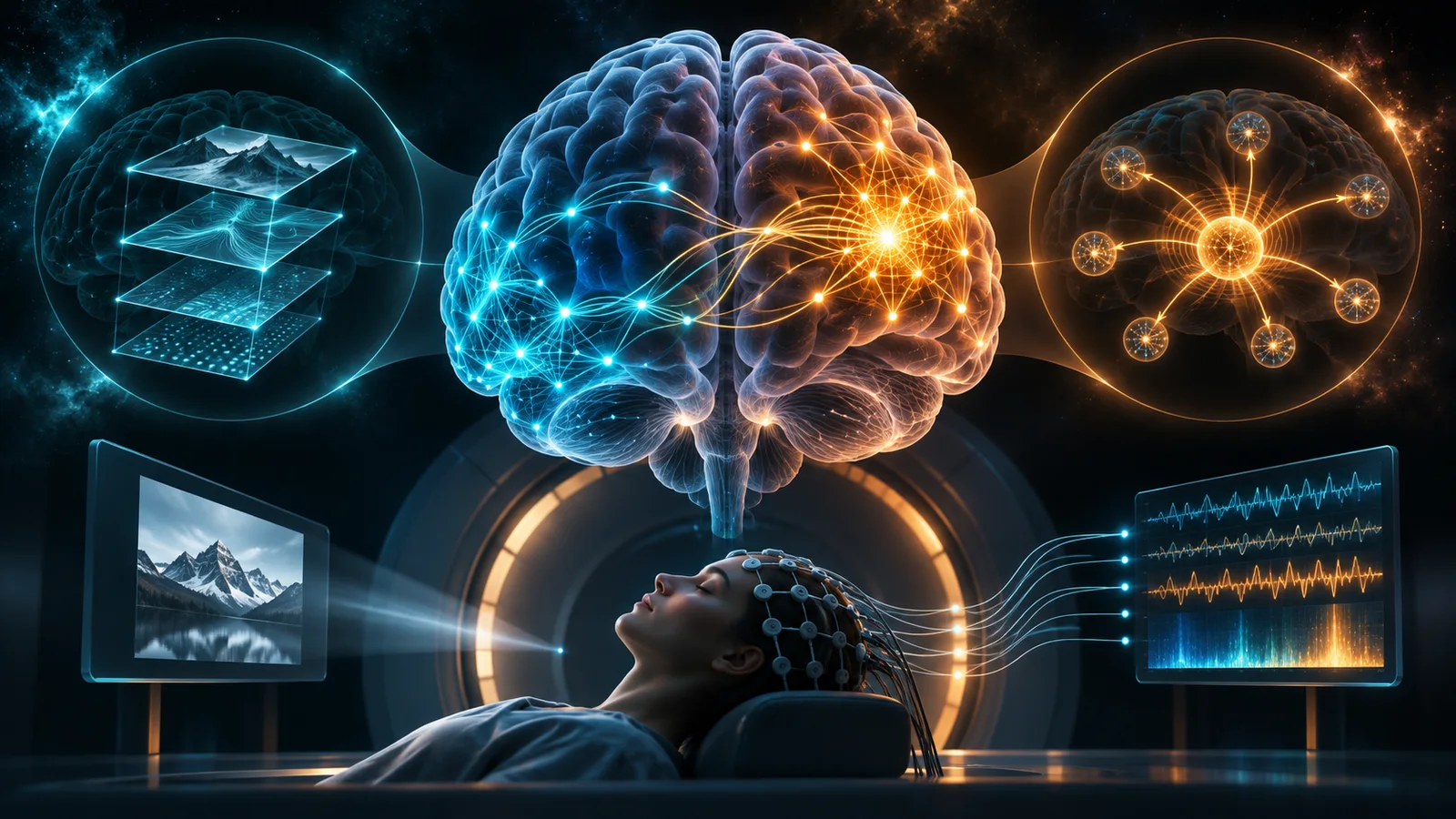
Proponents of integrated information theory and global neuronal workspace theory agreed in advance on experiments, analyses and outcomes that would count for or against their claims. A theory-neutral consortium then conducted the work.
Three windows on the brain
Participants viewed clearly visible faces and objects while researchers recorded functional MRI, magnetoencephalography and intracranial EEG. The design asked where conscious content was represented, how long it persisted and how distant regions synchronized.
What the data showed
Information about conscious content appeared in visual, ventrotemporal and inferior frontal cortex. Sustained responses tracked stimulus duration in occipital and lateral temporal regions, while frontal and early visual areas showed content-specific synchronization.
No simple winner
A key posterior-cortex prediction associated with IIT received support, while another IIT prediction about maximum integrated information failed. GNWT predictions were partly supported, partly challenged and sometimes inconclusive, especially regarding an all-or-none frontal ignition.
Why mixed results matter
A failed prediction does not automatically erase a broad theory, because auxiliary assumptions and measurement limits remain. Yet preregistration makes it harder to reinterpret every outcome after the fact. Progress may come from sharper hybrid or alternative models.
Discussion question
Should a theory of consciousness be abandoned after a failed critical prediction, or revised when other predictions still survive?
Sources and further reading
Nature — Adversarial testing of global neuronal workspace and integrated information theories of consciousness ↗Share your answer
You must log in to reply.
Sign Up / Log InEstablished evidence, active research and philosophical interpretation are clearly separated.