Published: 15 October 2026
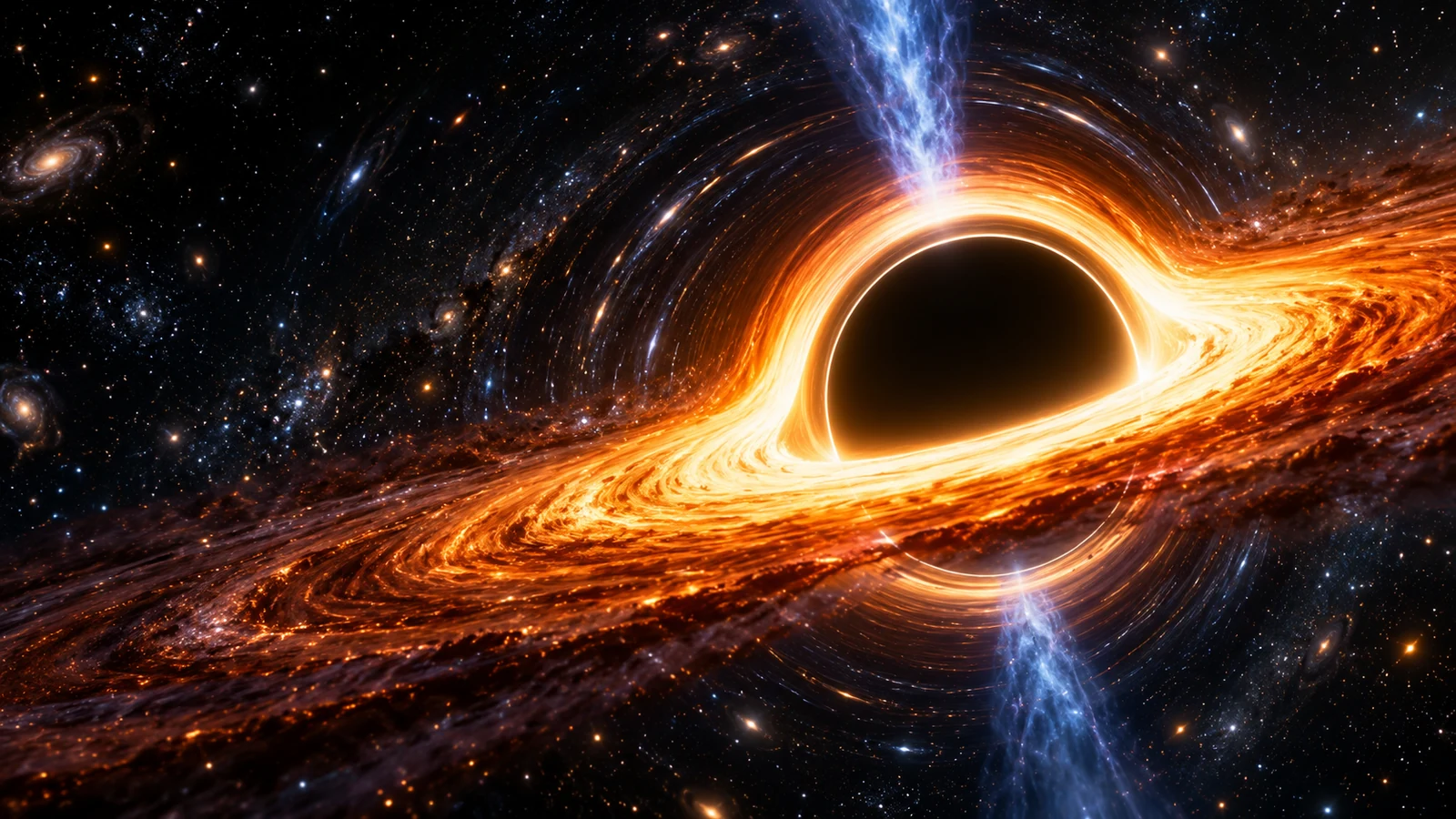
The horizon changes what can be known
An event horizon is a causal boundary, not a material wall. A distant observer receives increasingly redshifted signals from an infalling object, while the falling observer can cross the horizon in finite proper time. These statements describe different measurements and do not conflict.
Inside, inward is part of the future
For a simple non-rotating black hole, all future-directed paths inside the horizon lead toward smaller radius. This is a geometric restriction, not a conventional force that a stronger rocket can defeat. Rotating black holes have richer mathematical interiors, but realistic disturbances may make idealized structures unstable.
Where classical physics stops
General relativity predicts geodesic incompleteness, often represented as a singularity. That result is best read as a warning that the classical description has reached its boundary. Proposals involving bounces, cores or new spacetime phases require a tested theory of quantum gravity and currently remain hypotheses.
The information problem
Hawking radiation makes black holes thermodynamic objects. If evaporation ends in perfectly thermal radiation, information appears lost, conflicting with ordinary quantum evolution. Modern proposals seek information in radiation correlations or new horizon-scale physics, but observations cannot yet choose a unique microscopic account.
Discussion question
Can we claim to understand a region that cannot send us a direct report, or must understanding remain limited to exterior consequences?
Sources and further reading
NASA Science — Black Holes ↗Event Horizon Telescope Collaboration — M87 Results ↗Hawking — Particle Creation by Black Holes ↗Share your answer
You must log in to reply.
Sign Up / Log InEstablished evidence, active research and philosophical interpretation are clearly separated.