Published: 23 October 2026
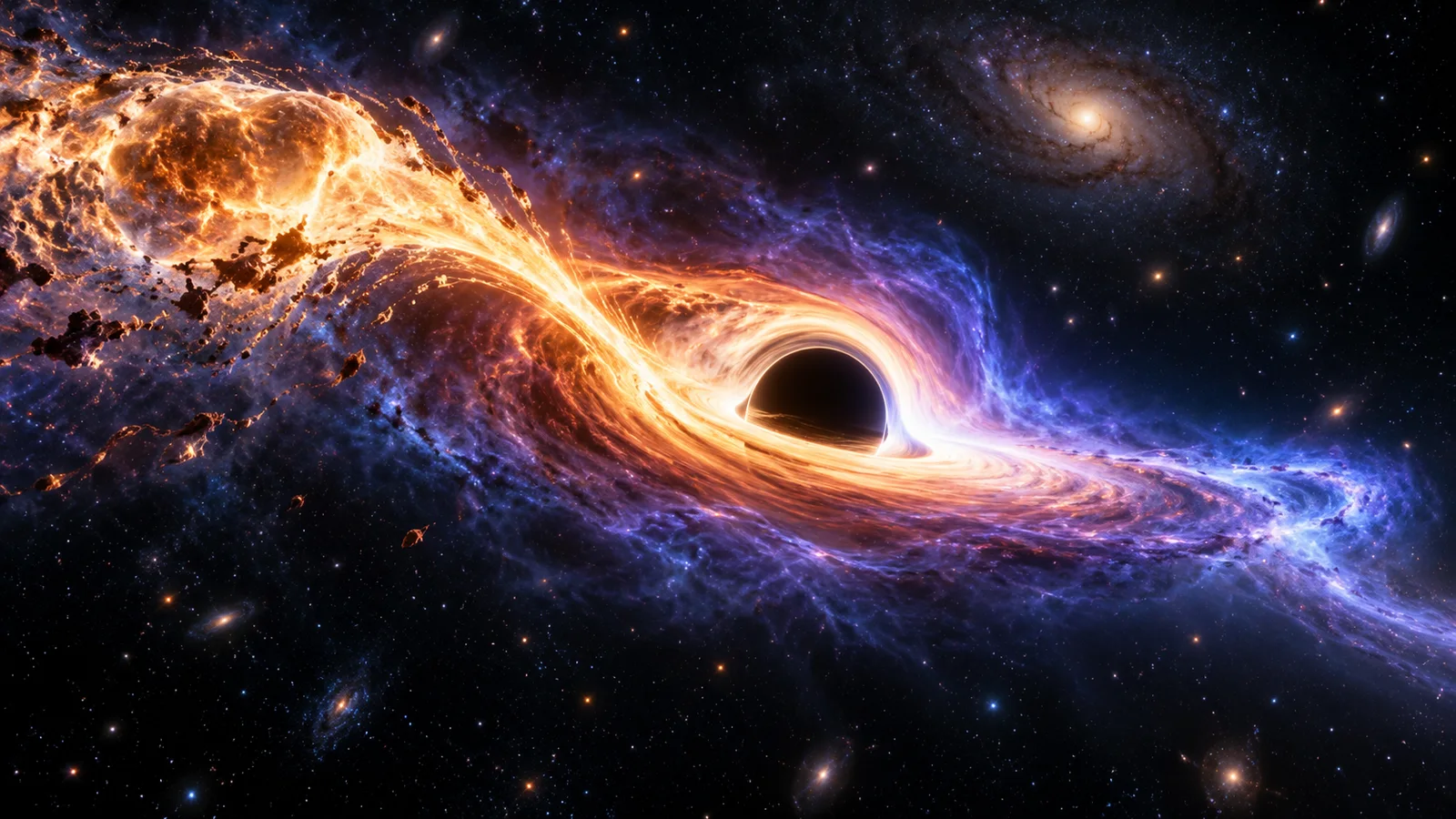
Gravity tears the star apart
When a star approaches a massive black hole, the difference in gravity across the star can exceed the star's self-gravity. The star is stretched and disrupted outside the event horizon. Some debris escapes, while bound material returns toward the black hole and can power a bright flare.
A flare turns darkness into a measurement
Many galactic black holes accrete too little gas to shine steadily. A tidal disruption event briefly illuminates the system in optical, ultraviolet and X-ray wavelengths. Its position can identify an otherwise dormant black hole, including rare objects displaced from a galaxy's center.
The light curve is not a simple scale
The rate at which debris returns provides a useful starting prediction, but observed light also depends on shocks, circularization, magnetic fields, viewing angle and reprocessing by surrounding gas. A decline resembling a theoretical fallback curve supports a disruption model; it does not determine every black-hole property by itself.
Multiwavelength follow-up breaks degeneracies
X-rays can trace the hot inner flow, optical and ultraviolet light can reveal reprocessed energy, and delayed radio emission can expose outflows. Combining these bands over months or years helps distinguish tidal disruption from unusual supernovae or changing active galactic nuclei.
Future surveys will find the quiet population
Wide-field time-domain surveys should discover many more flares. Their rates and host galaxies can test how frequently low-mass galaxies contain central black holes and how black holes grow. The inference remains statistical because selection effects and uncertain radiation physics shape which events are detected.
Discussion question
When an invisible object is known only through the destruction it causes, which observation most strongly establishes what the object is?
Sources and further reading
Annual Review — Tidal Disruption Events ↗NASA Hubble — Roaming massive black hole revealed by a tidal disruption event ↗LISA Science White Paper — Inspirals and tidal disruption events ↗Share your answer
You must log in to reply.
Sign Up / Log InEstablished evidence, active research and philosophical interpretation are clearly separated.