Published: 19 October 2026
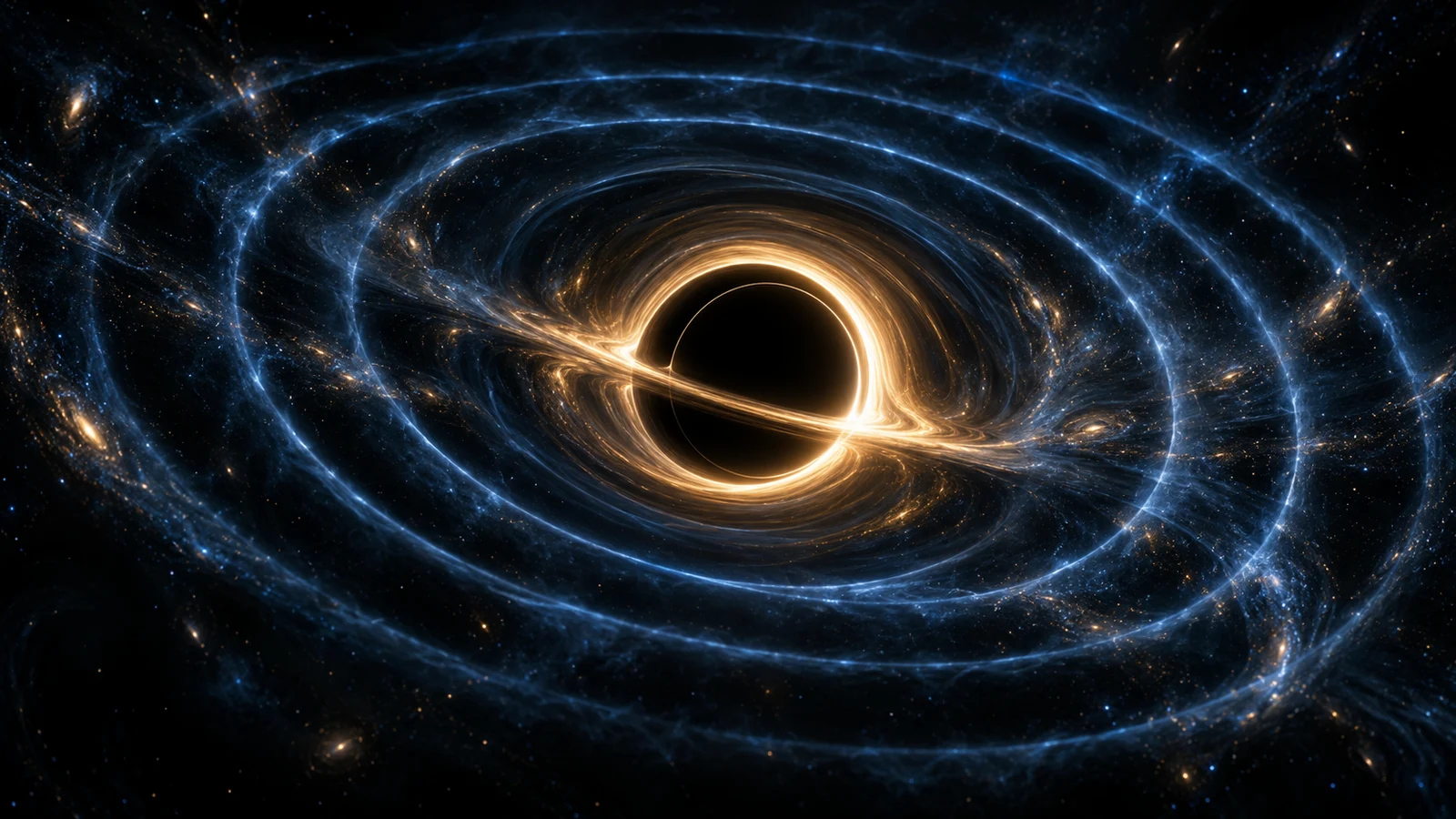
A black hole as a ringing object
A merger violently distorts the final black hole. It then settles by emitting gravitational waves whose damped frequencies are called quasinormal modes. In general relativity, an isolated astrophysical black hole is described by a small set of parameters, chiefly mass and spin. Those parameters determine the permitted ringdown tones.
Why several tones matter
One measured mode can estimate the remnant. A second independent mode allows a consistency test: do both tones correspond to the same mass and spin? If not, the mismatch could point to unmodelled astrophysics, measurement bias or gravity beyond the Kerr description. This is the gravitational-wave version of spectroscopy.
The evidence now
The exceptionally clear event GW250114 allowed the LIGO–Virgo–KAGRA collaboration to identify multiple ringdown components and perform stringent tests. Results were consistent with general relativity within current precision. Agreement strengthens the Kerr picture; it does not prove that every possible deviation is absent.
The difficult beginning of ringdown
Analysts must decide when the remnant can be modelled as a perturbed black hole. Starting too early risks mixing nonlinear merger physics with linear modes; starting too late discards signal. Independent waveform models, noise studies and population analyses are therefore essential.
What future detectors add
Larger ground-based observatories and the space mission LISA should observe louder ringdowns and different mass ranges. A population of consistent tones can tighten bounds, while a repeatable anomaly across instruments would be far more persuasive than one surprising fit.
Discussion question
How many independent ringdown tones would convince you that a black hole has no observable structure beyond mass and spin?
Sources and further reading
LIGO — GW250114 tests of general relativity ↗LIGO–Virgo–KAGRA — Tests with the latest catalog ↗Berti, Cardoso & Starinets — Quasinormal modes review ↗Share your answer
You must log in to reply.
Sign Up / Log InEstablished evidence, active research and philosophical interpretation are clearly separated.