Published: 21 October 2026
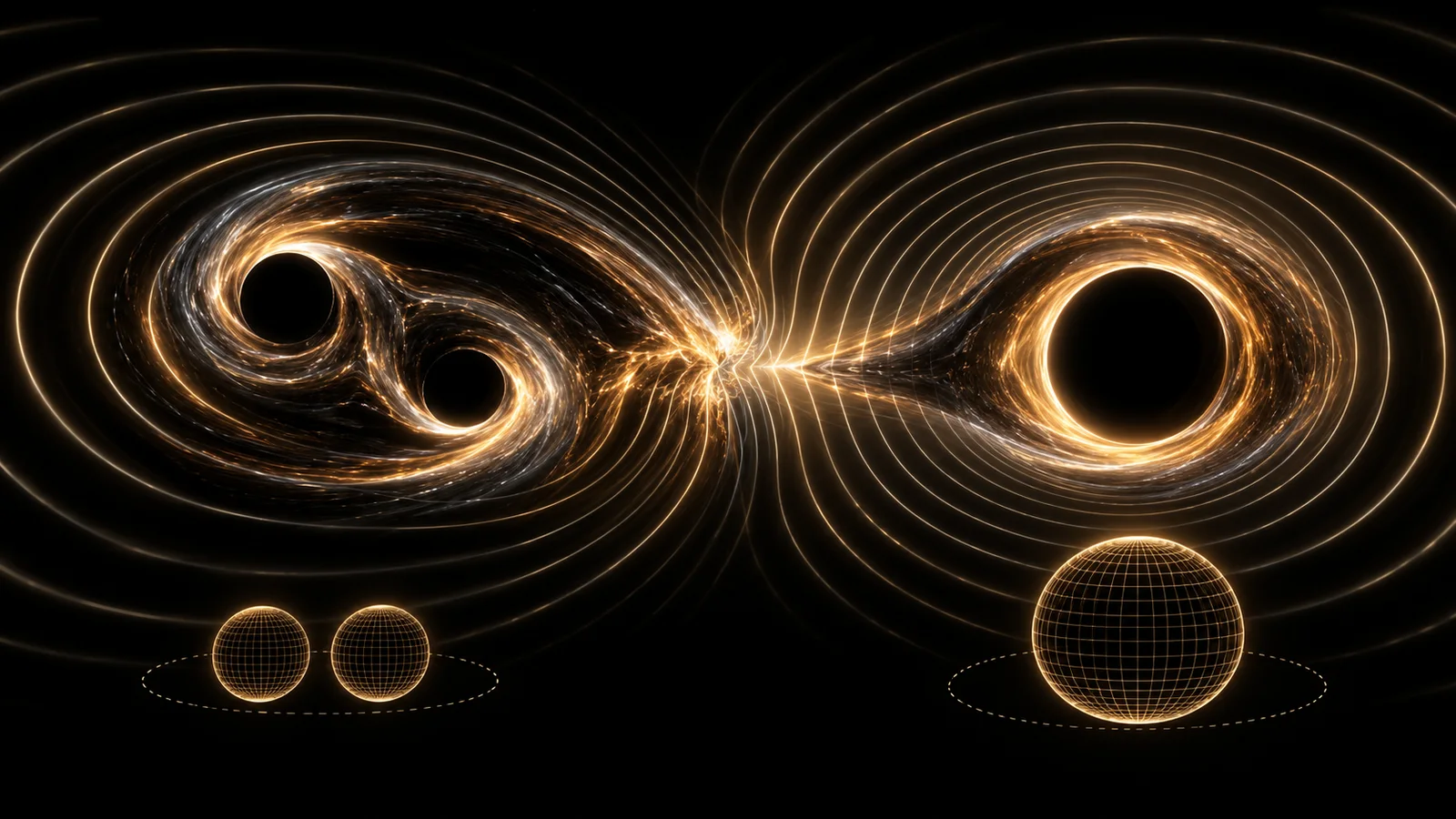
A geometric second law
Stephen Hawking's classical area theorem states that the total area of black-hole event horizons cannot decrease when matter obeys suitable energy conditions. The resemblance to thermodynamic entropy helped build the modern connection between gravity, heat and information.
A merger provides a test
Gravitational waves encode the masses and spins of the two initial black holes and of the final remnant. General relativity converts those parameters into horizon areas. Researchers can then ask whether the final area exceeds the sum of the initial areas.
Why the measurement is difficult
The initial and final parameters are inferred from different parts of a brief, noisy signal. Analyses must avoid assuming the theorem in the waveform model, propagate correlated uncertainties and test sensitivity to the chosen time windows.
What observations indicate
Analyses of GW150914 found consistency with an increase in area, and later, louder events have enabled more stringent tests of the area law and the Kerr nature of the remnant. Consistency supports classical general relativity; it is not a direct detection of black-hole entropy.
Where quantum physics enters
Hawking radiation can shrink a black hole, so the classical area theorem is replaced by a generalized entropy law that includes radiation outside the horizon. Astrophysical mergers test the classical, rapidly dynamical regime, not slow quantum evaporation.
Discussion question
If a future merger appeared to violate the area law, which explanation should be tested first: noise, waveform modelling, exotic matter or modified gravity?
Sources and further reading
LIGO/Virgo/KAGRA — GW250114 tests of Hawking's area law ↗LIGO — GW150914 observation and remnant parameters ↗Test of the black-hole area-entropy theorem with GW150914 ↗Share your answer
You must log in to reply.
Sign Up / Log InEstablished evidence, active research and philosophical interpretation are clearly separated.