Published: 5 November 2026
A crowded place to hide
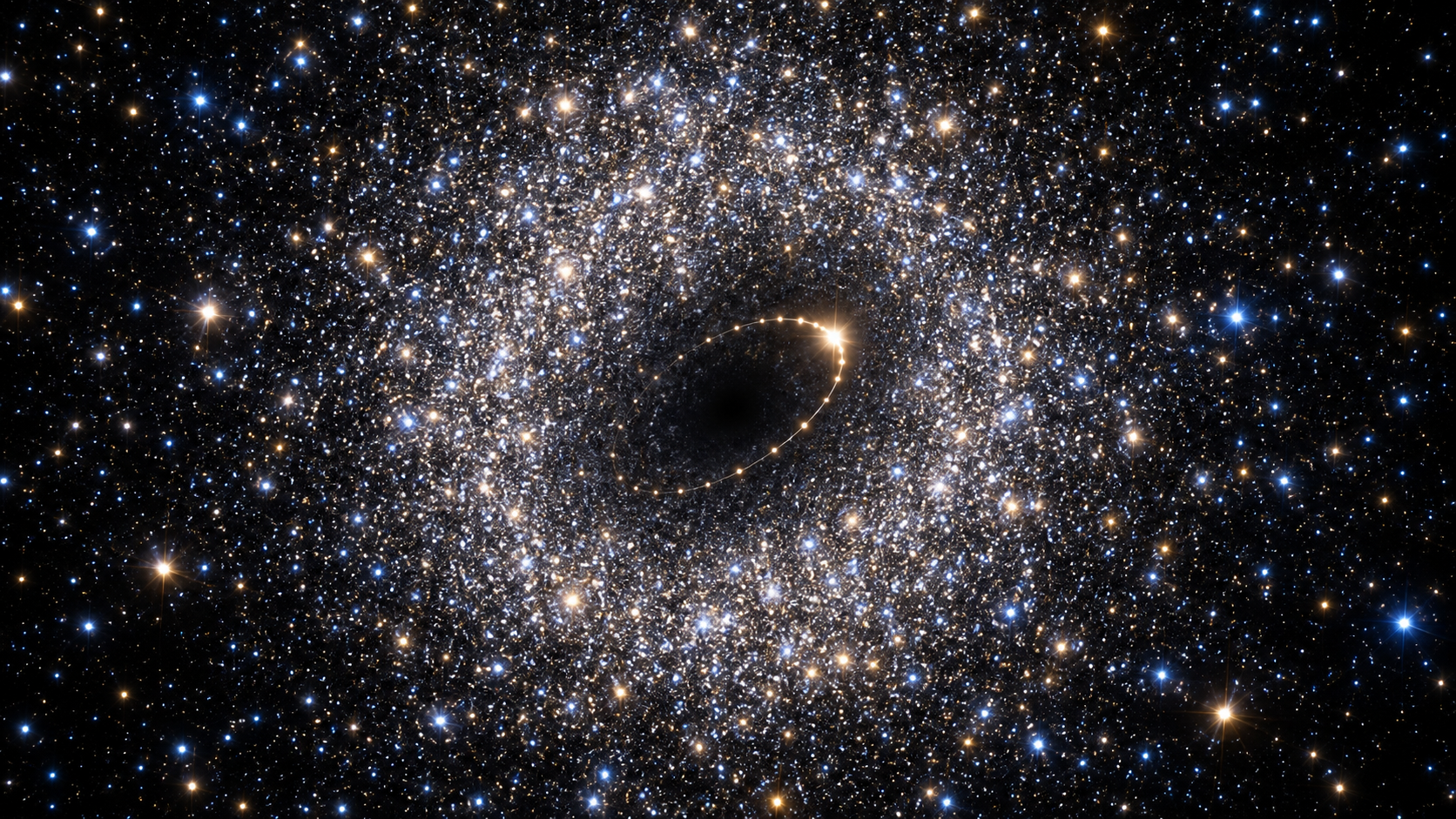
Omega Centauri contains roughly ten million gravitationally bound stars. In such a dense cluster, black holes can be almost invisible when they are not actively pulling gas from a companion. Researchers must infer them from gravity rather than from bright X-rays or radio emission.
Astrometry as a scale
Astrometry measures tiny changes in a star's position across the sky. A visible star moving around an unseen companion reveals the companion's gravitational pull. With a long enough record, the orbit constrains the hidden object's mass even when it emits no detectable light.
More than twenty years of motion
Researchers searched over two decades of Hubble observations and used newer Webb measurements to refine the positions. They identified a star whose path around an invisible object is too fast and compact to be explained by an ordinary faint star. The companion is therefore interpreted as a stellar-mass black hole.
One object, a larger population
Models predict that Omega Centauri may retain thousands of stellar-mass black holes, yet most have evaded X-ray, radio and radial-velocity searches. One astrometric detection does not count the whole population, but it demonstrates a route for finding quiet black holes through the motions of neighboring stars.
A cluster with two black-hole questions
Previous stellar-motion work also suggested an intermediate-mass black hole near the cluster's center. The new stellar-mass object addresses a different population. Separating a single central mass from a dense swarm of smaller remnants requires many stellar orbits and careful dynamical modeling.
Why the census matters
The number and distribution of retained black holes record how massive stars died, how compact objects received kicks and how clusters evolved. They also shape future mergers that may become sources of gravitational waves.
Discussion question
When an object emits no light, how many independent orbital measurements would convince you that a black hole is the best explanation?
Sources and further reading
NASA Science — Hubble Discovers First of Star Cluster's Missing Black Holes ↗Share your answer
You must log in to reply.
Sign Up / Log InEstablished evidence, active research and philosophical interpretation are clearly separated.