Published: 15 October 2026
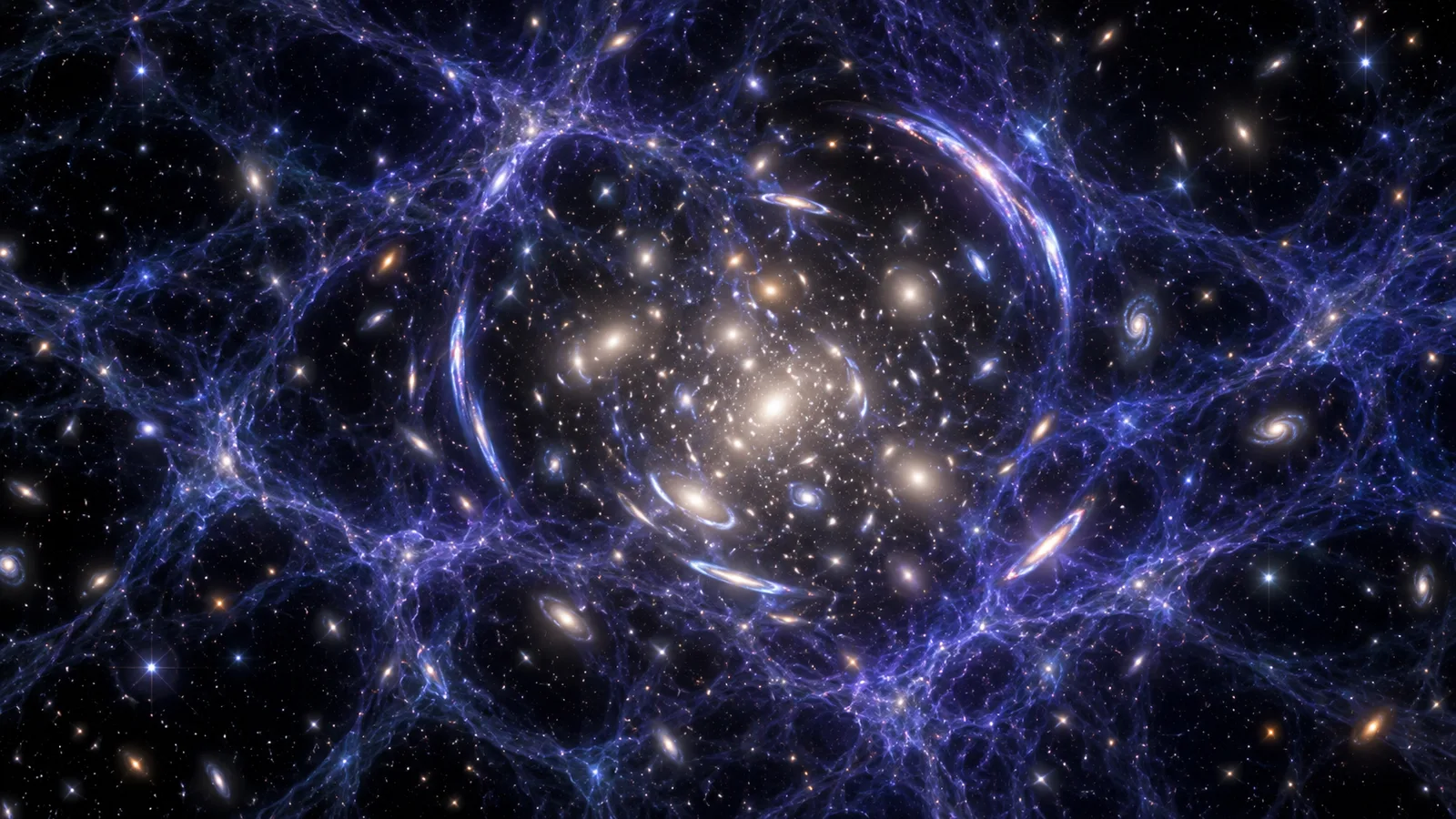
Reading a distortion
A distant galaxy can appear stretched, multiplied or curved when its light passes a massive foreground structure. Astronomers model these distortions to infer the distribution of gravitating matter. A lensing map is therefore an inference from light paths, not a photograph of dark-matter particles.
From pattern to model
Picture a transparent sheet whose shape you cannot see directly. A grid viewed through it looks distorted, allowing you to estimate the sheet's effect. Gravitational lensing uses a more demanding physical calculation: the foreground mass changes spacetime geometry, altering the apparent background images. Distances, ordinary matter and measurement uncertainties all enter the reconstruction.
What remains uncertain
Different observations support the dark-matter framework, but measuring a gravitational effect does not by itself identify a particle. A convincing candidate must also fit cosmology and laboratory constraints. Alternatives must explain the combined evidence rather than one striking image. This is why researchers compare multiple methods and publish uncertainties alongside their maps.
Looking carefully at an image
When a picture colours dark matter blue, the colour is an explanatory overlay. Ask which data produced the reconstruction, what assumptions were used and how robust the inferred structure is. Scientific images become more informative when we understand the chain between observation and visualization.
Discussion question
What makes an inference about something invisible persuasive to you?
Share your answer
You must log in to reply.
Sign Up / Log InEstablished evidence, active research and philosophical interpretation are clearly separated.