Published: 4 November 2026
A law written on a horizon
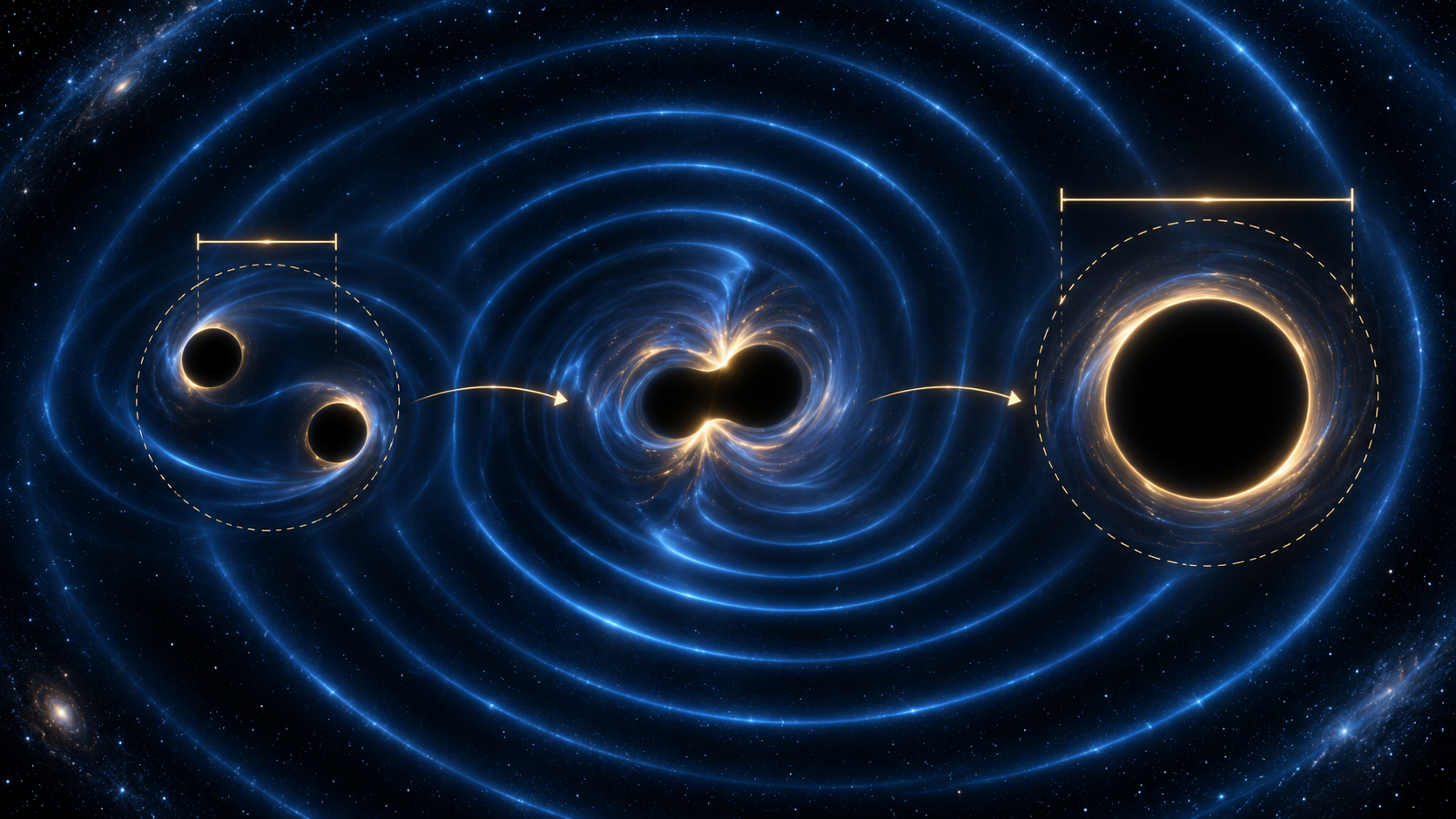
In classical general relativity, the total area of black-hole event horizons should not decrease. The idea, associated with Stephen Hawking, resembles the second law of thermodynamics: black-hole area behaves like entropy. Testing it requires measuring the two original black holes and the final remnant independently from the gravitational waves emitted during their collision.
Why GW250114 was special
On 14 January 2025, the two LIGO detectors recorded GW250114 with a network signal-to-noise ratio of 80, making it exceptionally clear. The source contained two near-equal black holes of about 34 and 32 solar masses with small spins. The strength of the signal allowed researchers to separate information from the inspiral, merger and ringdown more precisely than in earlier events.
Measuring before and after
The early waveform constrains the masses and spins of the incoming black holes, which determine their horizon areas in general relativity. The post-merger ringing constrains the final black hole. Across analyses designed to reduce sensitivity to the most complicated merger cycles, the inferred remnant area was larger than the sum of the initial areas with high credibility.
A black hole that rings like Kerr
The post-merger data were also consistent with the dominant quadrupolar ringing mode of a Kerr black hole and its first overtone. Researchers constrained the mode frequencies and found no statistically compelling leftover pattern after subtracting the best general-relativity waveform. Within current precision, the remnant behaved like the rotating black hole predicted by Einstein's theory.
What the result does not prove
The test is model-dependent and probabilistic. Detectors measure spacetime strain, not a visible surface, and the analysis assumes a framework for connecting waveforms to black-hole parameters. Agreement with the area law does not solve the quantum information problem or reveal the microscopic origin of black-hole entropy.
Why clearer signals change physics
One strong event can sometimes test a theory more sharply than many weak ones. Future detectors and louder mergers could resolve additional ringing modes, tighten deviations from Kerr geometry and compare independent area estimates. Each improvement narrows the space in which new strong-gravity physics might hide.
Discussion question
When an invisible horizon is inferred only through gravitational waves, what makes the test persuasive to you?
Sources and further reading
LIGO-Virgo-KAGRA — GW250114: testing Hawking's area law and the Kerr nature of black holes ↗LIGO Scientific Collaboration — GW250114 science summary ↗Share your answer
You must log in to reply.
Sign Up / Log InEstablished evidence, active research and philosophical interpretation are clearly separated.