Published: 17 October 2026
Why evaporation creates a paradox
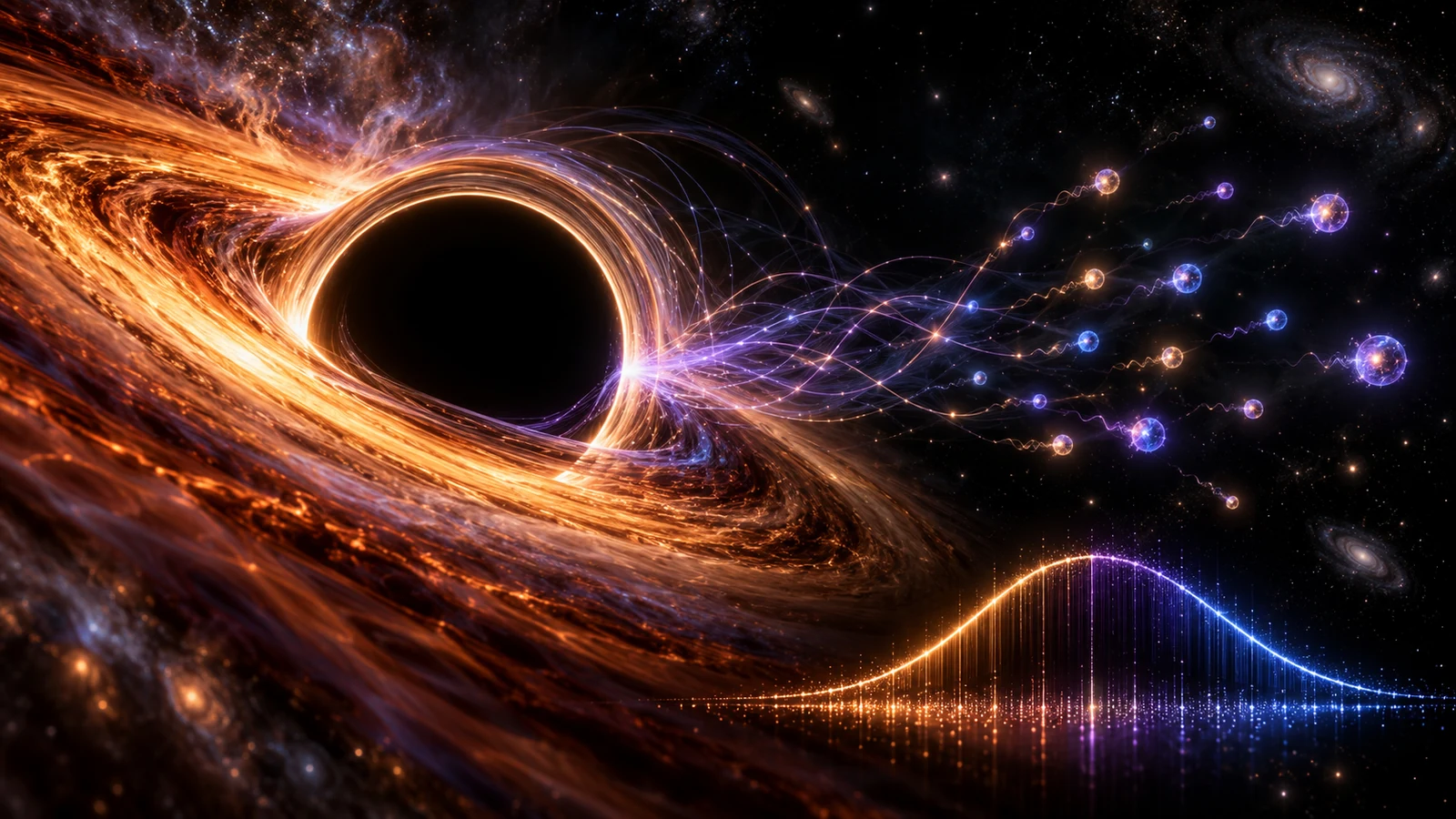
Hawking’s semiclassical calculation predicts that black holes emit nearly thermal radiation and lose mass. Thermal radiation appears to carry no detailed record of what formed the hole. If evaporation ends with that information destroyed, ordinary quantum evolution would fail to preserve distinctions between possible initial states. The conflict is not about missing paperwork; it challenges a basic structure of quantum theory.
Entanglement makes the problem sharper
Each outgoing quantum is correlated with degrees of freedom associated with the black hole. In the simplest calculation, the entanglement entropy of the radiation keeps rising as more quanta escape. If the complete process is unitary, that entropy should eventually turn over and fall as information becomes recoverable from correlations in the radiation. The expected rise and fall is called the Page curve.
What recent calculations show
Calculations using holography, quantum extremal surfaces and replica wormholes reproduce a Page-like curve in controlled gravitational models. They suggest that the radiation’s fine correlations can encode information even when each small piece looks thermal. This is major theoretical progress, but it is not a direct observation of an astrophysical black hole evaporating, and translating the models to our universe remains an active research problem.
The interior puzzle
Preserving information outside raises a second question: how is the interior represented without producing forbidden copies? Proposals include complementarity, state-dependent reconstruction, fuzzballs and modified horizon physics. Each protects some principles while putting pressure on others. Popular claims that the paradox is “solved” often hide which assumptions and spacetime settings made the calculation possible.
What observation can test
Astrophysical black holes are far too cold for present detectors to measure their Hawking radiation directly. Observations test horizons, accretion and gravity in strong fields, while analogue systems explore related thermal effects. The information question is therefore led by consistency, mathematical models and quantum-gravity theory rather than a completed laboratory test.
Discussion question
If information is recoverable only from correlations spread across all Hawking radiation, should we say it ever entered the black hole at all?
Sources and further reading
Hawking — Particle creation by black holes ↗Polchinski — The Black Hole Information Problem ↗Raju — Lessons from the Information Paradox ↗Share your answer
You must log in to reply.
Sign Up / Log InEstablished evidence, active research and philosophical interpretation are clearly separated.