Published: 22 October 2026
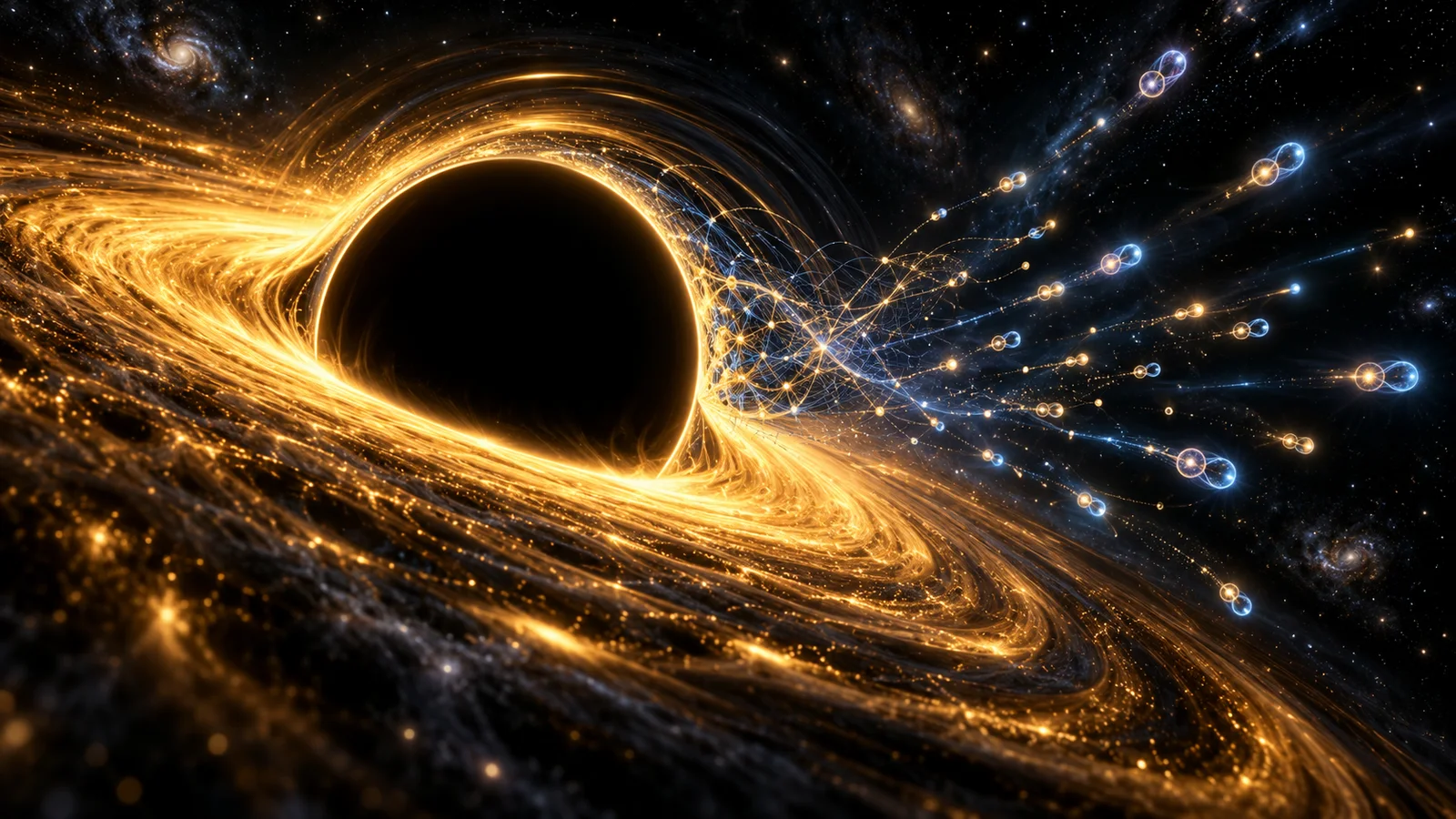
What an event horizon is
An event horizon is a causal boundary. Once an object crosses it, no signal from that object can reach a distant observer if classical general relativity holds. The horizon is not a material surface, and a sufficiently large black hole may produce no locally dramatic moment at crossing.
Why information becomes a problem
Quantum mechanics describes evolution in a way that preserves information about a system’s state. Hawking radiation appears approximately thermal, while an evaporating black hole seems able to disappear. If the radiation contains no record of what formed the hole, information would be destroyed, creating a conflict between quantum theory and gravity.
The horizon may encode more than it seems
Ideas such as holography propose that information about a gravitational region can be represented on a lower-dimensional boundary. Modern calculations involving entanglement and so-called islands reproduce the expected pattern in which information eventually becomes recoverable from radiation. These are powerful theoretical results, not direct observations of a real evaporating black hole.
No distant observer watches the crossing
To a faraway observer, light from infalling matter becomes increasingly redshifted and delayed near the horizon. This description does not necessarily mean the object physically freezes on a shell. Different coordinate descriptions can represent the same spacetime, and local passage can coexist with an outside record spread across correlations.
What could turn theory into evidence
Astrophysical black holes are far too cold for us to measure their Hawking radiation directly. Progress therefore comes from mathematical consistency, analogue systems and observations that constrain exotic near-horizon structures. A complete answer likely requires a tested theory of quantum gravity.
Discussion question
If every observable trace of an object were recoverable from correlations outside a black hole, would it still make sense to say that the object went inside?
Sources and further reading
NASA — What are black holes? ↗NASA Science — Black holes ↗Almheiri et al. — The entropy of Hawking radiation ↗Share your answer
You must log in to reply.
Sign Up / Log InEstablished evidence, active research and philosophical interpretation are clearly separated.