Published: 3 November 2026
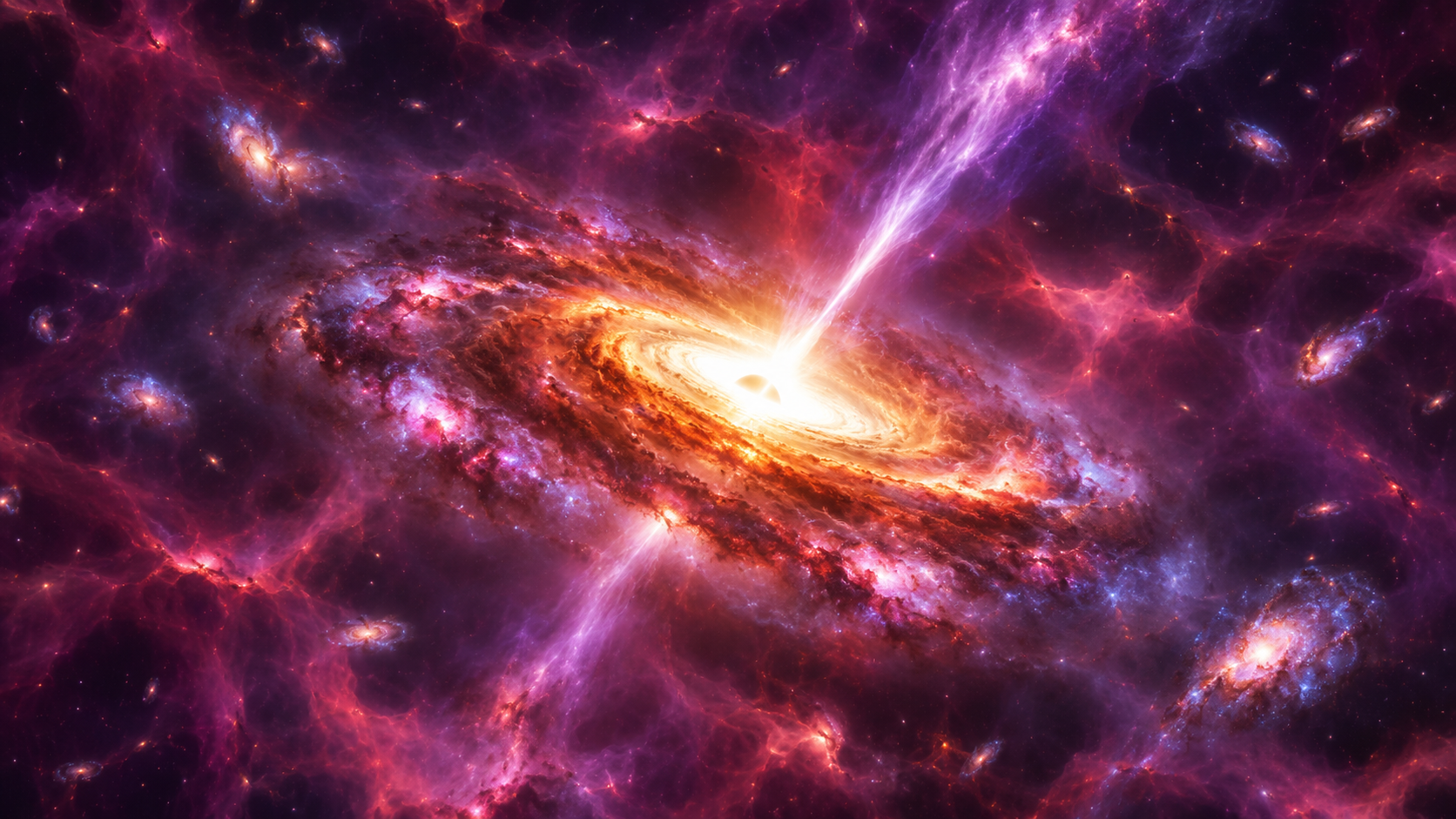
A lighthouse from the young universe
A quasar is the brilliant region powered by matter falling toward a supermassive black hole. Because its light can cross billions of years before reaching us, an ancient quasar reveals both a black hole and its host galaxy when the universe was still very young.
What Euclid added
The European Space Agency reported two quasars seen within roughly the first 670 million years after the Big Bang. Finding such objects in Euclid data expands the sample available for studying the earliest massive black holes and the environments in which they grew.
Why growth is difficult
Black holes gain mass by accreting gas and by merging. But ordinary stellar-remnant seeds begin small, and radiation from hot infalling material can push gas away. Building a very massive object in a few hundred million years therefore places tight demands on the starting mass, fuel supply and duty cycle.
The leading hypotheses
One possibility is that unusually massive seeds formed through the direct collapse of primordial gas. Another is that smaller seeds experienced long periods of rapid, perhaps temporarily super-Eddington, accretion. Dense mergers may also contribute. Each route predicts different host galaxies and surrounding gas.
How the puzzle can be tested
Spectra can estimate black-hole mass, accretion rate and chemical enrichment. Deeper infrared observations can search for the host galaxy, while surveys can measure how common these quasars are. The population—not one spectacular object—will determine which growth histories are plausible.
Discussion question
Would an early massive black-hole seed or an extreme episode of rapid growth be the more surprising discovery?
Sources and further reading
European Space Agency — Euclid discovers the most ancient quasar in the Universe ↗Share your answer
You must log in to reply.
Sign Up / Log InEstablished evidence, active research and philosophical interpretation are clearly separated.