Published: 7 November 2026
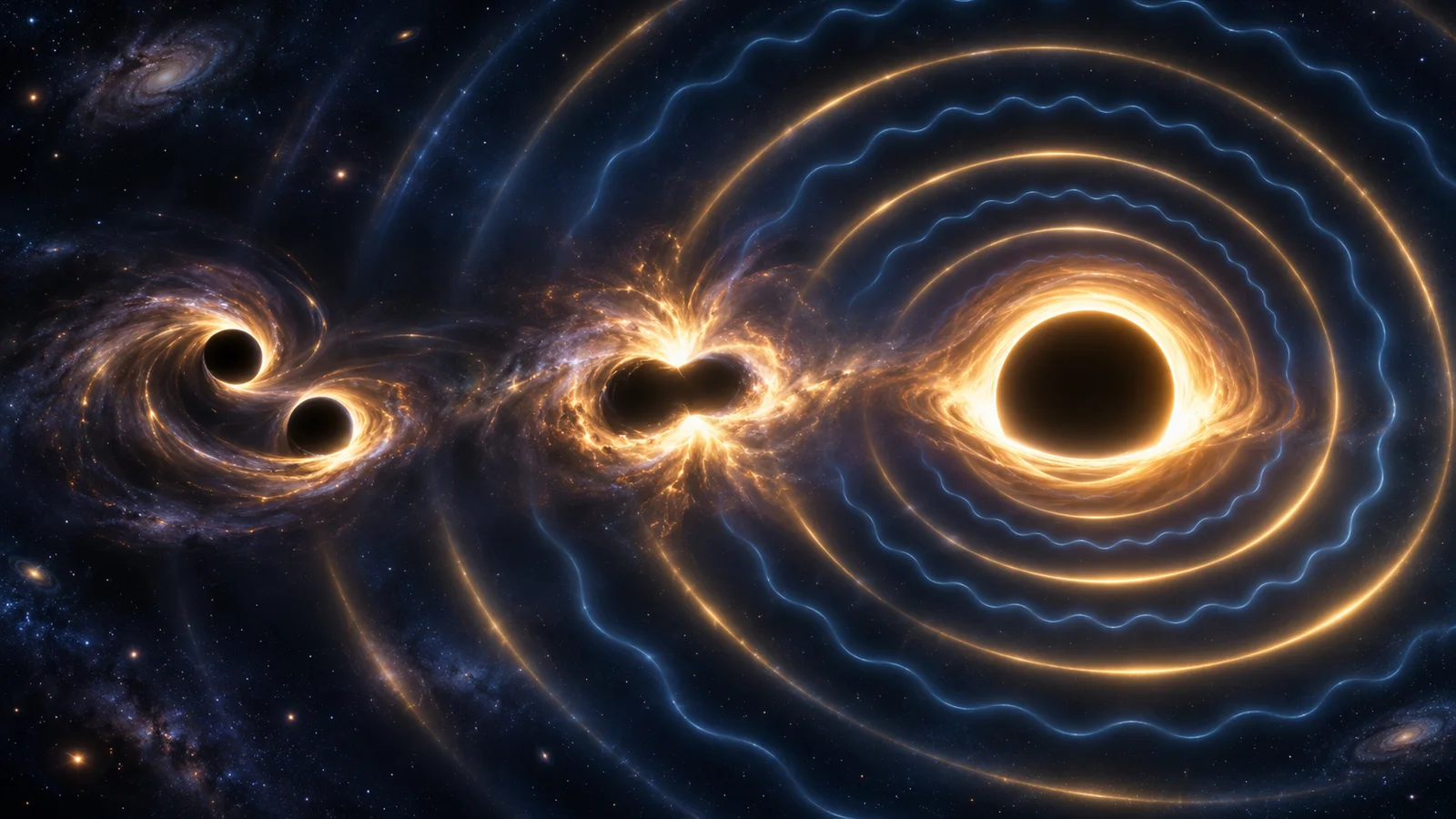
A signal loud enough for spectroscopy
GW250114 was recorded with a network signal-to-noise ratio near 80, making it the clearest binary-black-hole signal yet reported. The source contained two nearly equal black holes of roughly 34 and 32 solar masses.
A black hole rings like a bell
After merger, the distorted remnant settles by emitting gravitational waves at characteristic frequencies and decay times called quasinormal modes. In general relativity those tones are fixed by the remnant's mass and spin.
More than one tone
Ringdown-only analyses favored the dominant quadrupolar mode and its first overtone. Full-signal analyses also constrained a higher-frequency secondary mode. Within measurement uncertainty, the tones agreed with the Kerr prediction.
Testing the area law
Hawking's area theorem predicts that the total area of black-hole horizons cannot decrease in a classical merger. Independent estimates before and after GW250114 strongly favored a final area larger than the sum of the initial horizons.
What remains open
The result is a precision confirmation, not a final proof. Future detections with different masses, spins and orientations can test whether every remnant tells the same Kerr story and can search for small departures hidden below present uncertainty.
Discussion question
If two ringdown tones match one Kerr black hole, how many independent tones would make an alternative theory genuinely difficult to sustain?
Sources and further reading
LIGO DCC — GW250114: testing Hawking's area law and the Kerr nature of black holes ↗LIGO — Black hole spectroscopy and tests of general relativity with GW250114 ↗Share your answer
You must log in to reply.
Sign Up / Log InEstablished evidence, active research and philosophical interpretation are clearly separated.