Published: 12 October 2026
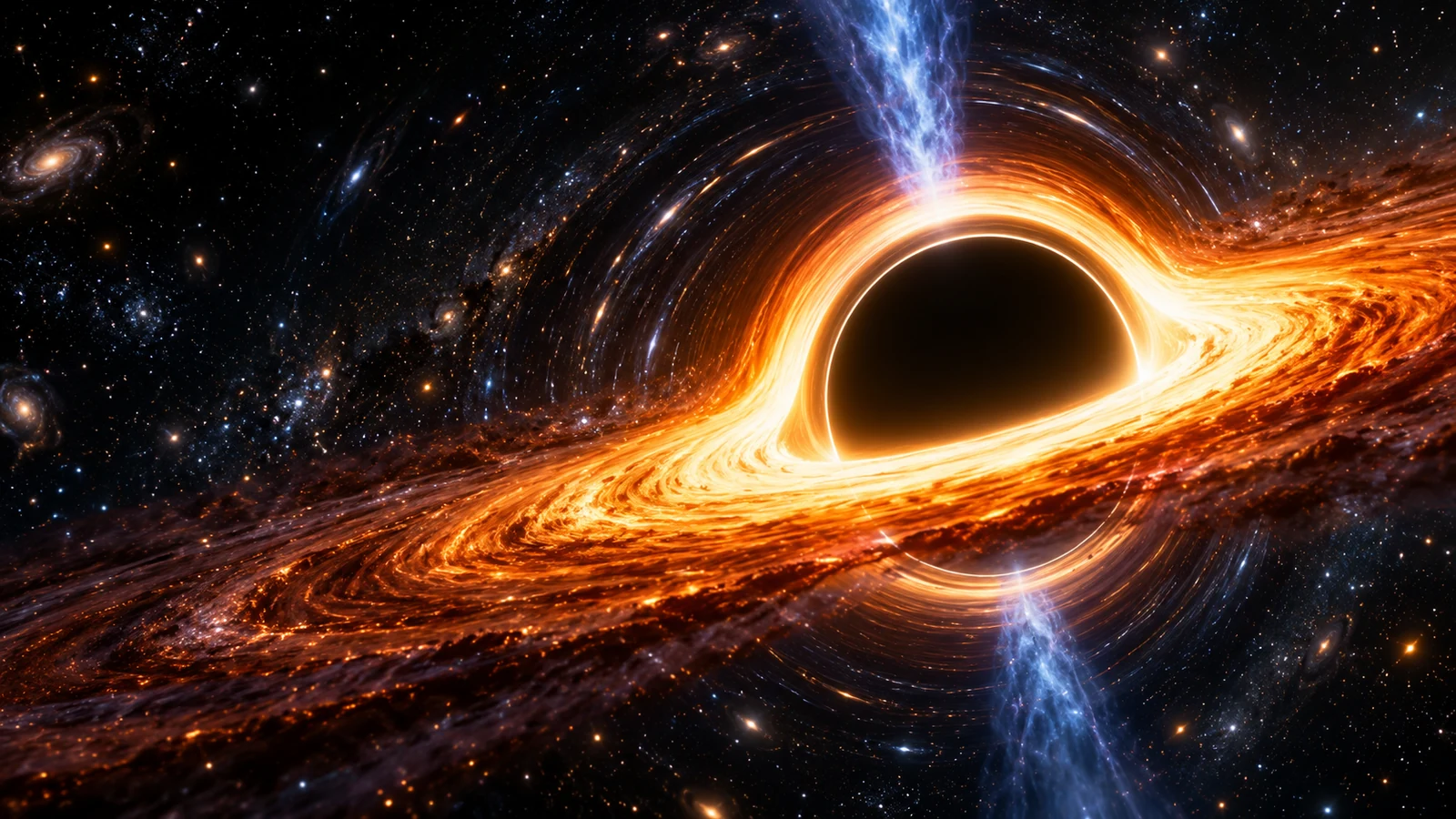
Crossing the event horizon
A black hole is a region of spacetime from which signals cannot reach distant observers. Its event horizon is not a solid shell. For a sufficiently large black hole, a freely falling observer could cross the horizon without encountering a locally special surface. Far away, light from the infalling object becomes increasingly redshifted and delayed. These descriptions are compatible because they refer to different measurements made along different paths through curved spacetime.
Why every future points inward
Inside a simple, non-rotating black hole, moving toward smaller radius becomes as unavoidable as moving toward the future. Firing a powerful rocket cannot reverse the causal direction and carry a message back across the horizon. This is not ordinary gravity pulling an object through space; it is the geometry of spacetime defining which future-directed paths are possible. Rotation and electric charge create more complicated mathematical interiors, but real astrophysical black holes are expected to be perturbed and surrounded by matter.
Tides and survival
Whether an observer is torn apart before or after crossing depends on the black hole’s mass. Tidal gravity measures how rapidly gravitational pull changes across an object. Near a stellar-mass black hole the gradient can become lethal outside the horizon. At the horizon of a supermassive black hole it can be comparatively mild, although destruction remains inevitable deeper inside. Popular descriptions call the stretching and squeezing “spaghettification”; the physical cause is differential curvature, not suction.
The singularity is a warning
Classical general relativity predicts that continued collapse leads to geodesic incompleteness, often represented as a singularity. It is misleading to picture this as a known point made of infinitely dense matter. The prediction tells us that the classical theory cannot extend every physical trajectory indefinitely. Quantum effects should become essential, but a tested theory of quantum gravity is not yet available. Claims about bounces, wormholes or baby universes are hypotheses, not observed interiors.
Information and observation
Hawking’s semiclassical calculation implies that black holes emit thermal radiation and can eventually evaporate. This creates the information problem: ordinary quantum theory preserves information, while a purely thermal final state appears not to. Proposed resolutions include information encoded in subtle radiation correlations, horizon-scale quantum structure and other quantum-gravity mechanisms. Telescopes and gravitational-wave detectors test the exterior geometry with increasing precision. No observation allows us to receive a report from inside the horizon.
Discussion question
When a theory predicts a region that cannot send information back to us, what kind of indirect evidence should count as understanding that region?
Sources and further reading
NASA Science — Black Holes ↗Event Horizon Telescope Collaboration — First M87 Event Horizon Telescope Results ↗Hawking — Particle Creation by Black Holes ↗Share your answer
You must log in to reply.
Established evidence, active research and philosophical interpretation are clearly separated.