Published: 21 October 2026
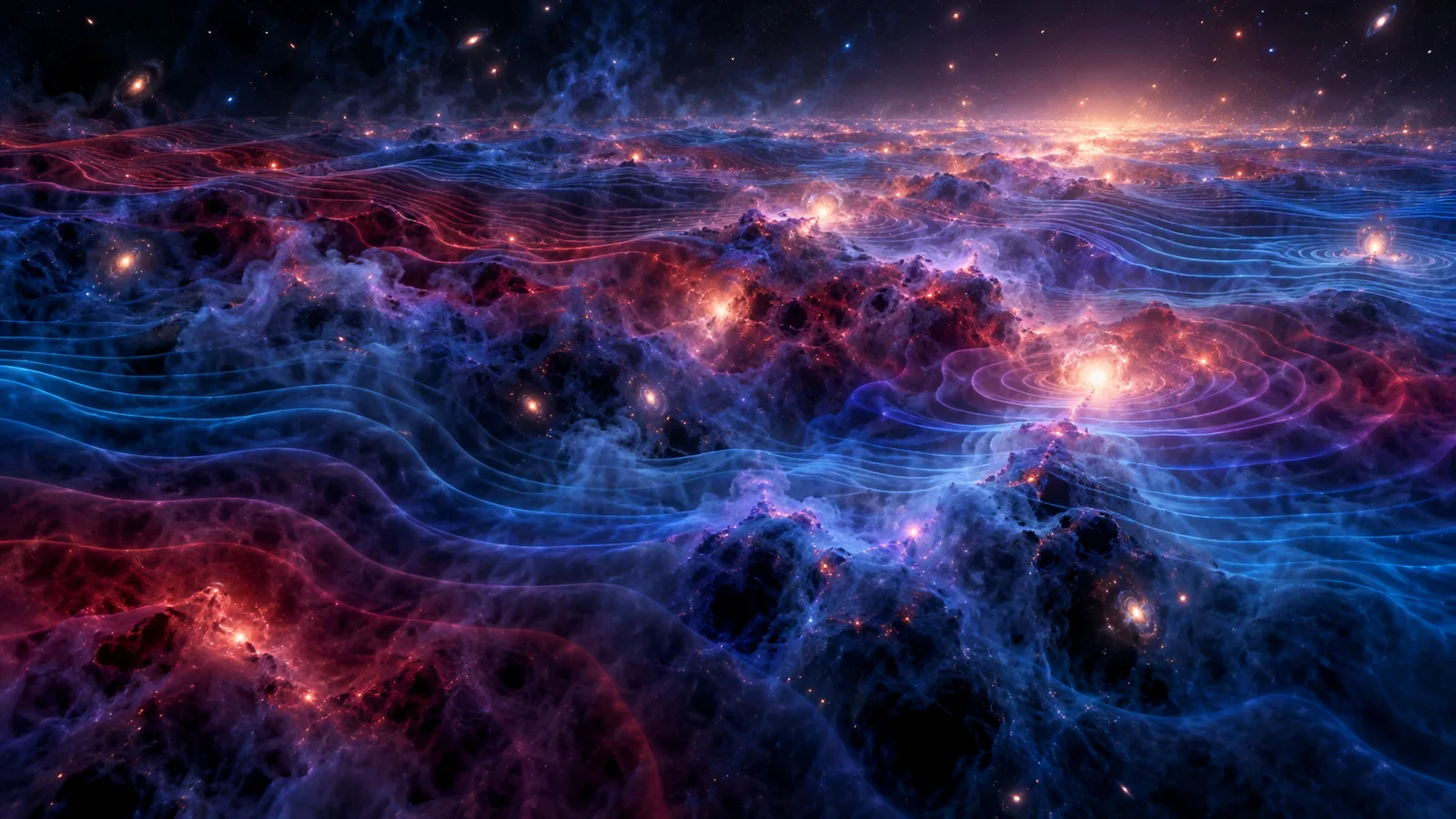
Hydrogen carries a faint clock
Neutral hydrogen can emit or absorb radiation at a rest wavelength of 21 centimetres through a hyperfine transition. Cosmic expansion stretches that signal to longer radio wavelengths, linking observed frequency to a period in the early universe.
Before the universe was transparent
After recombination, the cosmos entered dark ages without stars. The first stars produced ultraviolet and X-ray radiation that coupled, heated and eventually ionised surrounding hydrogen. Each stage changes the 21-centimetre signal in a characteristic way.
A three-dimensional map
Arrays can measure fluctuations across sky position and frequency. In principle this reconstructs the growth of early structure, the timing of star formation and the progress of reionisation across a vast cosmic volume.
The foreground problem
Galactic synchrotron emission and human radio interference are many orders of magnitude brighter than the cosmological signal. Calibration errors can imitate spectral structure, so detection requires redundancy, blind analyses and agreement among instruments.
Why it complements JWST
Infrared telescopes observe individual bright galaxies, while 21-centimetre experiments respond to diffuse hydrogen and populations too faint to resolve. Together they can connect luminous sources with their effects on the surrounding intergalactic medium.
Discussion question
Would a global 21-centimetre signal without a matching spatial map be enough to claim detection of cosmic dawn?
Sources and further reading
NSF — Light from cosmic dawn observed by ground-based telescopes ↗NSF Public Access — 21-cm signal during cosmic dawn ↗NASA technical review of Dark Ages and Cosmic Dawn 21-cm science ↗Share your answer
You must log in to reply.
Sign Up / Log InEstablished evidence, active research and philosophical interpretation are clearly separated.