Published: 4 November 2026
Stars before metals
The first generation of stars—Population III—formed from primordial hydrogen, helium and tiny traces of lithium. They manufactured heavier elements in their cores and explosions. Because massive first stars would have died quickly, astronomers often search not for the stars themselves but for the chemical patterns they left in later gas.
A cosmic backlight
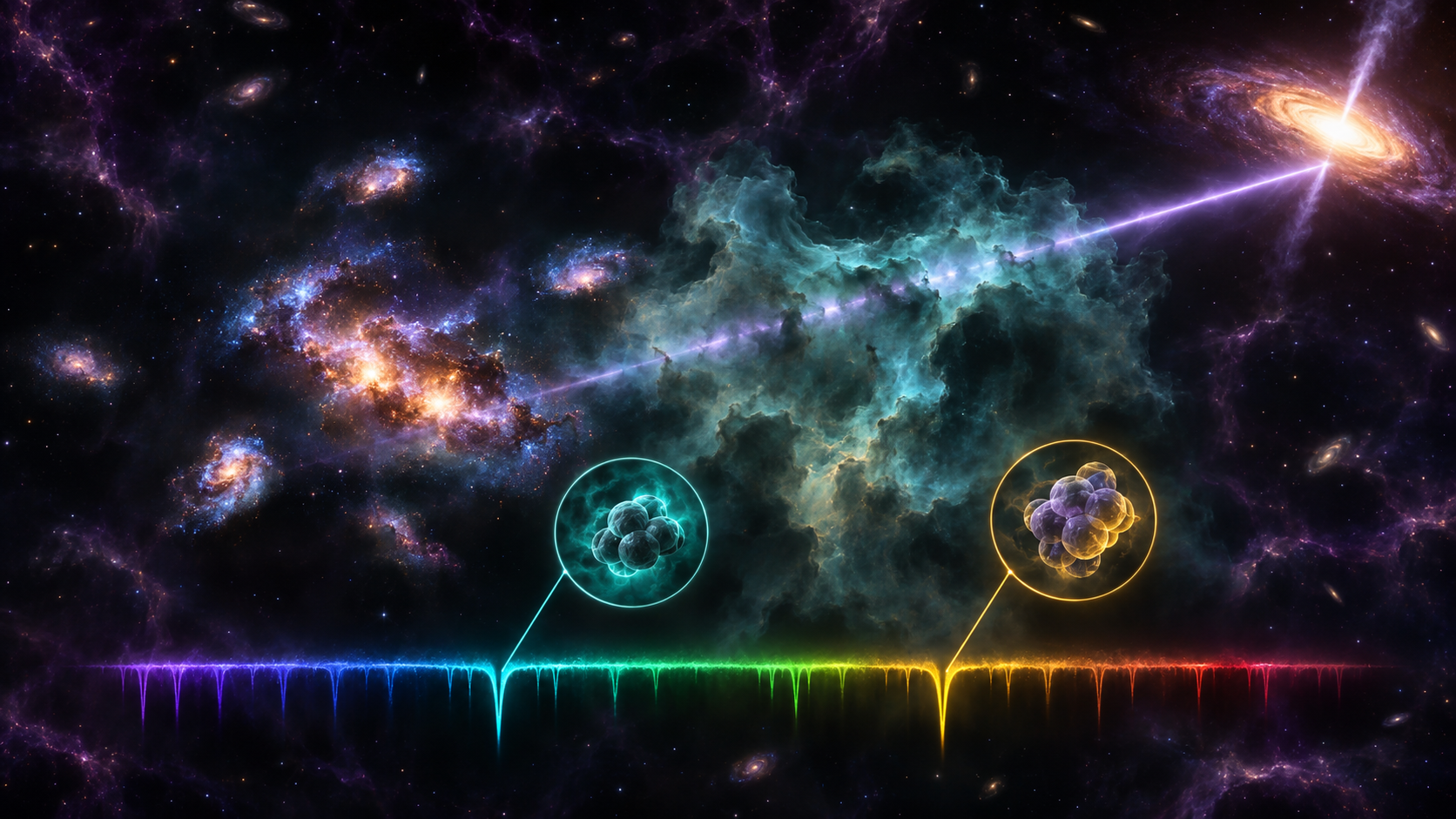
When light from a distant quasar crosses intervening gas, specific atoms absorb narrow wavelengths. The resulting spectrum acts like a chemical barcode. Along the sight line to quasar SDSS J0100+2802, an absorber at redshift 5.945 shows carbon and silicon abundances that have been interpreted as compatible with enrichment by very early stars.
What Webb found nearby
Using James Webb Space Telescope observations, researchers reported an overdensity of 17 galaxies near the absorber. Their mean metallicity was about three percent of the Sun's and lower than that of comparable galaxies in similarly dense environments. A less chemically evolved region could preserve early enrichment patterns that later generations of stars would otherwise blur.
What is established
The galaxies and absorber are observed, their redshifts and spectral lines are measured, and the environment is unusually metal-poor. These findings create a concrete laboratory for studying delayed chemical evolution near the end of reionization. They also demonstrate how galaxy surveys and quasar absorption spectroscopy can be combined.
What remains a hypothesis
An abundance pattern consistent with Population III enrichment is not a photograph of a first star. Different supernova masses, gas mixing histories and later stellar populations can produce overlapping signatures. The claim must survive comparisons with detailed nucleosynthesis models and additional elements measured at higher precision.
Why late first stars are possible
The analysis supports a scenario in which pockets of nearly pristine gas survived longer in the outskirts of growing dark-matter haloes. If so, Population III star formation may have continued later than a simple one-time cosmic transition suggests. The first stars could have appeared in scattered, delayed episodes rather than ending everywhere at once.
Discussion question
How many independent elemental signatures would you want before calling a gas cloud a fossil of the first stars?
Sources and further reading
Nature Astronomy — First-star imprints in a metal-poor galaxy overdensity near the end of reionization ↗NASA Webb — What Were the First Stars Like? ↗Share your answer
You must log in to reply.
Sign Up / Log InEstablished evidence, active research and philosophical interpretation are clearly separated.