Published: 19 October 2026
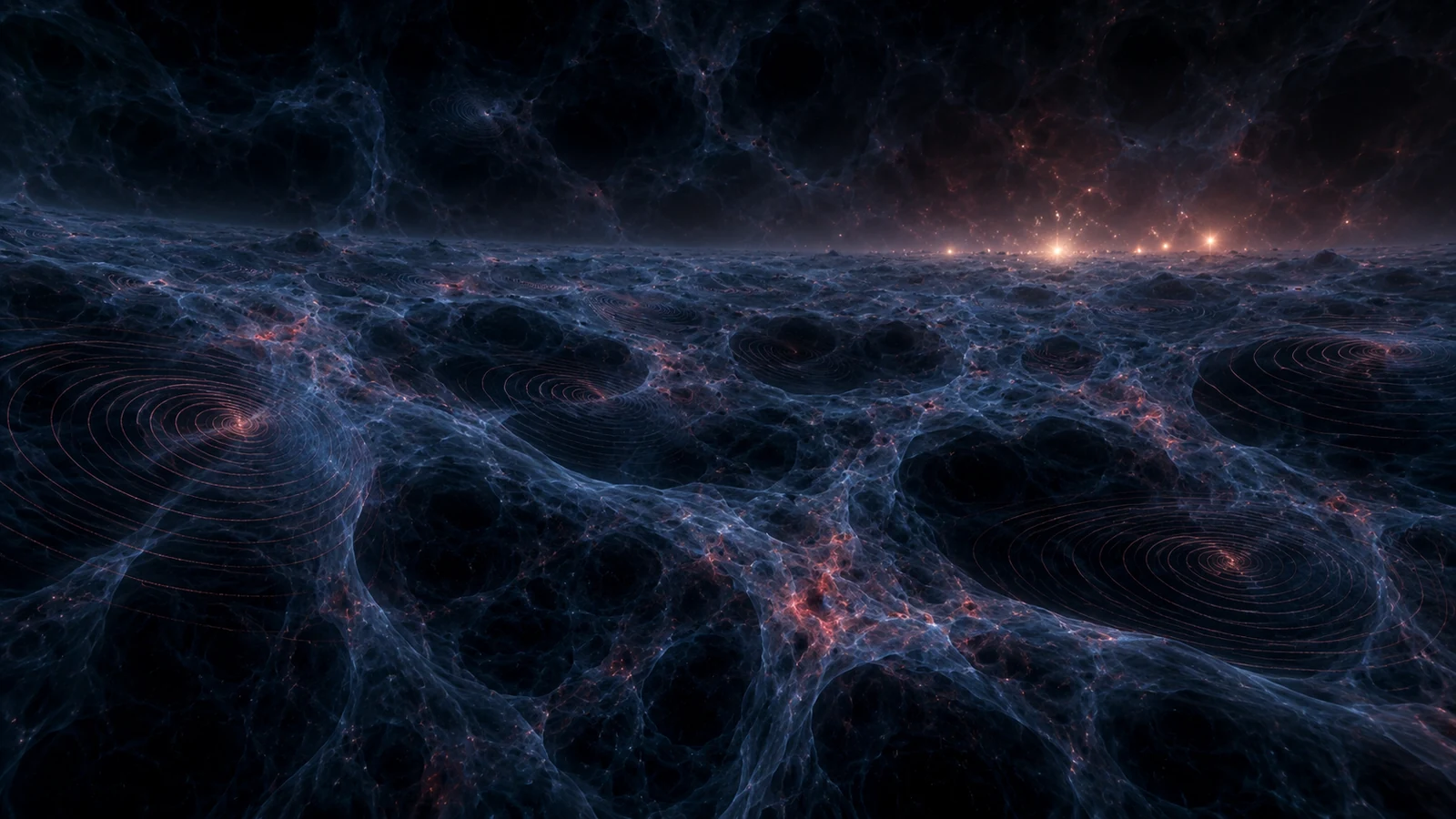
A line stretched across cosmic time
Neutral hydrogen can emit or absorb radiation at a rest wavelength of 21 centimetres. Cosmic expansion shifts that signal to longer radio wavelengths. Frequency therefore acts like a depth coordinate, potentially allowing astronomers to reconstruct changing hydrogen structure before and during the birth of the first luminous objects.
What the signal encodes
The brightness contrast depends on density, ionization, gas temperature and coupling to radiation. The first stars altered these quantities through ultraviolet and X-ray emission. A measured power spectrum would not be a photograph of one star; it would statistically describe fluctuations across enormous volumes.
Why foregrounds dominate
Our Galaxy and radio sources are vastly brighter than the expected cosmological signal. Instruments also imprint frequency-dependent structure, and antenna coupling can move foreground power into the modes researchers need. Calibration and blinded validation are as important as raw sensitivity.
HERA’s current position
The Hydrogen Epoch of Reionization Array is designed to measure the evolution of the 21-centimetre power spectrum. Phase I limits already ruled out parts of extreme astrophysical parameter space. Early Phase II work extends the frequency range and diagnoses new systematics. An upper limit narrows possibilities but is not a detection.
What a detection could reveal
A robust signal could constrain when the first stars heated the gas, how rapidly galaxies ionized their surroundings and whether additional radio or particle physics affected the early universe. Independent instruments and cross-checks will be essential because the claimed signal is so faint.
Discussion question
Would a statistical map of hydrogen feel like “seeing” the dark ages even if no individual first star is resolved?
Sources and further reading
HERA collaboration — Instrument and science goals ↗HERA Phase I limits and astrophysical constraints ↗HERA Phase II first results ↗Share your answer
You must log in to reply.
Sign Up / Log InEstablished evidence, active research and philosophical interpretation are clearly separated.