Published: 23 October 2026
A fragile relic
When the universe cooled enough for nuclei to form, protons and neutrons built deuterium, helium and traces of other light elements. Deuterium is especially useful because stars destroy it rather than manufacture large primordial-looking supplies. Low-metallicity gas can therefore preserve a record close to the original abundance.
Quasars provide the backlight
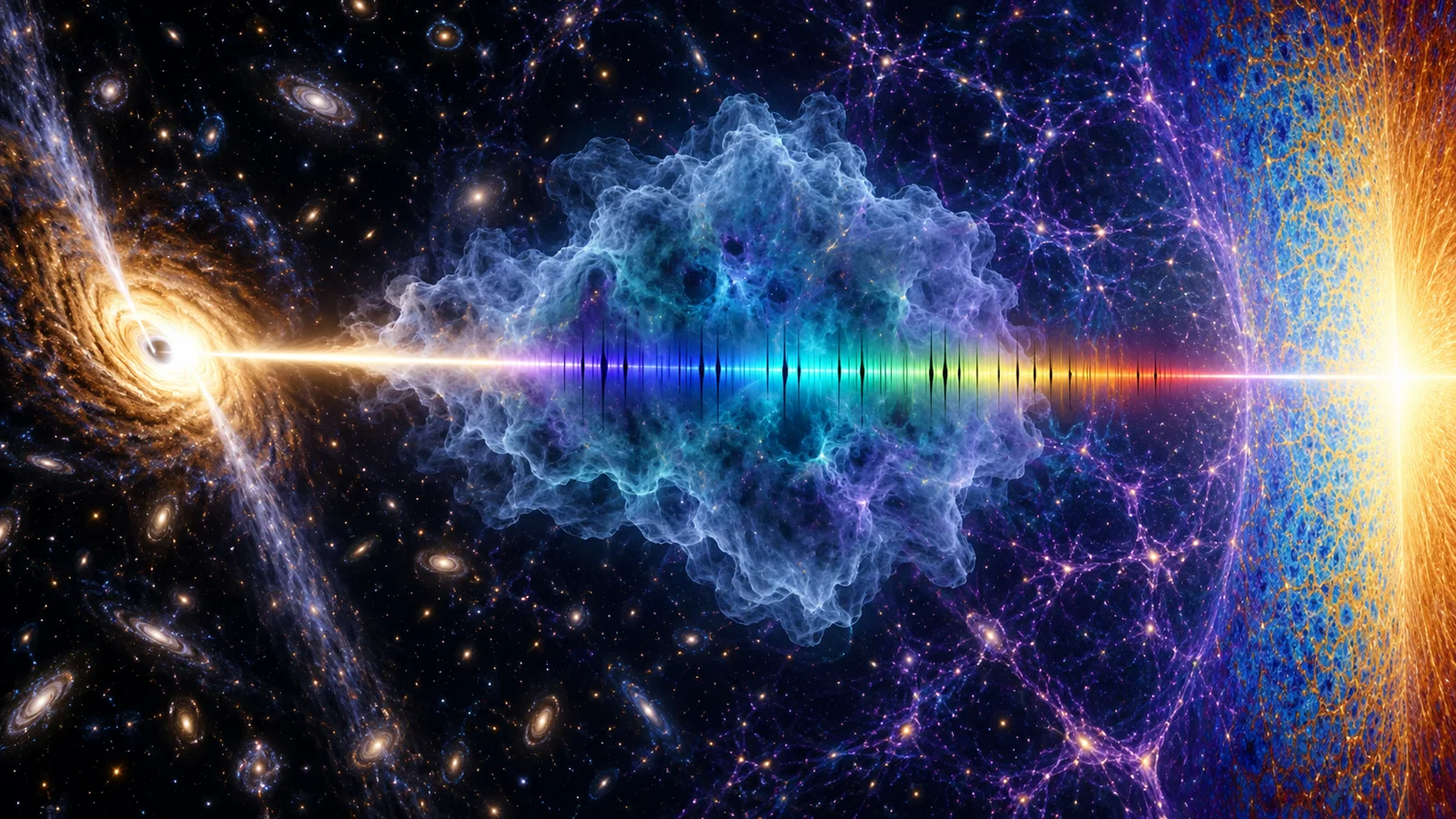
Astronomers observe bright distant quasars through ancient intervening gas clouds. Hydrogen and deuterium absorb light at slightly different wavelengths because their nuclei have different masses. Carefully resolving those features yields the deuterium-to-hydrogen ratio, although velocity structure and contamination must be modeled with care.
Why the ratio measures ordinary matter
In standard big-bang nucleosynthesis, a higher baryon density burns deuterium more efficiently into heavier nuclei. The surviving abundance therefore changes predictably with the baryon-to-photon ratio. Precision measurements act as a baryometer for the universe at an age of minutes.
Underground nuclear physics matters
The conversion from abundance to baryon density depends on reaction rates. The LUNA experiment measured deuterium burning deep underground, where cosmic-ray backgrounds are greatly reduced. Improving the d(p,gamma) helium-3 rate tightened the comparison between nucleosynthesis and later measurements from the cosmic microwave background.
Agreement is a powerful test
Deuterium and the microwave background probe very different epochs with different physics. Their broadly consistent baryon densities support the hot big-bang framework. Remaining uncertainties in absorption systems, nuclear rates and the well-known lithium discrepancy show why this is a test of a model, not a photograph of the first minutes.
Discussion question
When two independent cosmic clocks agree, how much confidence should that add to a theory of origins?
Sources and further reading
Nature — The baryon density of the Universe from an improved rate of deuterium burning ↗Astrophysical Journal — One Percent Determination of the Primordial Deuterium Abundance ↗Recent precision measurement of primordial deuterium ↗Share your answer
You must log in to reply.
Sign Up / Log InEstablished evidence, active research and philosophical interpretation are clearly separated.