Published: 23 October 2026
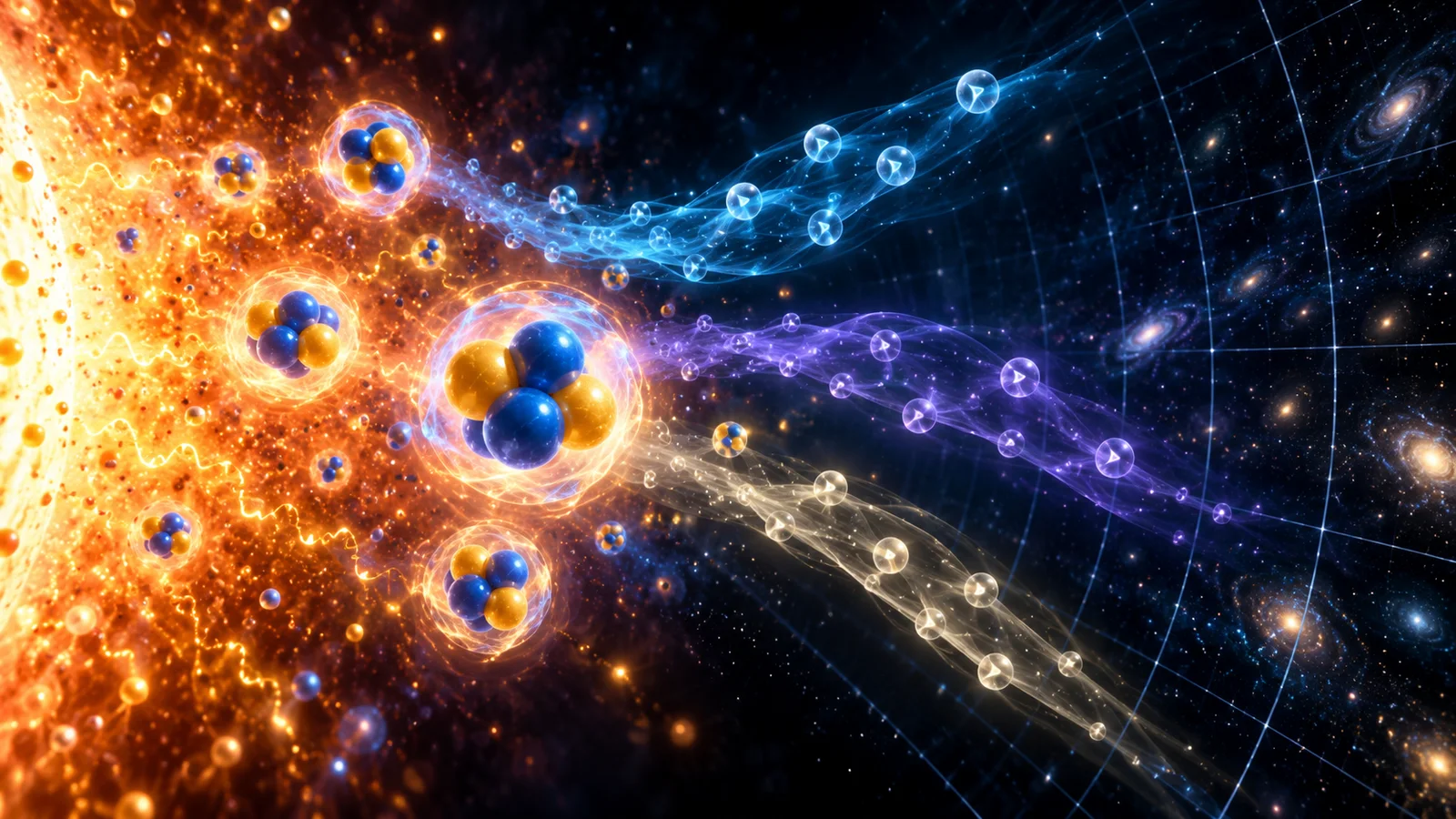
Expansion sets the nuclear clock
In the first minutes, neutrons and protons competed between radioactive decay and nuclear assembly. A faster expansion cooled the universe sooner and left less time for neutrons to disappear before becoming helium-4. The final helium fraction therefore records the expansion rate during big-bang nucleosynthesis.
Neutrinos contribute invisible energy
Relativistic particles add energy density even when they interact only weakly. Cosmologists summarize that contribution with the effective number of neutrino species, N_eff. The Standard Model predicts a value close to 3.044, including small effects from how neutrinos decoupled from the primordial plasma.
Astronomers look for pristine gas
Researchers estimate primordial helium from low-metallicity ionized gas in nearby galaxies. They measure helium and hydrogen emission lines, then correct for temperature, density, stellar absorption and unseen ionization states. Extrapolating toward zero metallicity aims to remove helium produced later by stars.
Helium and deuterium answer different questions
Deuterium is especially sensitive to the density of ordinary matter, while helium responds more strongly to the expansion rate and neutron lifetime. Combining them helps separate those effects. The cosmic microwave background supplies a third measurement from hundreds of thousands of years later.
No extra species has been established
Current results are broadly compatible with the Standard Model. Small shifts between datasets must be tested against calibration and astrophysical systematics before they can be treated as new particles. Primordial helium is valuable precisely because it turns invisible early-universe energy into a quantitative, falsifiable constraint.
Discussion question
If a chemical abundance consistently disagreed with the Standard Model, how many independent measurements would you require before inferring a new particle?
Sources and further reading
PHLEK Survey — A new determination of the primordial helium abundance ↗MNRAS — A new determination of primordial helium from SDSS H II regions ↗Primordial helium and the effective number of neutrino species ↗Share your answer
You must log in to reply.
Sign Up / Log InEstablished evidence, active research and philosophical interpretation are clearly separated.