Published: 5 November 2026
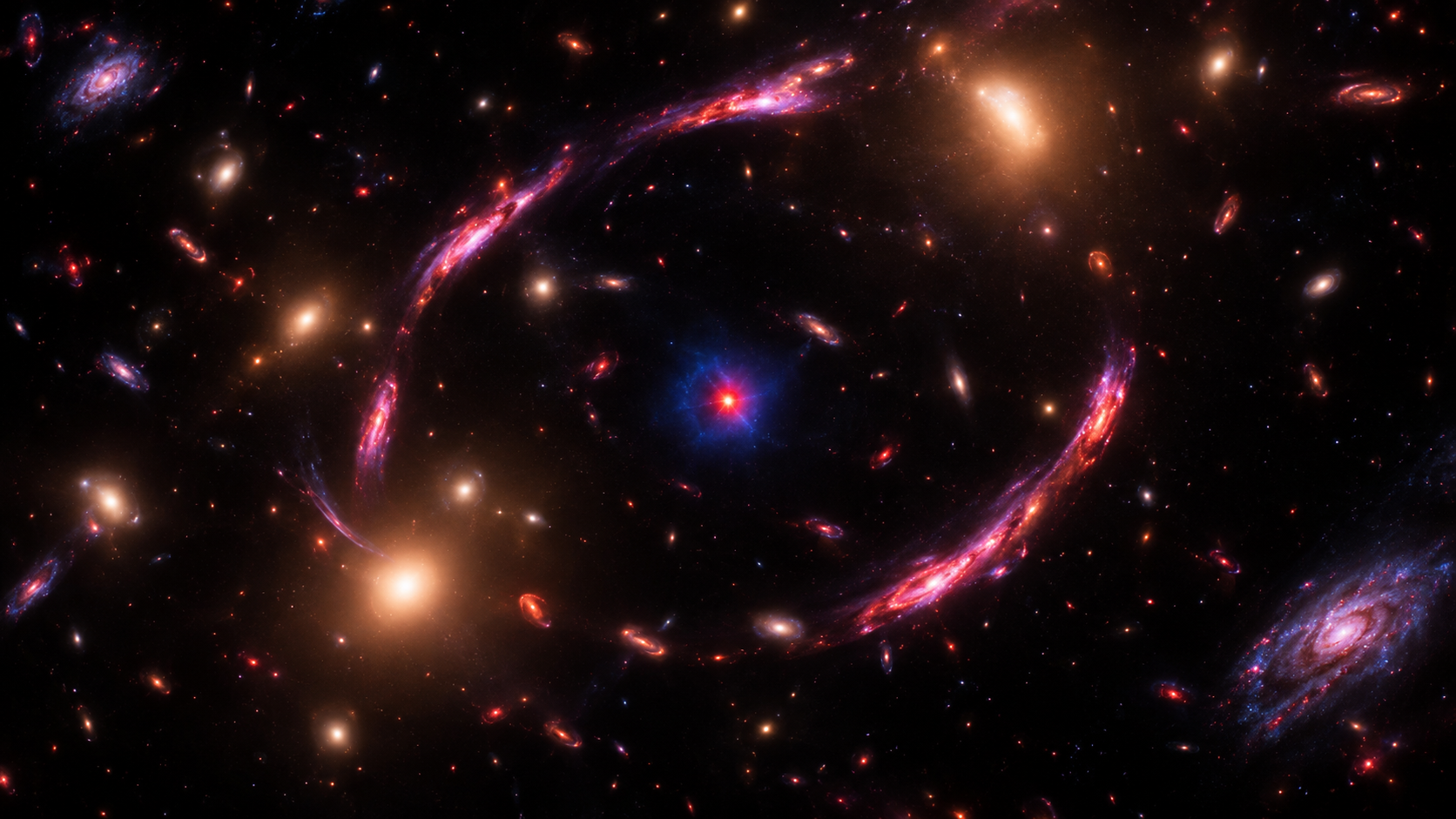
A new population in Webb's deep fields
James Webb Space Telescope surveys revealed many compact red objects in the early universe. Their colors and spectra are unusual enough that astronomers call them little red dots. Some may be dense galaxies, some may host growing black holes, and several models can reproduce parts of their appearance.
Why X-rays are decisive
Gas falling toward a black hole can heat to extreme temperatures and emit X-rays. Detecting those photons provides a different physical clue from infrared color alone. A multi-wavelength match can therefore test whether an object contains an actively accreting black hole rather than only a compact population of stars.
The X-ray dot
Chandra observations identified an X-ray source associated with a little red dot seen by Webb and Hubble. NASA describes it as a candidate transition phase in the growth of a supermassive black hole. The object connects the newly discovered infrared population with a process already known to generate high-energy radiation.
What one detection establishes
The observation shows that at least some little red dots can be linked to black-hole accretion. It strengthens models in which dense gas hides much of the central engine while letting selected radiation escape. It does not prove that every little red dot is the same kind of object.
Why the early timing is difficult
Massive black holes already existed when the universe was young. To explain them, models must combine seed mass, feeding rate, obscuration, mergers and feedback. Transitional objects could reveal how a seed moved from a hidden, rapidly growing phase into a more familiar quasar.
The population test
Researchers need a larger sample with secure distances, X-ray detections or limits, detailed infrared spectra and host-galaxy measurements. If different subgroups emerge, the little-red-dot label may describe an appearance rather than one physical species.
Discussion question
Would one X-ray counterpart change your explanation of an entire mysterious population, or only of that individual object?
Sources and further reading
NASA Science — NASA Connects Little Red Dots with Chandra, Webb ↗NASA Science — Webb Early Universe overview ↗Share your answer
You must log in to reply.
Sign Up / Log InEstablished evidence, active research and philosophical interpretation are clearly separated.