Published: 3 November 2026
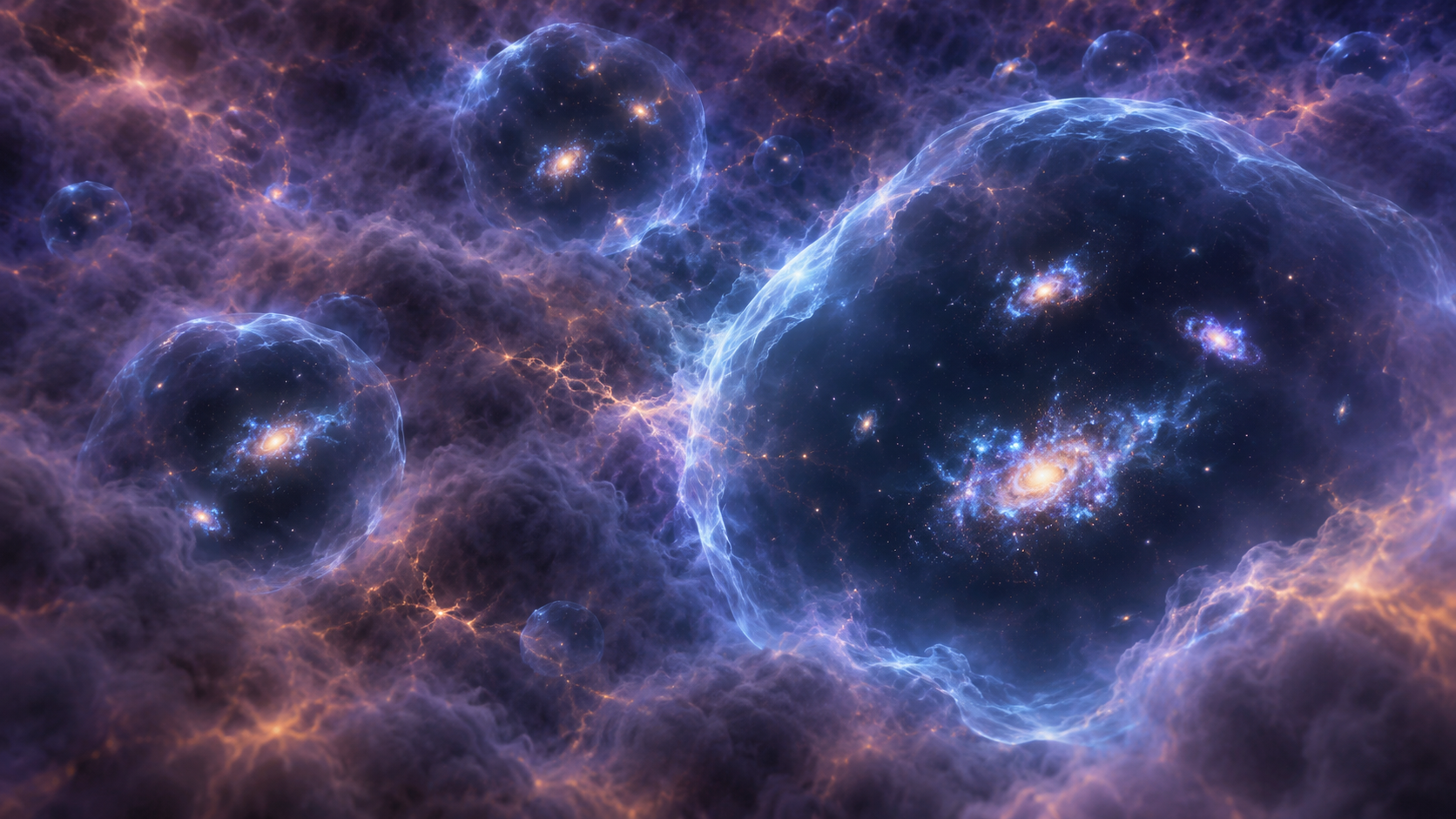
When the universe became dark
After the hot early universe cooled, electrons combined with nuclei and much of space filled with neutral hydrogen. The first stars and galaxies later produced energetic ultraviolet light. That radiation removed electrons from hydrogen again, gradually changing the intergalactic medium from neutral and opaque to ionized and transparent.
A galaxy changing its neighborhood
NASA reported Hubble observations of a galaxy seen about 1.4 billion years after the Big Bang whose energetic radiation appears to ionize gas around it. The observation offers a close look at the kind of local transformation that, repeated across the universe, could help end the cosmic dark ages.
What is established
Astronomers know that reionization occurred and that early luminous sources supplied ionizing photons. They can trace the process through the cosmic microwave background, quasar spectra, hydrogen emission and the changing visibility of distant galaxies.
What remains debated
The unresolved question is which sources dominated and how easily their ultraviolet photons escaped. Numerous faint galaxies may have contributed most of the total light, while rarer bright galaxies and active black holes could have shaped especially large ionized regions.
A universe of overlapping bubbles
The best current picture is patchy rather than instantaneous. Each source carved an ionized bubble into surrounding neutral gas. As galaxies multiplied, the bubbles expanded and overlapped. This is a physical reconstruction constrained by observations, not a direct movie of the whole transition.
Discussion question
If faint galaxies drove reionization, how many invisible or barely visible galaxies must future telescopes still uncover?
Sources and further reading
NASA Hubble — Hubble Details Early Galaxy Transforming Neighborhood ↗Share your answer
You must log in to reply.
Sign Up / Log InEstablished evidence, active research and philosophical interpretation are clearly separated.