Published: 12 October 2026
Expansion, not an explosion
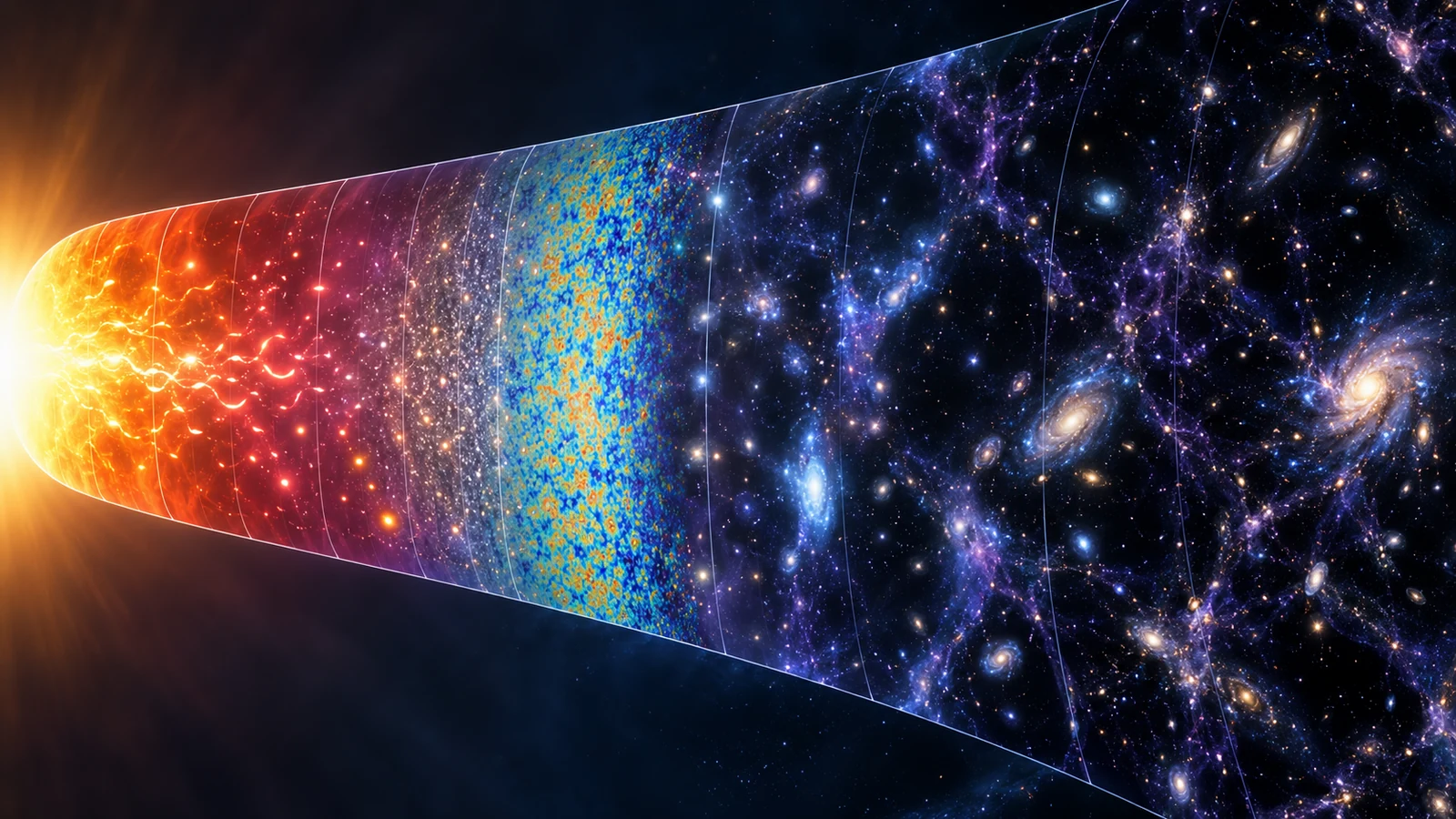
The Big Bang model says that the observable universe evolved from a much hotter, denser state. It does not describe matter exploding from a central point into pre-existing emptiness. On large scales, space itself expands, so distant galaxies recede from one another without a unique centre inside the observable universe. Running the equations backward raises temperature and density, but extrapolating all the way to a mathematical singularity exceeds the range in which our tested theories can be trusted.
The evidence chain
Three pillars support the hot Big Bang framework. Galaxy redshifts reveal cosmic expansion. The cosmic microwave background is relic radiation released when the universe became transparent roughly 380,000 years after the hot phase began. Primordial nucleosynthesis predicts the early production of light elements such as hydrogen, helium and deuterium. Precision measurements fit these pieces into a common history, while uncertainties remain about parameters and about physics at the earliest moments.
Inflation and its limits
Cosmic inflation proposes a brief period of accelerated expansion before the conventional hot Big Bang phase. It can explain why the observable universe is so nearly flat and uniform and how tiny quantum fluctuations could seed later structure. Several observations are compatible with inflation, but many inflationary models exist and the mechanism is not directly established. A primordial gravitational-wave signature would constrain the possibilities; current searches provide upper limits rather than a confirmed detection.
What does “before” mean?
If time is part of the universe’s dynamical geometry, asking what happened before the beginning may not resemble asking what happened before an ordinary event. Some models extend time through a bounce, propose an earlier contracting phase or describe quantum states without classical time. Others treat the earliest boundary as the limit of the question. None of these alternatives is observationally confirmed as the unique origin story. “We do not yet know” is the scientifically accurate answer.
From plasma to cosmic structure
After the early hot phase, expansion cooled the universe. Quarks became bound into protons and neutrons, nuclei formed, electrons later joined nuclei to make neutral atoms, and gravity amplified small density variations into stars and galaxies. Modern cosmology reconstructs this history by combining the microwave background, element abundances, galaxy surveys and supernova measurements. The theory is powerful because it connects independent observations, not because it supplies a complete answer to why existence began.
Discussion question
Would a successful model of the universe’s earliest measurable state answer why there is a universe at all, or would that remain a different kind of question?
Sources and further reading
NASA Science — The Big Bang ↗Planck Collaboration — Planck 2018 results VI: Cosmological parameters ↗ESA — Planck and the cosmic microwave background ↗Share your answer
You must log in to reply.
Established evidence, active research and philosophical interpretation are clearly separated.