Published: 21 October 2026
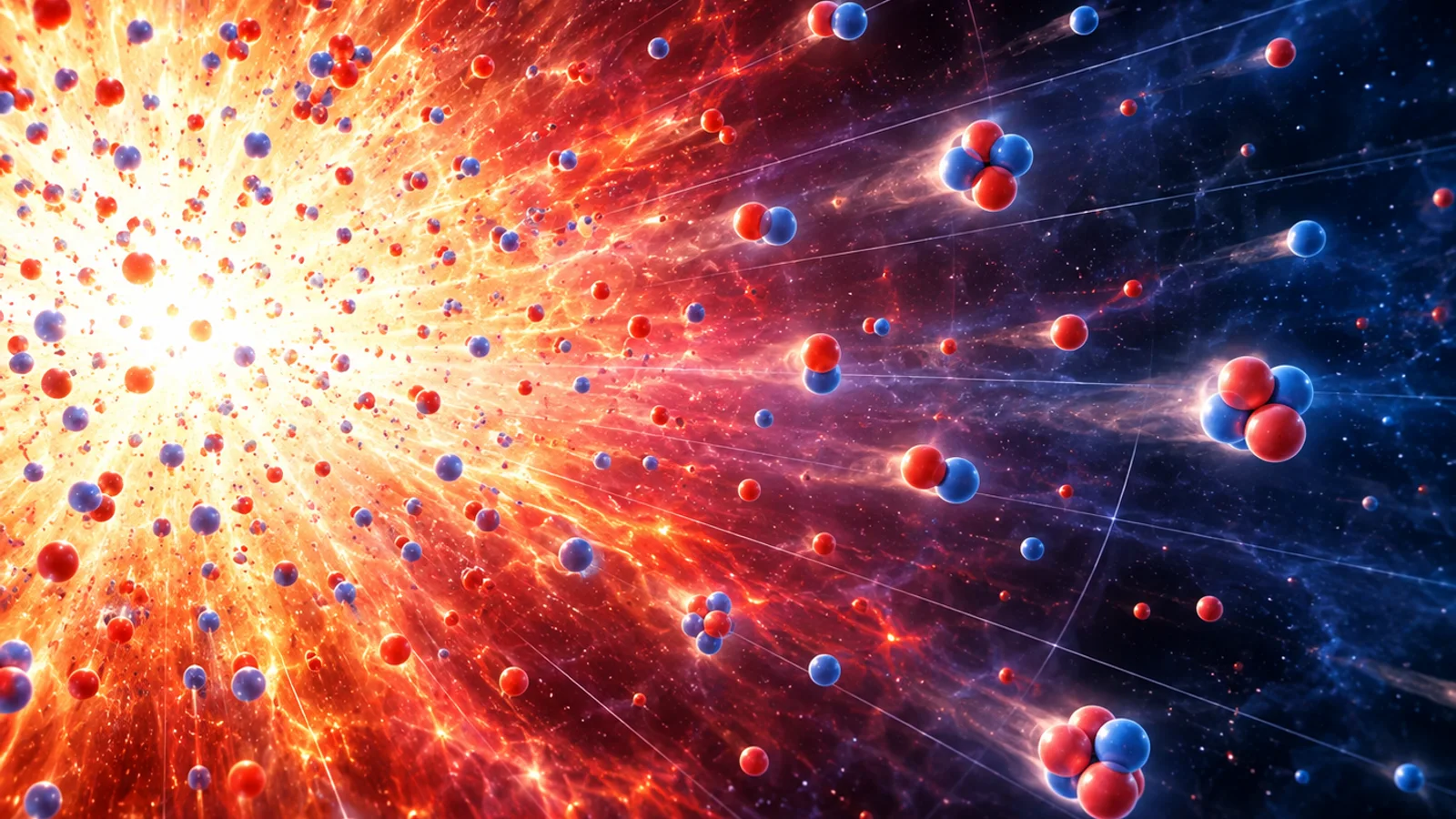
A laboratory before atoms
During the first minutes, the universe was hot and dense enough for nuclear reactions but too hot for neutral atoms. Protons and neutrons combined into deuterium, helium and traces of other light nuclei. Expansion cooled the plasma rapidly, freezing a characteristic pattern of abundances.
One parameter links the predictions
Standard big-bang nucleosynthesis uses measured nuclear reaction rates and the density of ordinary matter to predict primordial abundances. Deuterium is especially sensitive to the baryon density because it is readily destroyed in stars. Observations of chemically simple gas clouds provide the cleanest comparisons.
An independent cosmic cross-check
The baryon density inferred from primordial deuterium broadly agrees with the value inferred hundreds of thousands of years later from cosmic microwave background patterns. These methods use different physics and data. Their agreement is a powerful test of an expanding universe that passed through a hot early phase.
Helium supports the picture
Most primordial neutrons ended up in helium-4, producing a large mass fraction that ordinary stellar history alone cannot explain. Measurements in low-metallicity environments broadly match the predicted value, although stellar processing and systematic corrections must be modelled carefully.
Lithium keeps the story open
Old stars contain substantially less lithium-7 than standard calculations predict. The discrepancy may reflect stellar depletion, measurement systematics, nuclear inputs or physics beyond the standard model. A successful framework can contain a real unsolved problem without losing the evidence that works.
Discussion question
Does agreement between deuterium and the microwave background persuade you more than a direct image, even though both conclusions depend on models?
Sources and further reading
NASA COBE — Evidence for a hot, dense cosmic origin ↗ESA Planck — History of cosmic structure formation ↗Cyburt et al. — Big Bang Nucleosynthesis: Present Status ↗Share your answer
You must log in to reply.
Sign Up / Log InEstablished evidence, active research and philosophical interpretation are clearly separated.