Published: 15 October 2026
Separate the questions
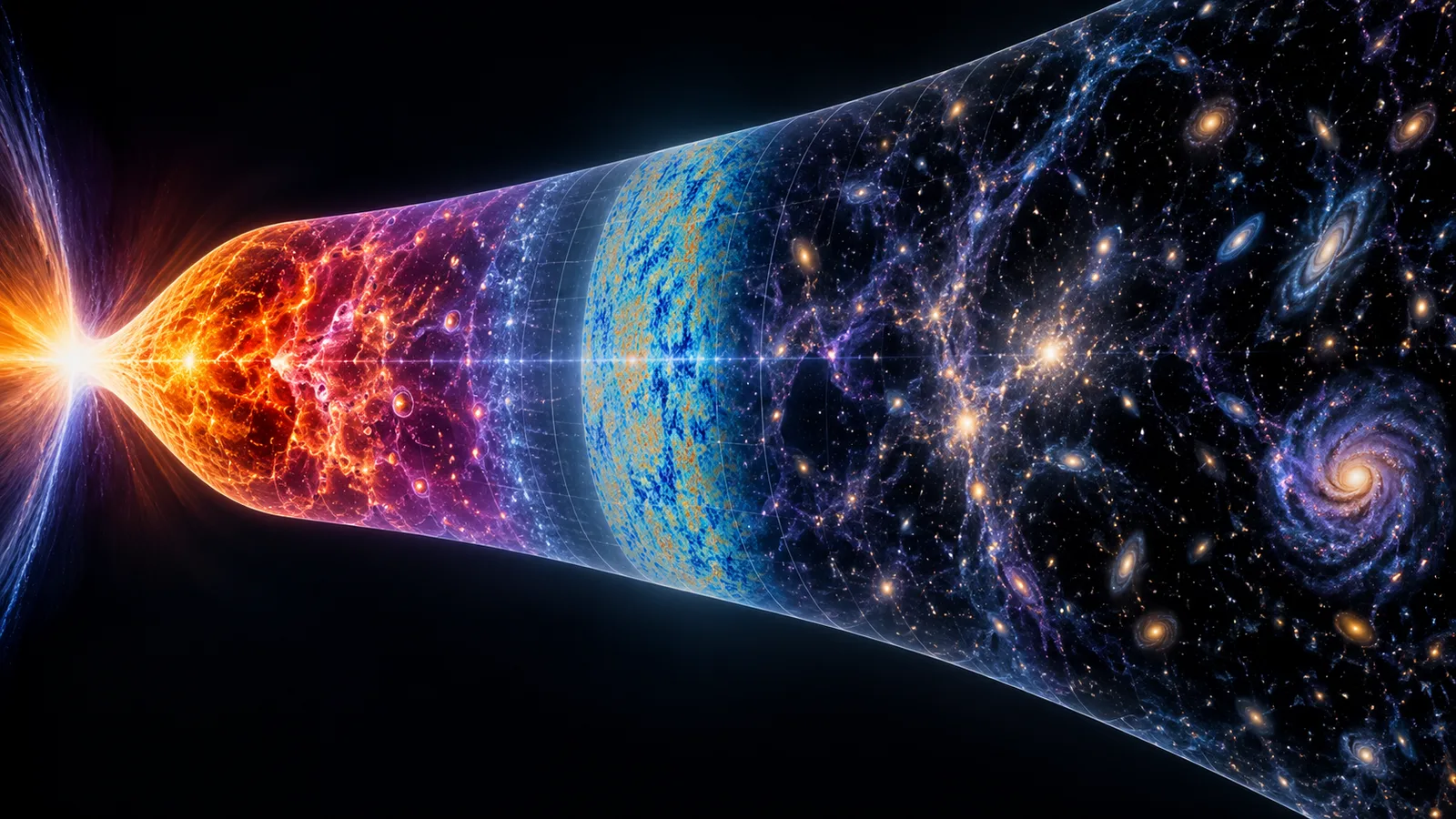
The hot Big Bang framework describes an expanding universe that cooled from an earlier hot, dense state. Cosmic inflation proposes an earlier period of accelerated expansion. They are connected in many models, but evidence for the hot phase is not automatically evidence for every proposed inflationary mechanism.
An observational bridge
Expansion, light-element abundances and the cosmic microwave background support the hot-universe picture. Inflationary models aim to explain features such as large-scale smoothness and the origin of primordial fluctuations. Researchers compare predicted patterns with observations; agreement can constrain a model without uniquely establishing its underlying physical mechanism.
Why models multiply
Imagine several machines producing nearly identical patterns on paper. Seeing the pattern narrows the possibilities, but may not identify the machine. Similarly, different early-universe scenarios can share observable predictions. Additional signatures and better measurements can help distinguish them, while theoretical assumptions about initial conditions and particle physics remain important.
Before the beginning?
An inflationary phase, if established, would not automatically explain why anything exists or demonstrate an absolute beginning of time. Those are further questions. A careful account keeps observational reconstruction, proposed mechanisms and philosophical interpretation in view without treating them as interchangeable answers.
Discussion question
When several models fit the same evidence, what should decide between them?
Share your answer
You must log in to reply.
Sign Up / Log InEstablished evidence, active research and philosophical interpretation are clearly separated.