Published: 7 November 2026
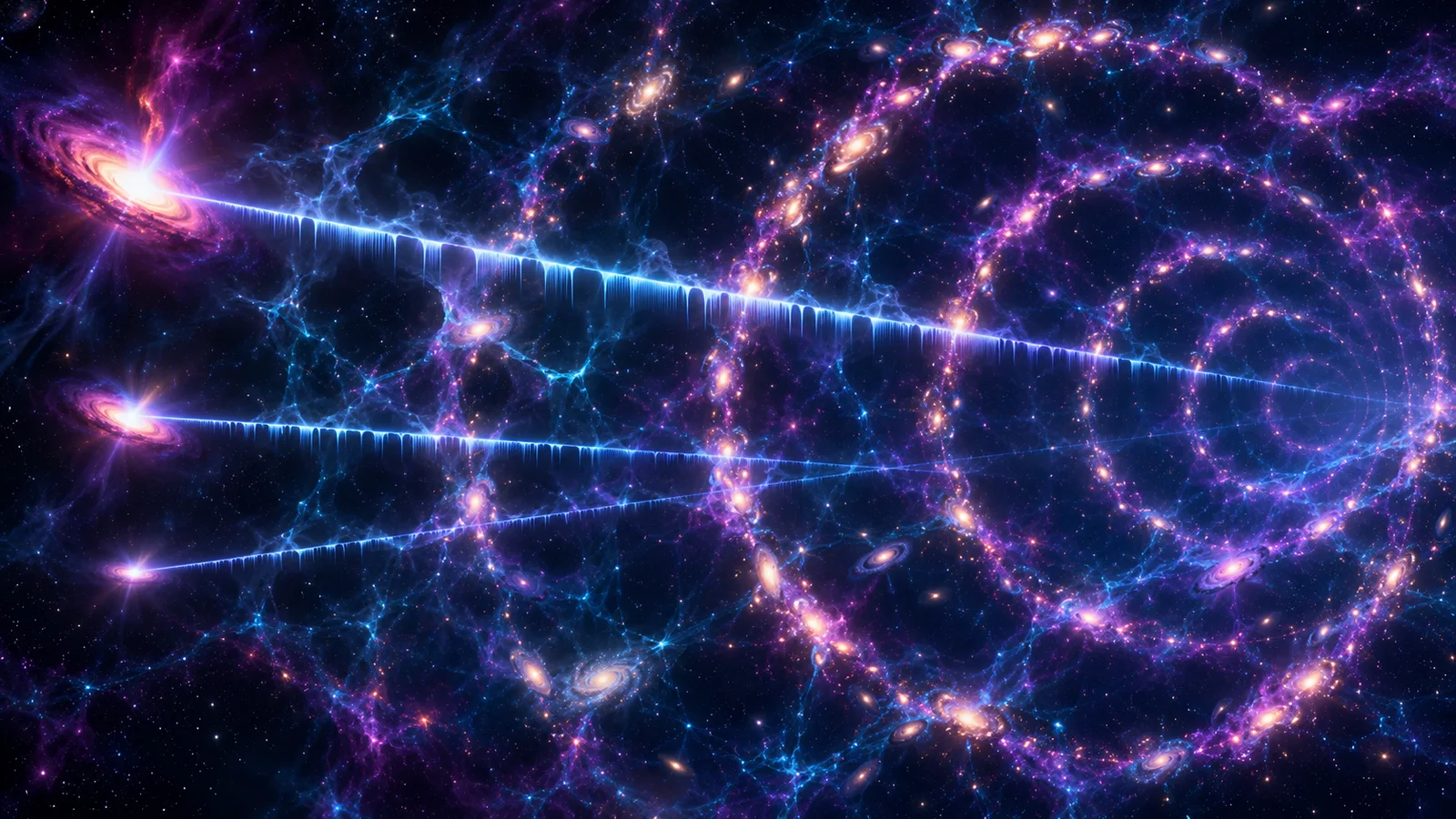
A fossil ruler from the early universe
Baryon acoustic oscillations left a preferred separation scale in the distribution of matter. Because its original size is calibrated by early-universe physics, astronomers can compare its apparent size at different redshifts to reconstruct cosmic expansion.
Galaxies and hydrogen tell the story
DESI maps millions of galaxies and quasars. At high redshift it also uses the Lyman-alpha forest—absorption features made by intervening hydrogen in quasar light—to trace matter where ordinary galaxy samples become sparse.
Why evolving dark energy entered the debate
DESI DR2 baryon-acoustic-oscillation measurements, when combined with cosmic microwave background and supernova datasets, strengthened preferences for models in which dark energy changes with time. The strength depends on the supernova compilation and model assumptions.
A 2026 twist from full-shape analysis
A newer Lyman-alpha analysis used more than the acoustic peak: it modeled the full correlation pattern of intergalactic hydrogen. Its tighter result shifted toward the standard ΛCDM prediction, showing how additional information can change the balance.
Precision is not the same as certainty
Different probes carry different calibrations, systematics and parameter degeneracies. Cosmologists must test whether one model explains all datasets consistently rather than selecting only the combination that produces the most dramatic tension.
Discussion question
When one probe favors evolving dark energy and another leans toward ΛCDM, should we first change the model—or search harder for hidden systematics?
Sources and further reading
DESI Data — DR2 publications ↗DESI — New DR2 Lyman-alpha results shed light on dark energy ↗Share your answer
You must log in to reply.
Sign Up / Log InEstablished evidence, active research and philosophical interpretation are clearly separated.