Published: 15 October 2026
Begin with the evidence chain
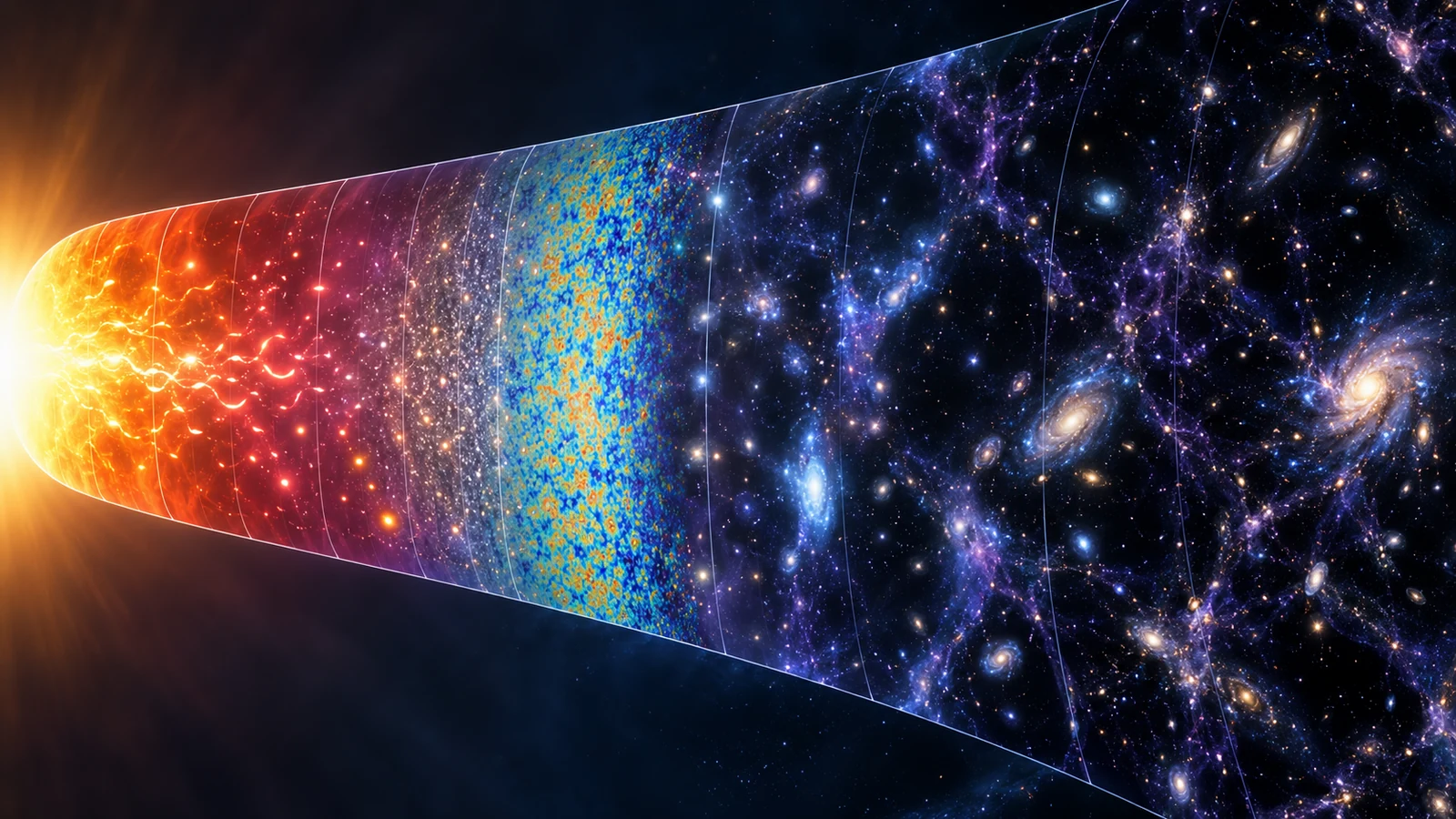
Cosmic expansion, the microwave background and primordial light-element abundances independently point to a hotter and denser early universe. Their agreement makes the hot Big Bang framework powerful. It describes evolution from an early state; it does not by itself prove creation from nothing.
The first three minutes
As expansion cooled the universe, protons and neutrons formed light nuclei. Calculated abundances of hydrogen, helium and deuterium can be compared with observations. This successful prediction reaches far earlier than direct starlight, yet it still begins after physical conditions about which our theories are less certain.
Inflation is a research programme
Inflation can explain large-scale uniformity, near-flat geometry and the origin of structure from small fluctuations. Many versions fit current constraints, and no unique mechanism has been confirmed. Searches for primordial gravitational waves and improved maps of the microwave background continue to narrow the possibilities.
The boundary of the question
Extrapolating classical equations to a singularity is not the same as observing an absolute beginning. Bounce models, no-boundary proposals and other quantum-cosmology ideas offer alternatives, but none is established as the history of our universe. Scientific precision requires separating measured early history from origin speculation.
Discussion question
If a theory perfectly described the earliest measurable state, would it also answer why anything exists?
Sources and further reading
NASA Science — The Big Bang ↗Planck Collaboration — Cosmological parameters ↗ESA — Planck and the cosmic microwave background ↗Share your answer
You must log in to reply.
Sign Up / Log InEstablished evidence, active research and philosophical interpretation are clearly separated.