Published: 17 October 2026
The oldest light is not the earliest evidence
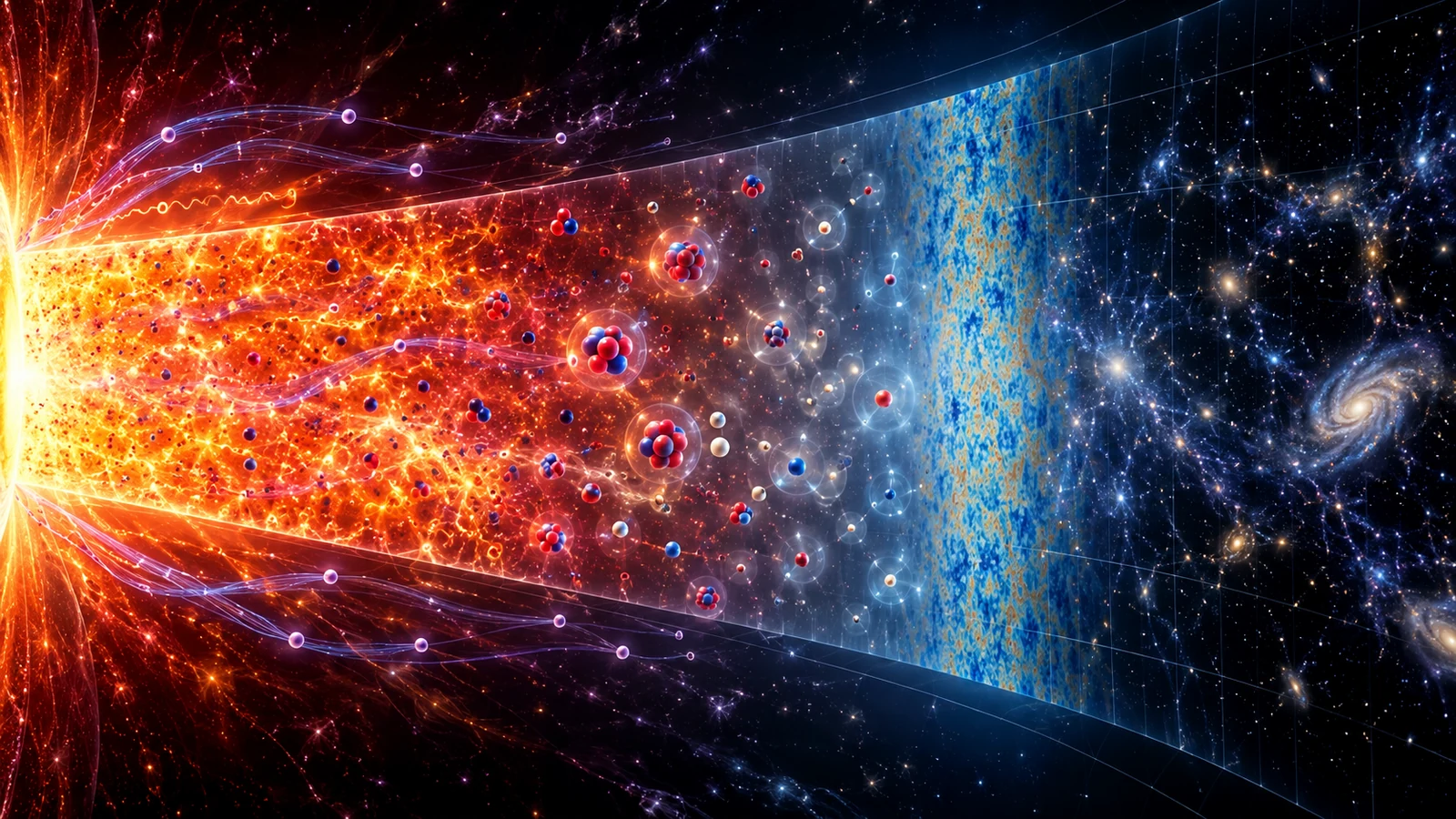
The cosmic microwave background was released when the universe became transparent roughly 380,000 years after the hot early phase. Before that, photons scattered constantly in an ionized plasma. Telescopes cannot see through this wall with ordinary light, yet earlier processes left other traces that can be compared with physical models.
Nuclei record the first minutes
As the universe expanded and cooled, protons and neutrons formed light nuclei. Big Bang nucleosynthesis predicts the abundances of hydrogen, helium and deuterium from the expansion rate, nuclear reactions and ordinary-matter density. Measurements broadly match this framework. The agreement is evidence for a hot, dense early universe, not a photograph of an absolute beginning.
A relic neutrino background
Neutrinos stopped interacting freely about one second after the hot phase began, far earlier than the release of the microwave background. Cosmological models predict a cold cosmic neutrino background today. It has not been directly detected as individual relic particles, but its contribution affects nucleosynthesis and patterns in the microwave background. These indirect effects constrain the number and behaviour of light particle species.
Possible messengers from still earlier times
Primordial gravitational waves could travel from epochs inaccessible to electromagnetic light. Their imprint might appear in large-scale polarization patterns or future direct detectors. No decisive primordial signal has been established. A detection would constrain early expansion models; a non-detection progressively rules out models predicting signals above measured limits.
Where reconstruction stops
Every step further back depends more heavily on theory. Evidence supports the hot Big Bang history over a vast range, while inflation, quantum origins and pre-Big-Bang scenarios remain less settled. “Before first light” is therefore a ladder of inference with different strengths, not a single revealed scene.
Discussion question
Which would change cosmology more: direct detection of relic neutrinos or a primordial gravitational-wave background?
Sources and further reading
ESA — Cosmic Microwave Background radiation ↗Planck Collaboration — Cosmological parameters ↗PDG Review — Big-Bang Cosmology ↗Share your answer
You must log in to reply.
Sign Up / Log InEstablished evidence, active research and philosophical interpretation are clearly separated.