Published: 6 November 2026
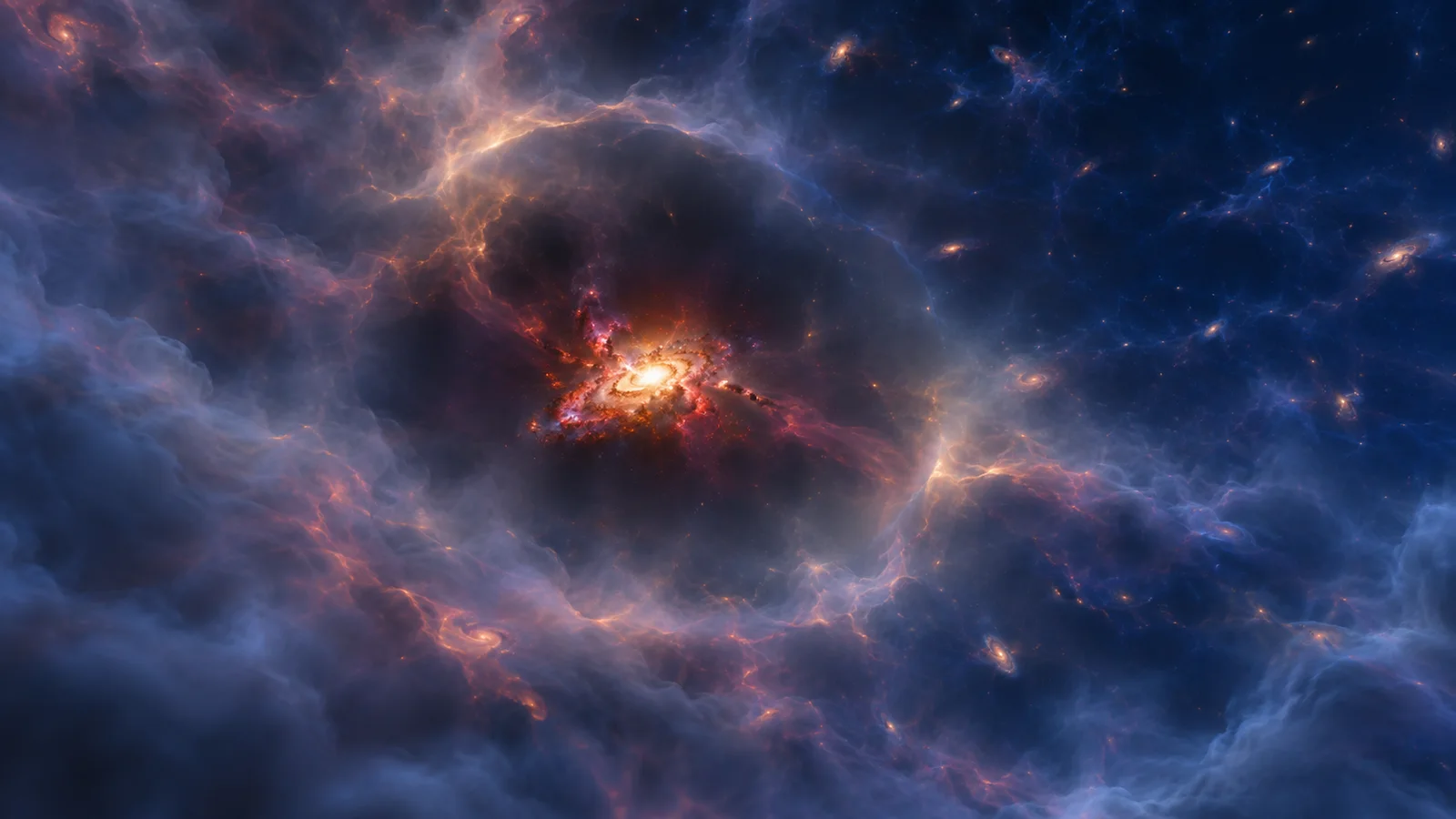
A distance confirmed by a spectrum
Images can suggest that a galaxy is extremely distant, but spectroscopy provides the stronger test. Webb's NIRSpec instrument measured a cosmological redshift of 14.44 for MoM-z14, placing the observed galaxy about 280 million years after the Big Bang.
Looking back is not a simple ruler
The galaxy's light has travelled for about 13.5 billion years while space expanded, stretching its wavelengths toward the red. Redshift, light-travel time and present-day distance describe different aspects of the observation; none should be treated as a simple snapshot measured with an ordinary ruler.
Too bright for old expectations
MoM-z14 belongs to a growing population of unexpectedly luminous early galaxies. The research team reports that such bright objects are far more common than pre-Webb theoretical studies predicted. The finding does not overturn the Big Bang; it tests how quickly stars and galaxies assembled within it.
An unusual chemical clue
The spectrum shows strong nitrogen enrichment even though there was little time for many generations of ordinary stars to manufacture it. One proposal invokes very massive stars in the dense early universe, but alternative stellar populations and enrichment pathways must be compared.
A bubble in the hydrogen fog
MoM-z14 also appears to have helped clear neutral hydrogen around itself. This contributes to the timeline of reionization, when ultraviolet light from early stars and galaxies transformed the intergalactic medium and allowed light to travel more freely.
What larger samples will decide
Detailed Webb spectra can reveal chemistry and star formation, while the Roman Space Telescope is expected to find many more bright early galaxies across wider areas. Models will improve when one spectacular object becomes a statistically understood population.
Discussion question
If early galaxies repeatedly appear brighter than predicted, should astronomers first revise star formation, stellar populations, dust—or the assumed distribution of galaxies?
Sources and further reading
NASA Science — Webb Pushes Boundaries of Observable Universe Closer to Big Bang ↗Open Journal of Astrophysics — A Cosmic Miracle: MoM-z14 confirmed with JWST ↗Share your answer
You must log in to reply.
Sign Up / Log InEstablished evidence, active research and philosophical interpretation are clearly separated.