Published: 13 October 2026
Light released after the hot beginning
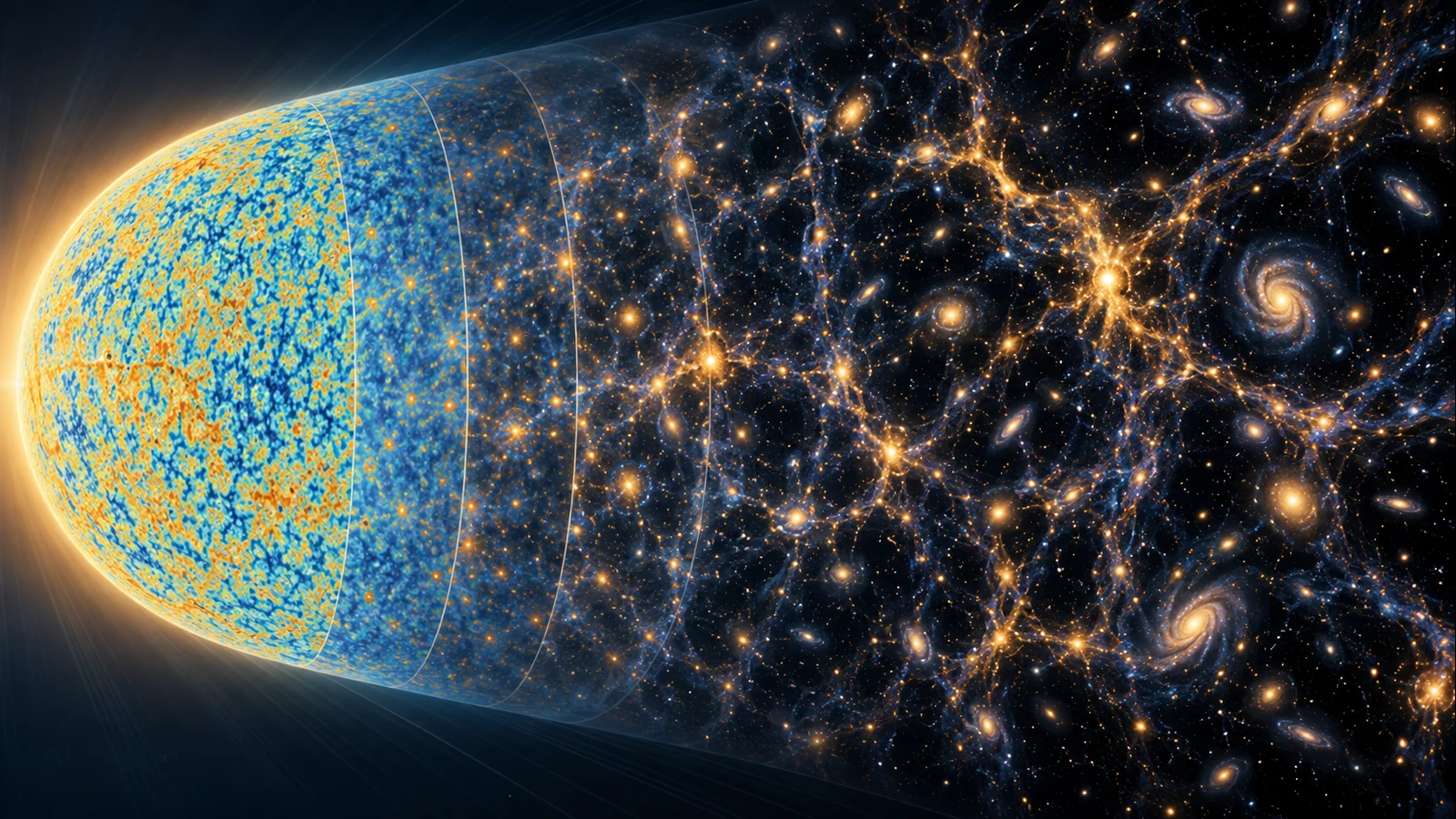
For roughly the first 380,000 years of cosmic history, matter formed a hot ionized plasma that scattered photons repeatedly. As expansion cooled the universe, electrons combined with nuclei and space became transparent. The photons then travelled freely and are observed today as the cosmic microwave background, cooled by expansion to microwave wavelengths. It is the oldest electromagnetic light we can directly detect.
A nearly perfect thermal spectrum
The cosmic microwave background has an extraordinarily precise blackbody spectrum at about 2.7 kelvin. That spectrum is powerful evidence that the observable universe passed through a hot, dense phase. The sky is almost uniform, yet tiny temperature differences—roughly parts in one hundred thousand—encode variations in density and motion in the young universe. Gravity later amplified those variations into galaxies and the cosmic web.
Reading the pattern
The angular pattern of hotter and cooler patches carries information about ordinary matter, dark matter, geometry and the expansion history. ESA’s Planck mission mapped temperature and polarization anisotropies across the sky with high precision. Researchers compare the measured pattern with physical models, allowing independent parameters to be tested together rather than fitting an origin story to a single image.
What it says about inflation
Inflation proposes a very early interval of accelerated expansion that stretched microscopic fluctuations to cosmic scales. The microwave background’s near-uniformity and statistical pattern are compatible with broad classes of inflationary models. Compatibility is not unique confirmation: many models remain possible, and a decisive primordial gravitational-wave signal has not been established. The evidence constrains early-universe physics without completing it.
The boundary of the evidence
The cosmic microwave background is not light from time zero. It comes from a later transparent phase and carries indirect traces of earlier conditions. Physics can reconstruct a remarkably detailed history from that boundary forward and test hypotheses about what preceded it. Whether the universe had an absolute beginning, emerged from a quantum state or followed an earlier phase remains open. First light is a record, not a final answer to why anything exists.
Discussion question
How far can indirect traces take us when the earliest state of the universe cannot be observed with light?
Sources and further reading
ESA — Cosmic Microwave Background radiation ↗ESA — Planck overview ↗Planck Collaboration — Cosmological parameters ↗Share your answer
You must log in to reply.
Sign Up / Log InEstablished evidence, active research and philosophical interpretation are clearly separated.