Published: 20 October 2026
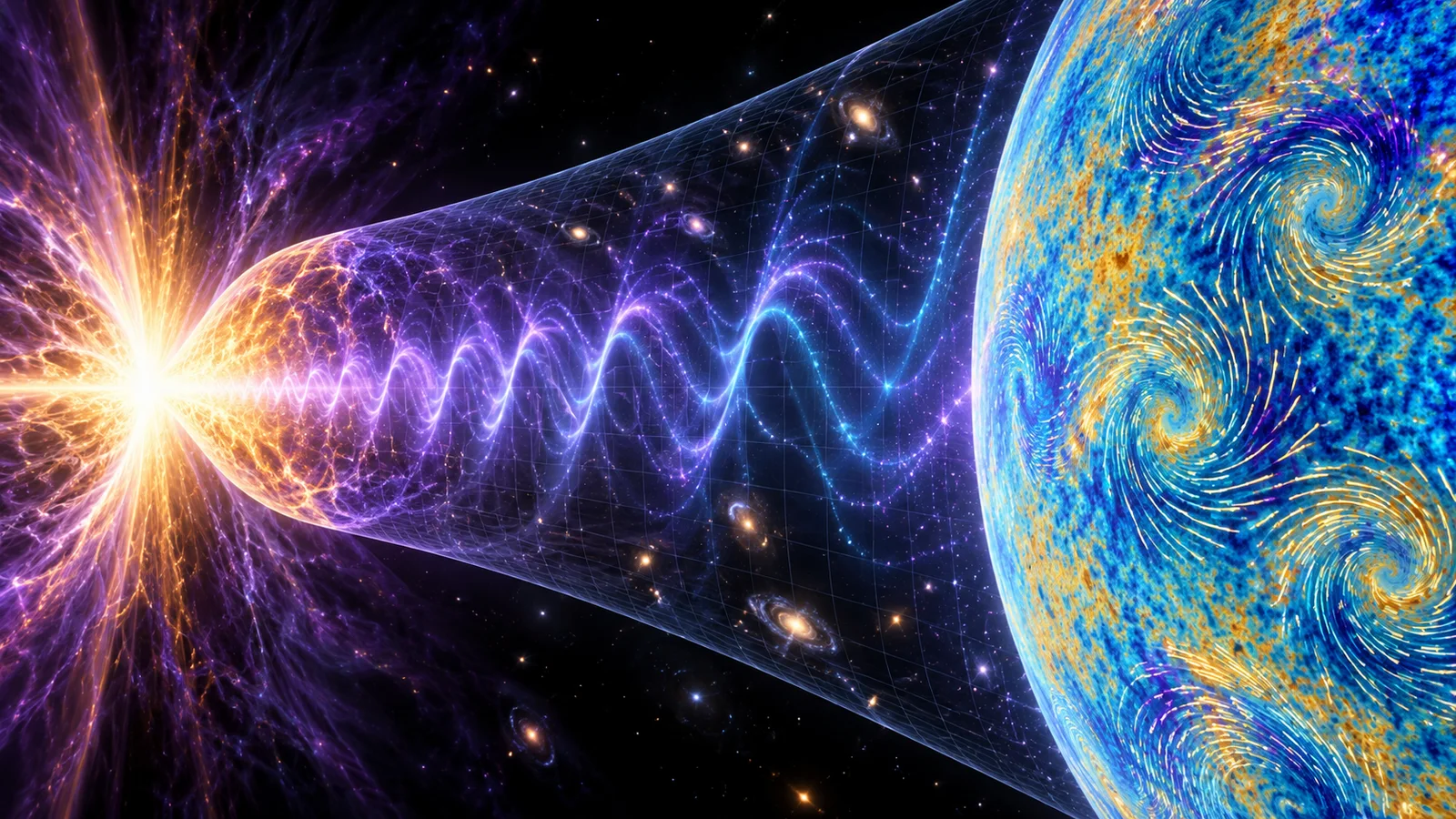
A fossil from extreme energies
Inflation is a family of models in which the early universe underwent accelerated expansion. Quantum fluctuations in spacetime could have been stretched to cosmic scales, producing a stochastic background of gravitational waves. Their amplitude is often summarized by the tensor-to-scalar ratio, r.
Why B modes are important
Primordial gravitational waves can generate a curl-like B-mode pattern in cosmic microwave background polarization. Density fluctuations mainly create E modes at first order, so a large-angle primordial B-mode spectrum would be a distinctive clue. Gravitational lensing also converts E modes into B modes and must be removed statistically.
Dust changed the lesson
The 2014 BICEP2 result initially appeared consistent with a large primordial signal, but Galactic dust could explain the observed pattern. Joint analyses with Planck transformed a dramatic claim into increasingly strong upper limits. The episode showed why multi-frequency measurements and independent confirmation are essential.
Current constraints
BICEP/Keck and Planck analyses have placed the tensor-to-scalar ratio below a few hundredths for standard assumptions; one widely cited BK18 combination reported r below 0.032 at 95 per cent confidence. A limit rules out parts of model space, but it does not prove inflation false.
What a detection would and would not settle
A well-characterized primordial spectrum could constrain the expansion scale and distinguish classes of inflationary models. It would not automatically identify the inflaton or explain why inflation began. Foregrounds, lensing and instrument systematics would still need cross-checks across experiments.
Discussion question
Would a primordial gravitational-wave detection count as evidence for inflation, or only for an unknown process in the early universe?
Sources and further reading
BICEP/Keck Collaboration — Inflation and the CMB ↗BICEP/Keck + Planck — Improved constraints on primordial gravitational waves ↗ESA Planck — Polarization and primordial constraints ↗Share your answer
You must log in to reply.
Sign Up / Log InEstablished evidence, active research and philosophical interpretation are clearly separated.