Published: 3 November 2026
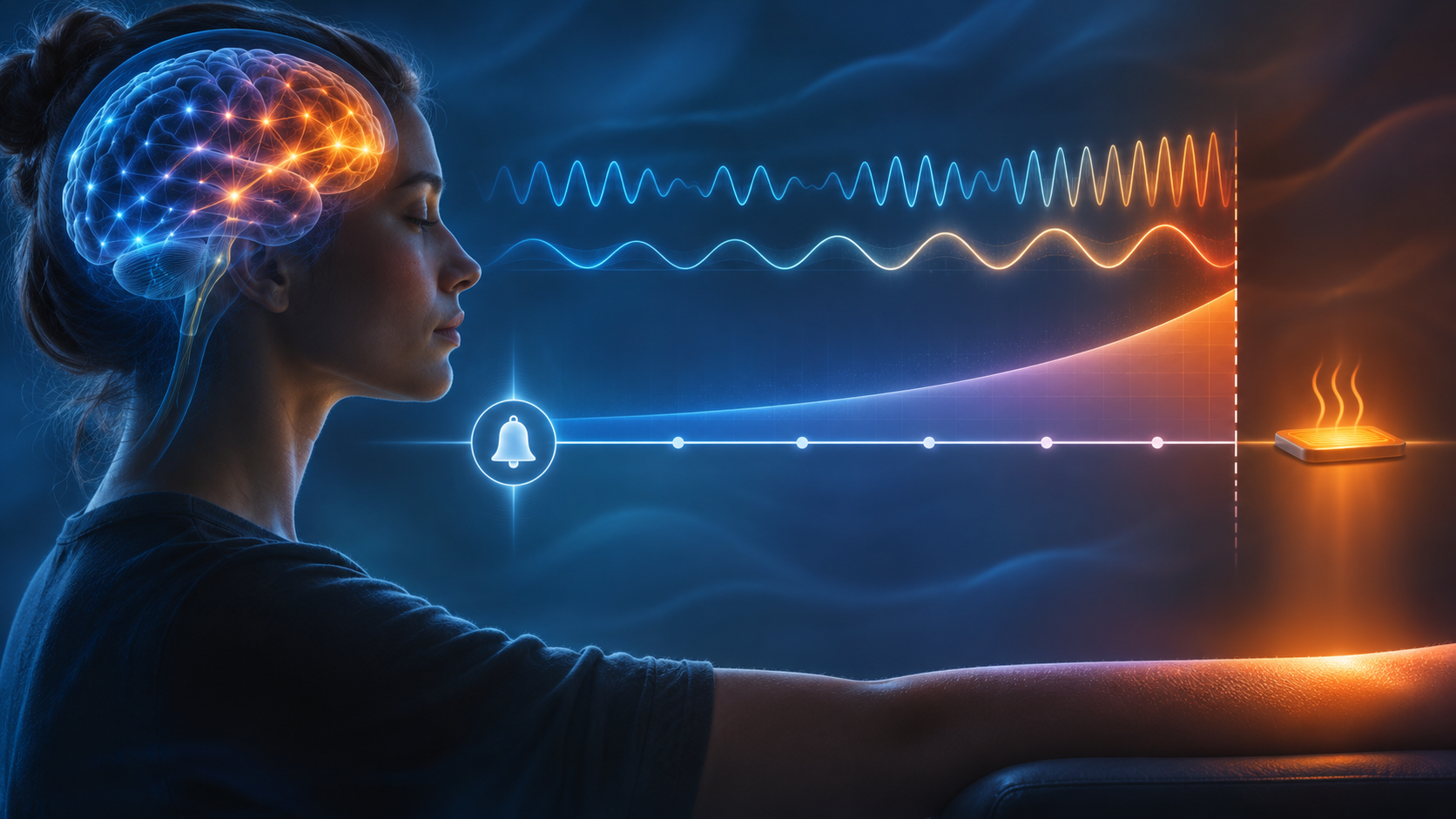
The clock inside expectation
Waiting is not empty. The brain uses temporal cues to predict when an event will occur and prepares perception and action around that prediction. This raises a precise question: can an expected delay change the way a later bodily sensation is experienced?
What the experiment found
A 2026 Nature Communications study manipulated participants' expectations about the delay before a somatosensory stimulus. Expecting a longer delay amplified reported perception, while changing the actual latency alone did not produce the same effect. EEG measurements also linked the cue period to changes in alpha and beta activity.
What is established
The study supports a causal role for temporal expectation in shaping somatosensory perception under controlled conditions. It adds to evidence that perception is an active inference: the brain combines incoming signals with predictions about timing and context.
What it does not show
The result does not mean that anticipation always makes pain worse, that every bodily sensation is imagined, or that physical time is created by the mind. It concerns how a prediction changes perceptual processing and report in a specific experimental design.
Why it matters
Temporal expectations could help explain why uncertain waiting feels different from a known countdown, and why clinical procedures are influenced by cues and context. Translation to medicine requires further studies across pain types, patient groups and real-world settings.
Discussion question
Would knowing exactly when an unpleasant sensation will arrive make it easier to bear—or intensify your attention to it?
Sources and further reading
Nature Communications — Temporal predictions shape somatosensory perception ↗Share your answer
You must log in to reply.
Sign Up / Log InEstablished evidence, active research and philosophical interpretation are clearly separated.