Published: 4 November 2026
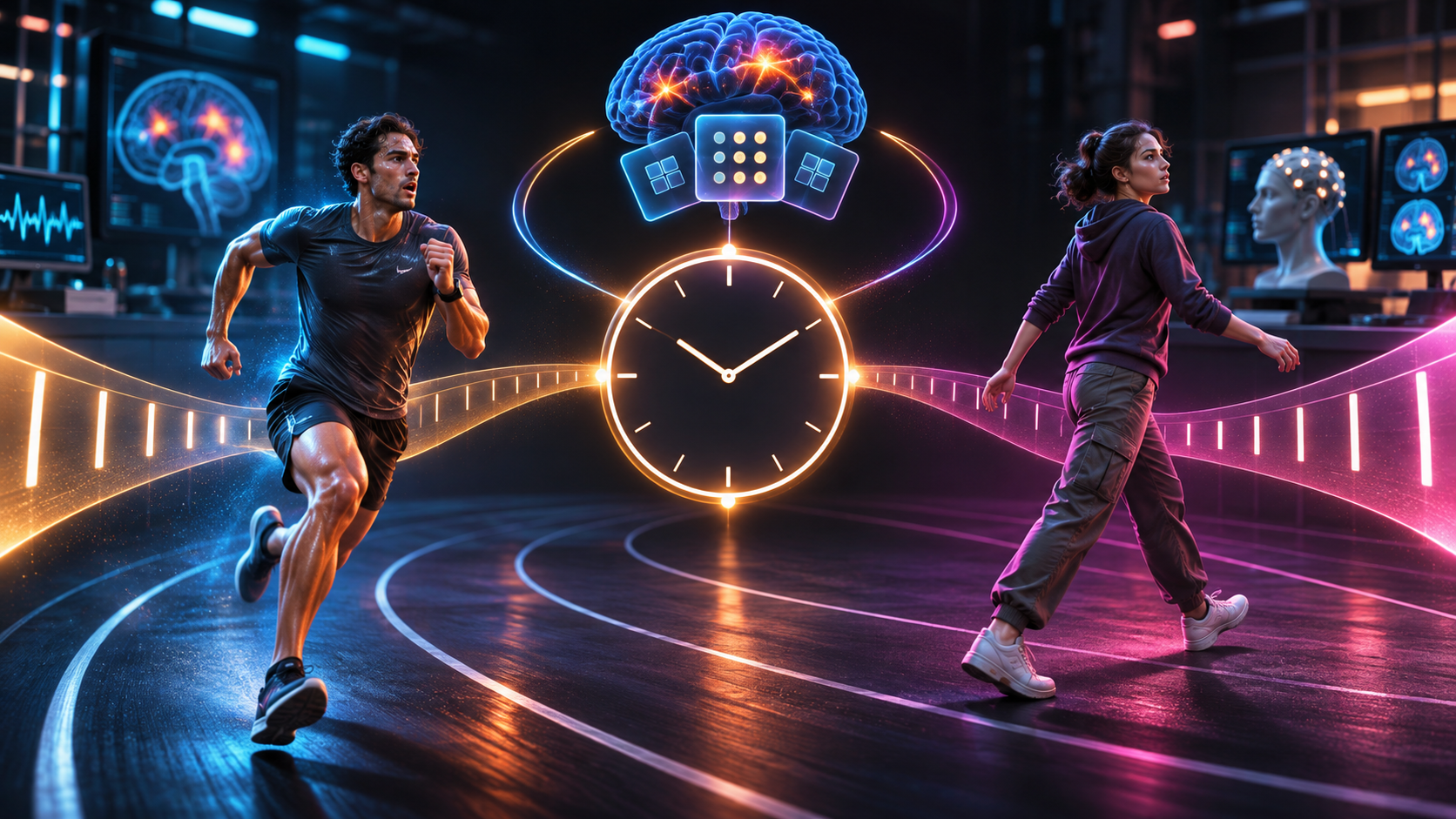
One clock, several experiences
A laboratory clock can mark identical intervals while people judge them differently. Attention, emotion, movement and expectation all influence temporal estimates. To separate bodily exertion from mental demand, researchers compared duration judgments during running, backward walking and a working-memory task performed while standing.
The experiment
Participants learned a two-second visual reference and compared it with test stimuli lasting between one and four seconds. They completed the task at baseline, while running, while walking backward and while performing a concurrent visual memory task. Heart rate indexed physical effort, while the dual task reduced available cognitive resources without requiring exercise.
What the participants perceived
Across the active and dual-task conditions, shorter stimuli were judged as equivalent to the two-second reference. The shift corresponded to about nine percent overestimation while running and roughly seven percent during backward walking and the cognitive dual task. Precision did not show the same clear change as perceived duration.
Not simply a faster heartbeat
The magnitude of the timing bias did not correlate with the increase in heart rate. Similar shifts appeared in conditions with very different physical demands, including the stationary memory task. This pattern suggests that shared attentional or cognitive resources may contribute, although the observed correlations between conditions were weak and do not establish a single mechanism.
What the result means
The experiment shows that perceived short intervals can be systematically altered while the external clock remains unchanged. It does not show that physical time speeds up, that every exercise session feels longer, or that seconds and minutes are distorted by the same processes. The task, sample and time range define the conclusion.
A mind that measures by doing
Time perception may depend partly on how the brain organizes changing sensory, motor and cognitive states. Effort could add events, divide attention or alter the reference against which duration is judged. Competing explanations can be tested by varying task difficulty, movement, arousal and sensory modality independently.
Discussion question
When a demanding activity feels longer, is your brain counting more change—or paying less attention to the clock?
Sources and further reading
Scientific Reports — The role of physical and cognitive effort on time perception ↗Share your answer
You must log in to reply.
Sign Up / Log InEstablished evidence, active research and philosophical interpretation are clearly separated.