Published: 22 October 2026
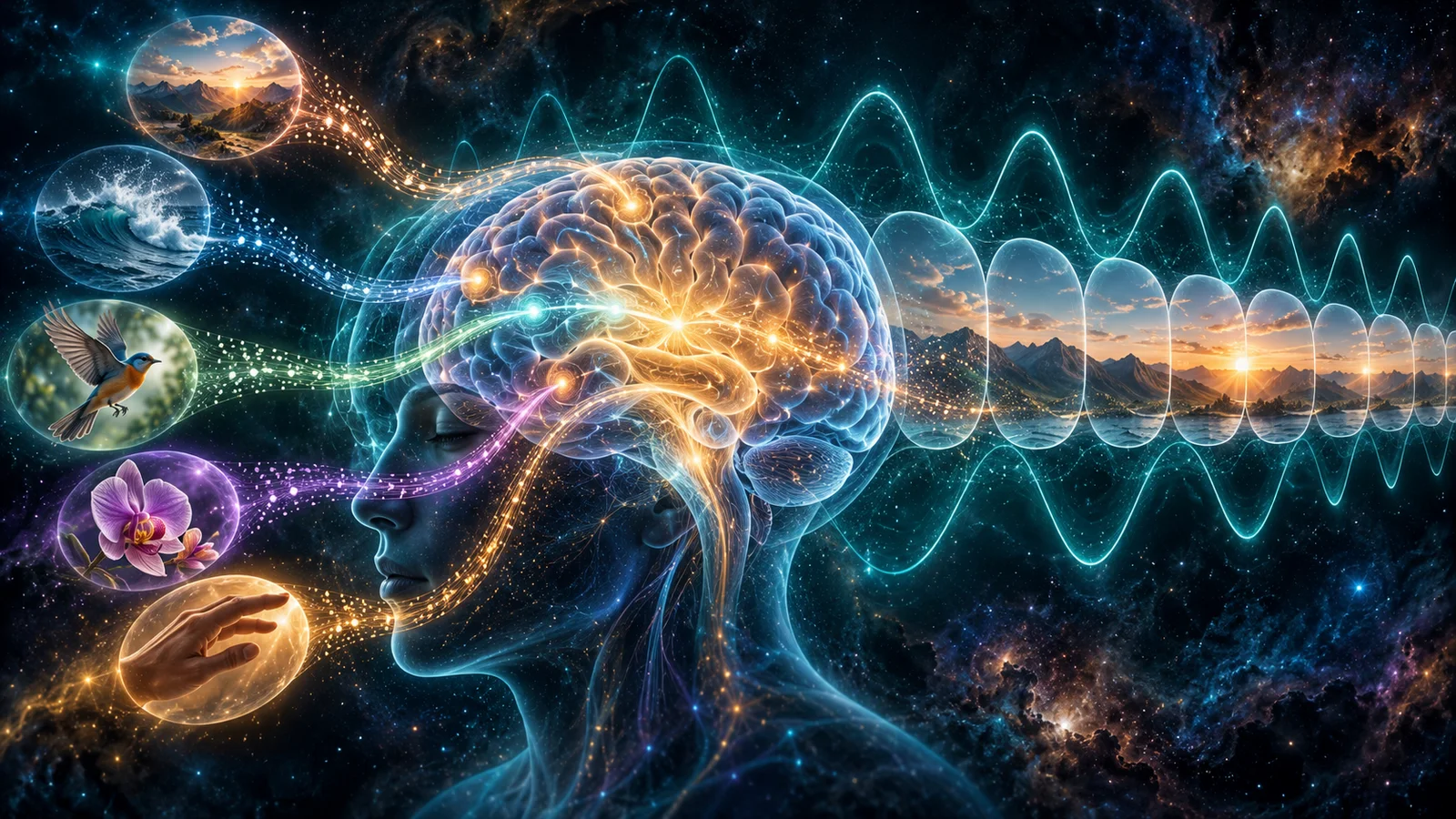
The present is not an instant
Light, sound and touch arrive through different pathways and are processed at different speeds. Yet experience normally presents a unified scene. The brain must integrate information across a brief interval, meaning the psychological present is better described as a window than as a mathematical point.
Different tasks use different windows
Speech sounds, musical rhythm, movement and narrative meaning operate on distinct timescales. Experiments on temporal binding show that the allowable gap between events changes with context, training and sensory modality. There is probably no single universal duration for the experienced now.
Prediction helps synchronize the senses
The brain does not wait passively for every signal. It predicts when events should occur and updates those expectations when timing errors appear. Repeated exposure can recalibrate which sights and sounds are judged simultaneous, showing that temporal perception is adaptive rather than fixed.
Neural dynamics provide candidate clocks
Oscillations, recurrent activity and changing population states may define periods over which signals are combined. Researchers study whether these processes create discrete perceptual frames or a continuously sliding integration window. Evidence currently supports multiple interacting timescales more strongly than one master clock.
Physics and experience answer different questions
Relativity concerns how clocks and causal order behave in spacetime. Neuroscience concerns how a nervous system groups events into experience. Discovering that the brain constructs a present does not show that physical time is unreal; it shows that direct experience is an interpretation of temporal information.
Discussion question
If your experienced present is assembled after events occur, in what sense are you ever aware of the world ‘right now’?
Sources and further reading
Review — Temporal binding windows and multisensory perception ↗Review — Neural timescales and conscious experience ↗Research review — Subjective time and temporal integration ↗Share your answer
You must log in to reply.
Sign Up / Log InEstablished evidence, active research and philosophical interpretation are clearly separated.