Published: 7 November 2026
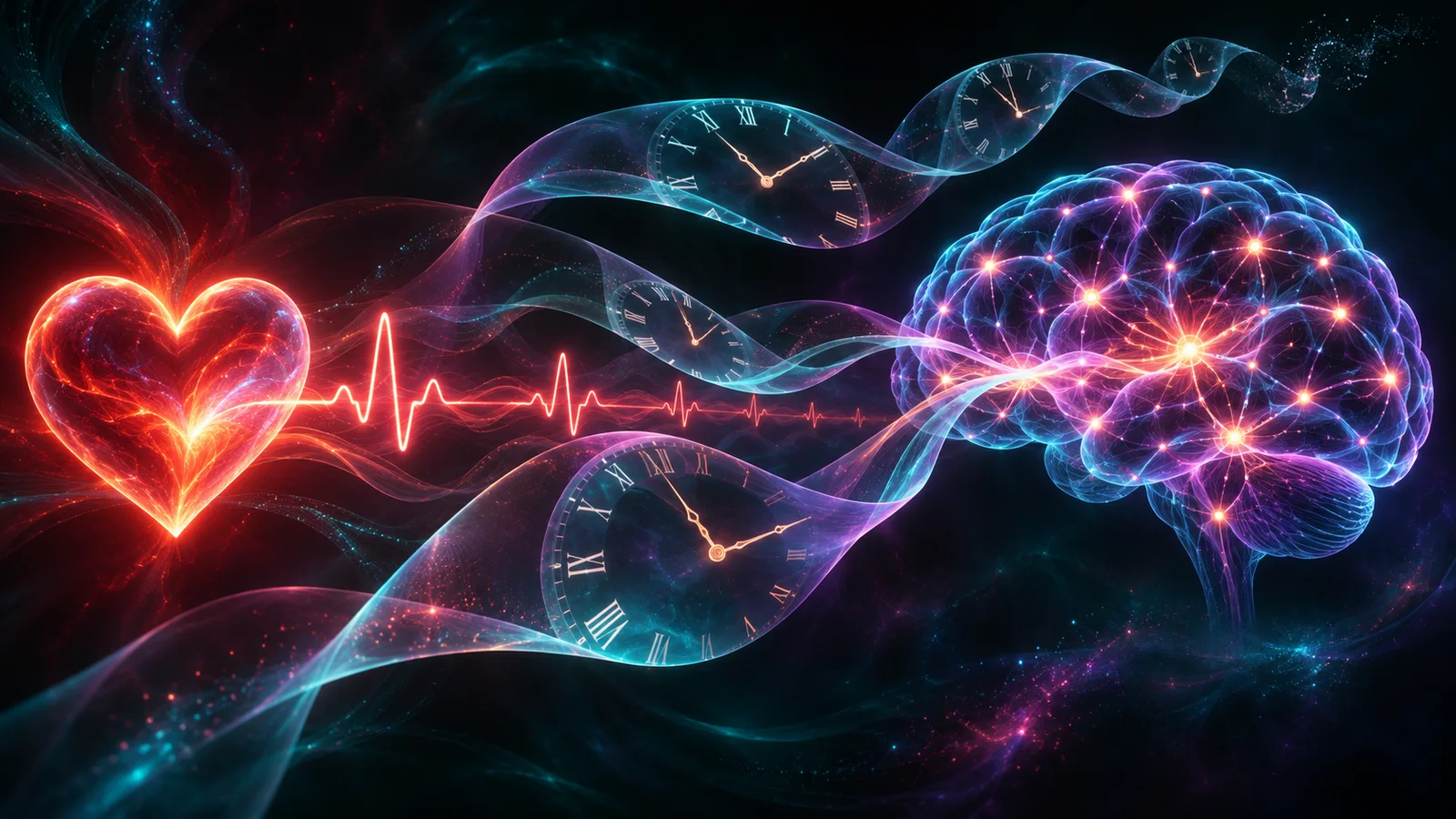
Time is measured in more than one way
Explicit timing asks people to judge or reproduce durations. Implicit timing appears in readiness and reaction without asking for a time estimate. These tasks can depend on different combinations of attention, memory, movement and bodily state.
Heartbeat accuracy and confidence diverge
A 2025 study found that better heartbeat-counting performance was associated with faster motor readiness in an implicit task. Yet greater confidence in heartbeat detection predicted poorer performance in a time-bisection task, suggesting that confidence can exceed accuracy.
Vagal tone and self-paced rhythm
In a second sample, higher high-frequency heart-rate variability was associated with a faster self-paced tapping rhythm. This links autonomic regulation to temporal behavior, but correlation does not establish that cardiac rhythm directly drives a mental clock.
Emotion changes the body and the estimate
Another study found that emotional content altered duration estimates and that heart rate partly mediated the effect. Internal attention was also linked to stronger underestimation. The heart contributed, but much of the emotional influence remained unexplained.
An embodied network, not a stopwatch
The emerging picture involves the insula, supplementary motor regions, attention and memory interacting with bodily signals. Subjective time may be constructed from changing states rather than counted by one central mechanism.
Discussion question
If bodily rhythms influence time perception, would changing the heartbeat change experienced time—or only the brain's interpretation of it?
Sources and further reading
PubMed — In the heart of time ↗PubMed — Interoceptive signals and emotional states shape temporal perception ↗Share your answer
You must log in to reply.
Sign Up / Log InEstablished evidence, active research and philosophical interpretation are clearly separated.