Published: 5 November 2026
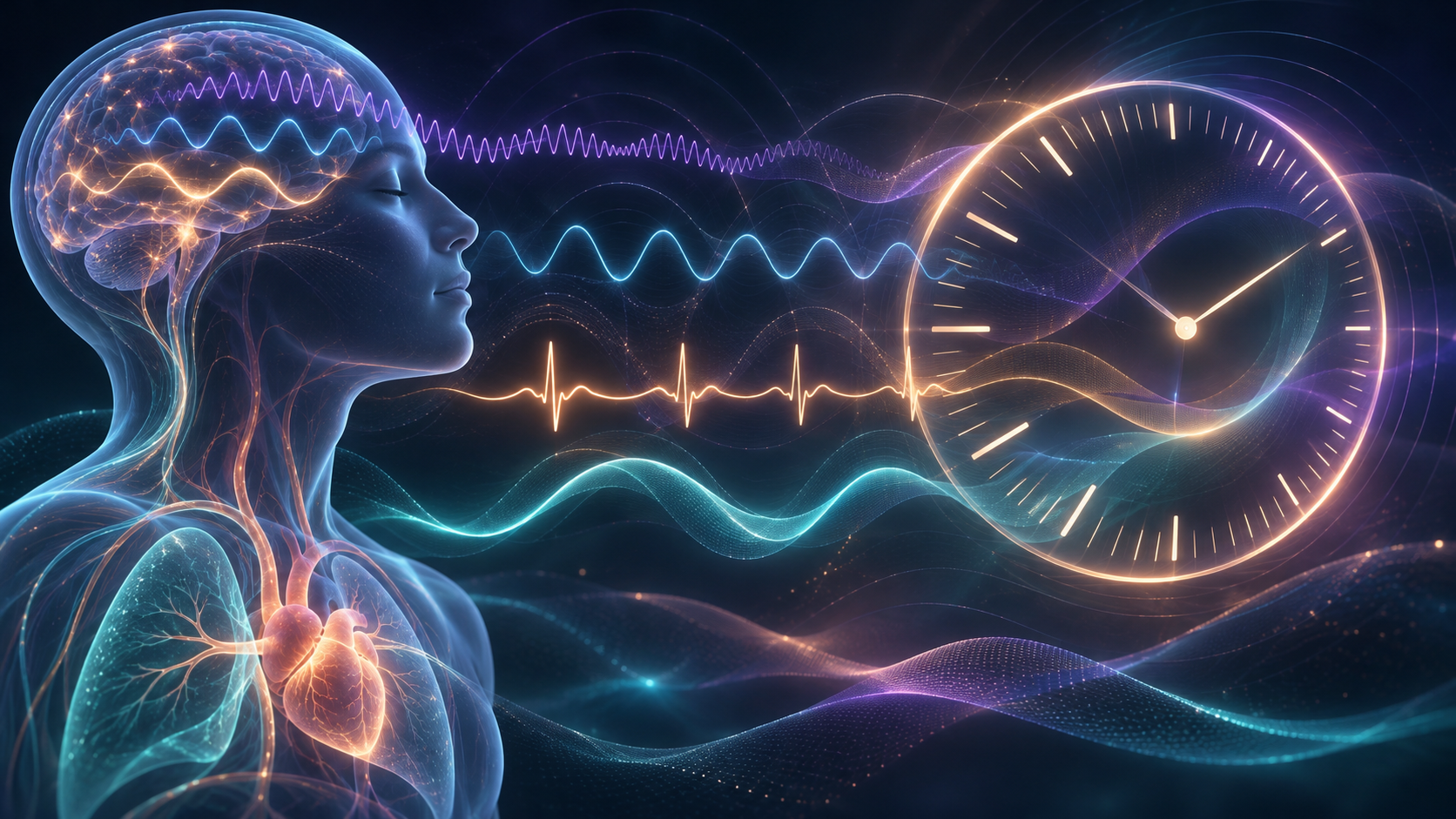
The body is full of clocks
Neurons oscillate across many frequencies, the heart beats, breathing cycles and movements create repeated events. These rhythms give the nervous system structured opportunities to sample signals and coordinate distant regions. It is tempting to identify one of them as the source of our sense of time.
A hierarchy rather than one tick
A 2026 Nature Reviews Neuroscience perspective argues that nested brain-body rhythms provide a scaffold for sequence, duration and memory. Fast oscillations can organize local processing while slower rhythms group events into larger windows. The proposal links timing to action and memory rather than to a detached stopwatch in the brain.
What rhythms can explain
Oscillations can coordinate when information is most excitable, align perception with expected events and divide continuous activity into episodes. Heartbeat and breathing phases also influence detection, emotion and memory. These measurable effects make bodily timing a serious component of temporal cognition.
Why rhythms may not be enough
A published critique notes that subjective duration also changes with spatial mapping, magnitude, attention and memory even when no physiological rhythm is directly manipulated. People can judge the same interval differently because of what it contains or how it is represented. A complete account therefore needs more than oscillatory entrainment.
Physical time and experienced time
Atomic clocks measure reproducible physical intervals. Neural and bodily rhythms help an organism organize events within those intervals. Neither observation shows that physical time itself speeds up when a moment feels long. The scientific question is how changing internal states map a stable interval onto experience and memory.
How the theory can be tested
Experiments can manipulate breathing or sensory rhythms while independently varying attention, memory and spatial representation. A strong model should predict when rhythms dominate, when non-rhythmic factors override them and how effects scale from milliseconds to remembered years.
Discussion question
If many biological rhythms contribute to time perception, should we speak of one inner clock—or a negotiation among many clocks?
Sources and further reading
Nature Reviews Neuroscience — Time, space, memory and brain–body rhythms ↗Nature Reviews Neuroscience — Rhythms alone cannot explain subjective time ↗Share your answer
You must log in to reply.
Sign Up / Log InEstablished evidence, active research and philosophical interpretation are clearly separated.