Published: 12 October 2026
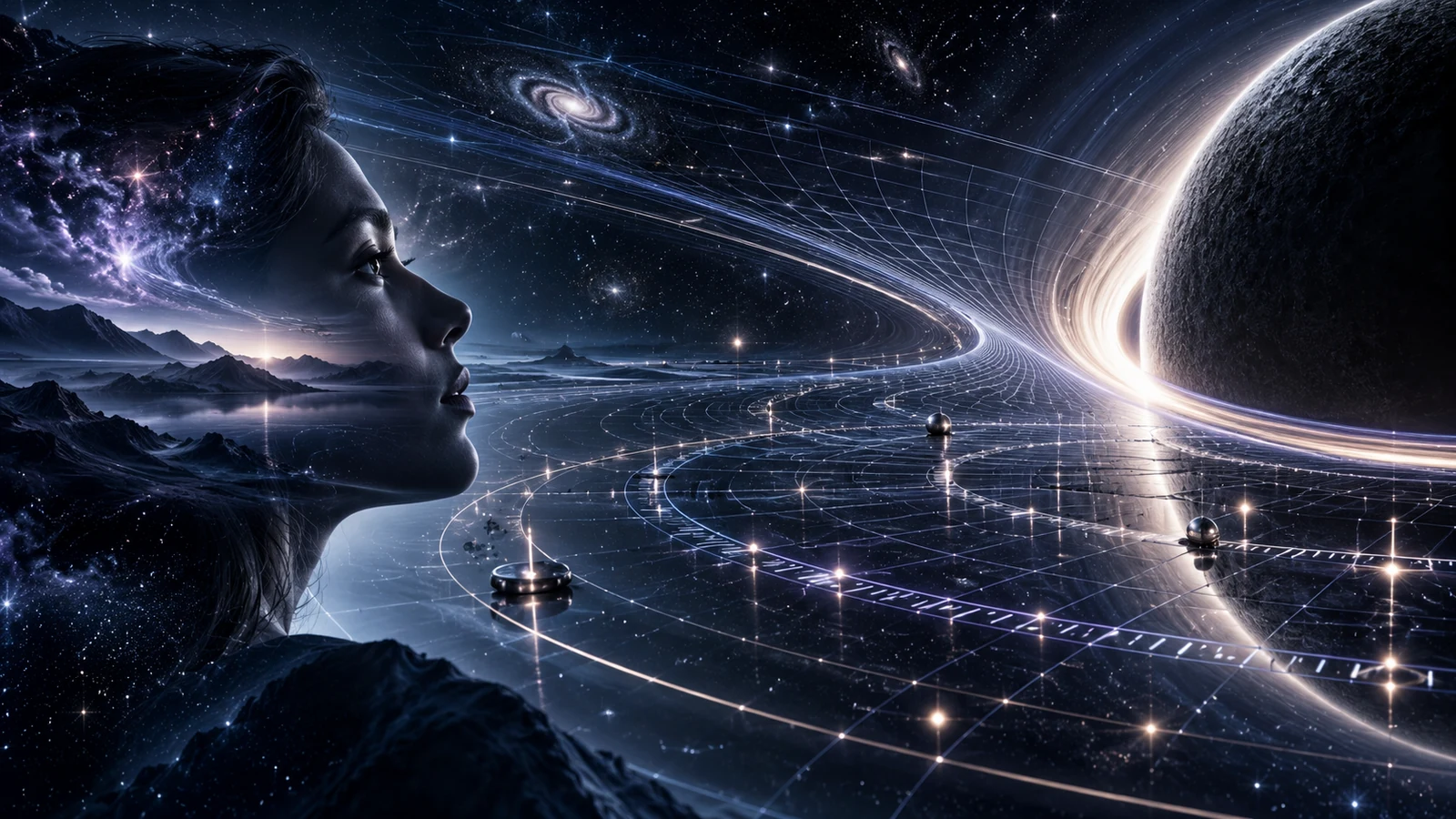
Two questions hidden in one
“Is time real?” can ask whether physical events possess measurable temporal relations, or whether the felt flow from past to future exists independently of minds. Physics answers the first question operationally: clocks compare durations, events can be ordered within causal structure, and theories predict how measurements change. Psychology and neuroscience address the second by studying how attention, memory, emotion and bodily rhythms shape perceived duration. Confusing these levels makes a genuine scientific puzzle look like a simple choice between reality and illusion.
What relativity changed
Newtonian physics treated time as a universal background. Special relativity showed that observers in relative motion can measure different elapsed times between events. General relativity added that clocks at different gravitational potentials tick at different rates. These are not perceptual tricks. Atomic clocks, particle lifetimes and satellite navigation confirm the effects. There is no single universal “now” that all distant observers must share, yet each observer measures a valid proper time along their path through spacetime.
Why time seems to speed up or slow down
Human duration estimates change with attention, novelty, emotion and memory. A threatening second can feel long while it happens; a familiar month can seem compressed in retrospect. The brain does not contain one master stopwatch. Different tasks recruit distributed systems for interval timing, prediction, movement and episodic memory. Subjective time is therefore constructed, but construction does not mean fabrication: perception is the nervous system’s way of tracking real change with limited and context-sensitive mechanisms.
The arrow of time
Many microscopic physical equations work almost equally well when the time direction is reversed. Everyday life does not: eggs break, heat spreads and memories refer to the past. Statistical mechanics links this arrow to entropy, which tends to increase for closed macroscopic systems prepared in low-entropy conditions. Cosmology then inherits a deep question: why did the early universe have the special conditions required for a strong thermodynamic arrow? Physics describes the asymmetry without yet providing a universally accepted final explanation.
Does time “flow”?
Some philosophers and physicists regard past, present and future as parts of a four-dimensional spacetime, with passage belonging to experience. Others defend an objective becoming or a privileged present. Relativity constrains these views but does not automatically decide every metaphysical question. The safest conclusion is layered: temporal intervals and causal ordering have measurable physical consequences; the vivid feeling of a moving present depends on cognition; and the ultimate ontology of time remains open to philosophical debate.
Discussion question
If two clocks follow different paths and record different elapsed times, while two people also feel the same minute differently, which difference tells us more about what time is?
Sources and further reading
NIST — Atomic clocks and gravitational time dilation at the millimetre scale ↗Nature — Resolving the gravitational redshift across a millimetre-scale atomic sample ↗Einstein Online — Elementary Einstein ↗Share your answer
You must log in to reply.
Established evidence, active research and philosophical interpretation are clearly separated.