Published: 23 October 2026
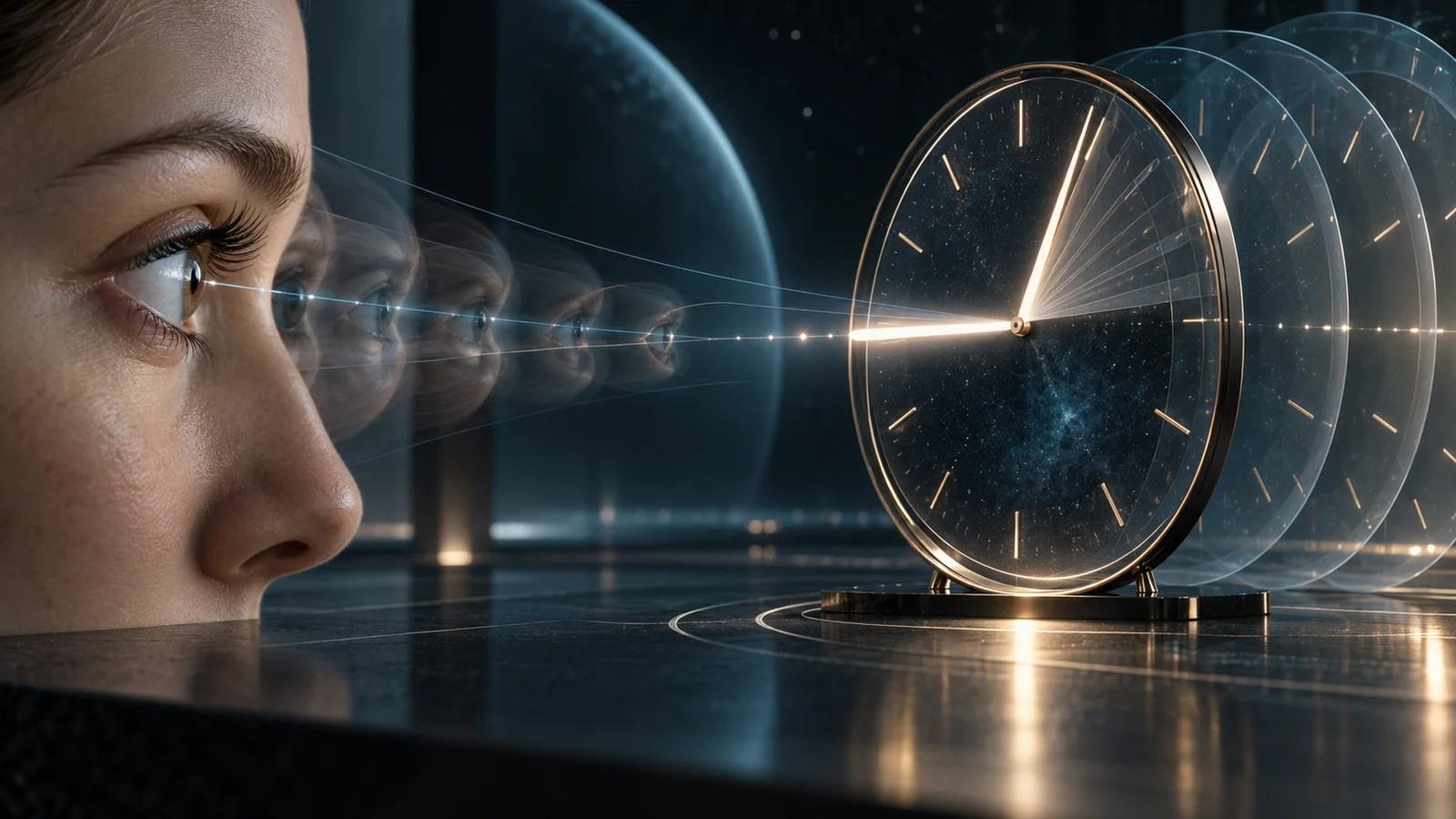
The stopped-clock illusion
Look quickly from another object to an analog clock and the first movement of the second hand may seem delayed. The clock has not changed. The illusion, called saccadic chronostasis, appears near the end of the rapid eye movement that brings the clock into view.
Vision is disrupted during a saccade
During a saccade, the image sweeps rapidly across the retina. Sensitivity is reduced and the visual system suppresses much of the blur. Yet experience does not usually contain a dark gap. The brain combines information before and after the movement into an apparently continuous scene.
A backdated first impression
One influential account proposes that the brain assigns the stable post-saccadic image to an earlier moment, effectively filling the interval occupied by the eye movement. The longer the movement, the larger the apparent extension can become. The result makes the first clock interval feel longer than subsequent ones.
The mechanism is still debated
Experiments have tested attention, spatial correspondence and changes in sensory processing. Chronostasis also occurs in other senses, but not every result supports a single universal backdating mechanism. Some effects depend on task design and the reliability of information before and after the movement.
Perceived time is constructed, not arbitrary
The illusion does not show that physical time stops or that perception is wholly unreliable. It shows that the nervous system prioritizes a coherent world over a frame-by-frame record. Normally that reconstruction is useful; a clock makes the hidden correction noticeable.
Discussion question
If the brain quietly fills gaps in perception, does continuity belong to the world, to the mind or to both?
Sources and further reading
Yarrow et al. — Illusory perceptions of space and time preserve cross-saccadic perceptual continuity ↗Study of chronostasis and temporal compression ↗Review of mechanisms underlying chronostasis ↗Share your answer
You must log in to reply.
Sign Up / Log InEstablished evidence, active research and philosophical interpretation are clearly separated.