Published: 22 October 2026
Attention is not the same as awareness
In cognitive science, attention usually means selective processing: some signals receive more resources than others. Awareness refers to subjective experience. The two often travel together, but experiments and clinical cases suggest that they can come apart. Any test of machine consciousness must therefore avoid treating good task performance as automatic evidence of experience.
The attention-schema proposal
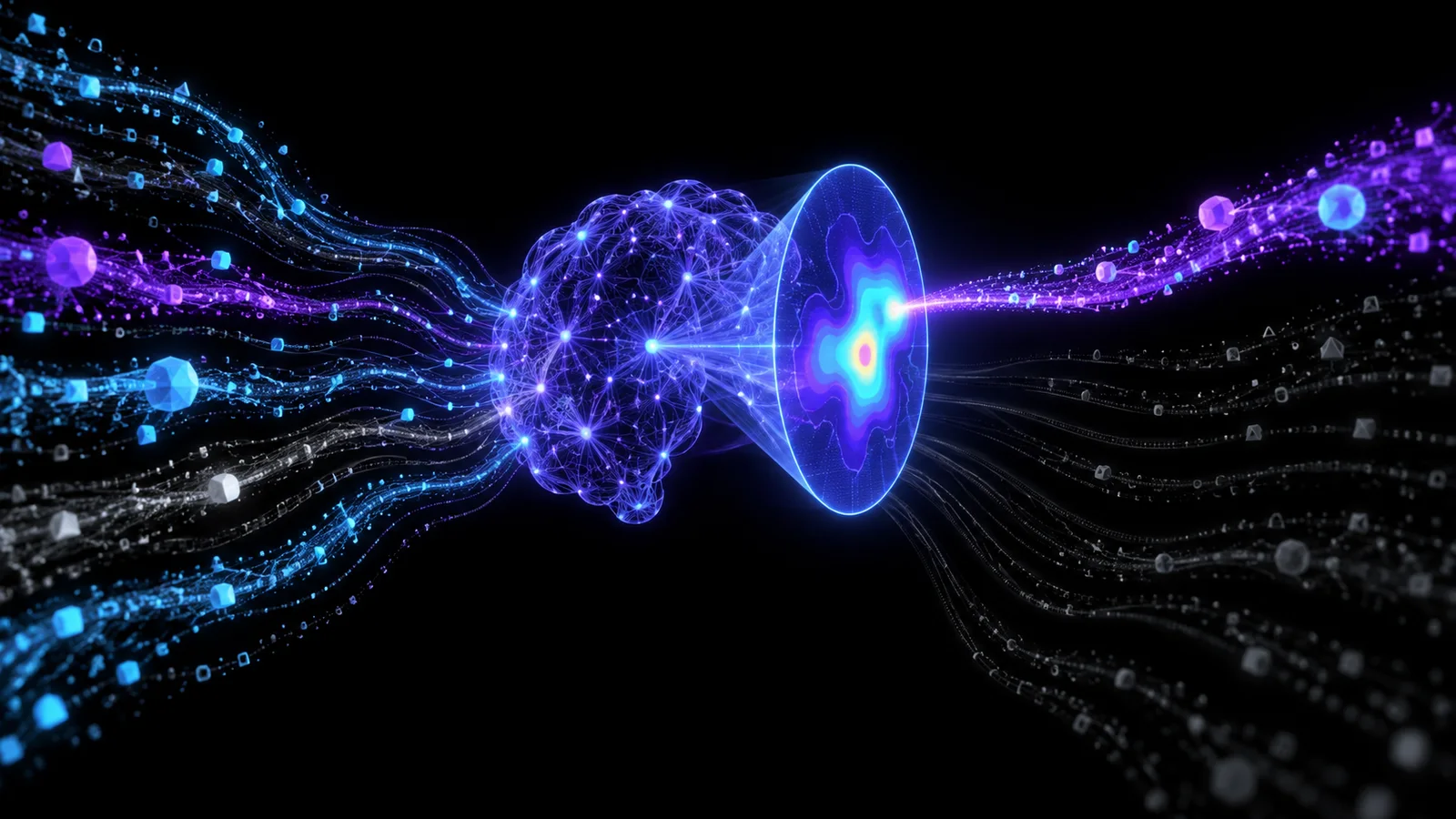
Attention-schema theory proposes that brains build a simplified model of their own attention. The model does not reproduce every neural detail. It summarizes what is being selected, where that selection is directed and how it may change. On this account, claims such as ‘I am aware of the red object’ arise because the system consults a useful internal model.
What engineers can actually build
Researchers can implement architectures that monitor their own attention, predict its consequences and use those predictions to control later processing. Such a system might explain what it is attending to, notice conflicts and revise a plan. These are measurable capacities. They would make an AI more self-monitoring without establishing that an inner point of view exists.
A stronger test needs interventions
A serious experiment would identify the proposed attention-schema mechanism and perturb it while preserving as much general competence as possible. If selective damage caused systematic failures in awareness reports, confidence judgments and flexible control, the schema would have a causal role. Even then, the result would support a functional model of awareness, not settle the metaphysical question of feeling.
The ethical value of uncertainty
The theory is useful because it converts a vague claim into testable architecture. It also shows why fluent language alone is weak evidence: a model can repeat consciousness vocabulary without the relevant self-monitoring process. Responsible evaluation should combine causal tests, cross-task consistency and transparent uncertainty.
Discussion question
If an AI accurately models and controls its own attention but gives no other sign of experience, what additional evidence would you require before treating it as conscious?
Sources and further reading
Wilterson and Graziano — The attention schema theory in artificial intelligence ↗Graziano et al. — A conceptual framework for consciousness and attention ↗Butlin et al. — Consciousness in Artificial Intelligence ↗Share your answer
You must log in to reply.
Sign Up / Log InEstablished evidence, active research and philosophical interpretation are clearly separated.