Published: 21 October 2026
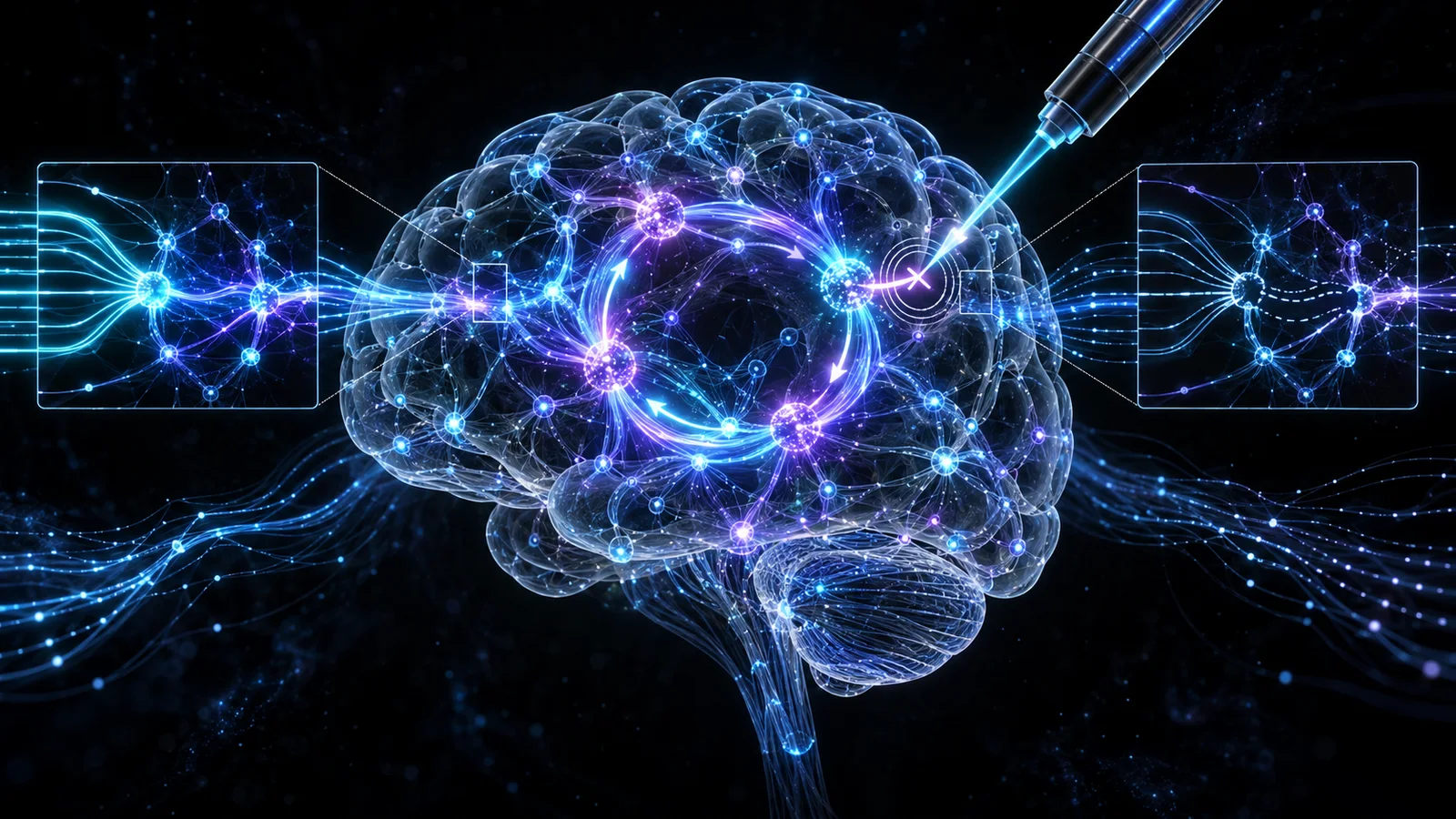
Self-talk is not a self-model
An AI can describe its goals, uncertainty and identity because such language appears in training data and prompts. A functional self-model is a stronger claim: an internal representation that tracks the system's own state and causally guides planning, error correction and action.
Why intervention matters
Correlations between an internal representation and a report do not establish what the representation does. Researchers can suppress, alter or transplant the proposed self-model while controlling for general performance. Selective changes in self-monitoring would support a causal role.
The right controls
A convincing test would compare interventions on the candidate mechanism with matched interventions elsewhere, use tasks the model has not memorised and measure whether effects generalise across planning, confidence and error recovery. Broad damage would be uninformative.
What the result could show
Successful interventions could demonstrate that a system maintains a usable model of its own processing. They would not show that the representation is experienced. Functional self-knowledge and phenomenal consciousness remain distinct hypotheses.
A cumulative case
Self-modelling would matter most when combined with recurrent processing, global availability, metacognitive calibration and stable goal-directed behaviour. A theory-linked profile is more defensible than a binary verdict based on one striking conversation.
Discussion question
If disrupting an AI's self-model selectively erased introspection while preserving intelligence, what would that tell us about consciousness?
Sources and further reading
Butlin et al. — Identifying indicators of consciousness in AI systems ↗Melloni et al. — Adversarial testing of consciousness theories ↗Consciousness in Artificial Intelligence: Insights from the Science of Consciousness ↗Share your answer
You must log in to reply.
Sign Up / Log InEstablished evidence, active research and philosophical interpretation are clearly separated.