Artificial Intelligence · Philosophy · Simulation
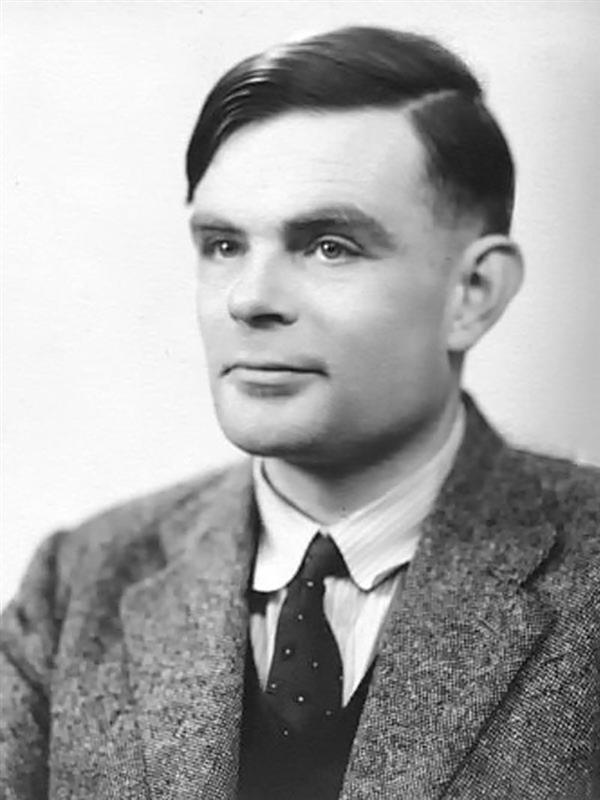
Alan Turing
1912–1954 · Mathematician and computer science pioneer
By what criterion can we evaluate a machine's thinking?
He mathematically examined the limits of computability; In 1950, he discussed machine intelligence with a debatable criterion through the imitation game.
Contribution: define what computation is
Turing's 1936 work deals with computability through an abstract machine operating with symbols and rules. The idea of a universal machine explains the basis on which a system can appropriately represent other computational processes. However, not every mathematical problem can be solved with a general algorithm. This limit is an important warning against the idea that a fast or large computer can solve every problem.
Imitation game and artificial intelligence
The 1950 article Computing Machinery and Intelligence transforms the question of whether machines can think into a more functional discussion through the imitation game. Thus, instead of simply agreeing on an abstract definition of thinking, one can ask how behavior can be evaluated. The article also discusses learning machines and various objections. Our relationship to today's language models is one of historical comparison; It is not a claim that Turing predicted today's systems in detail.
Are success and consciousness the same thing?
Just because a machine resembles a human in speech does not mean that it has a subjective experience or that every answer is correct. Behavioral performance, accuracy, reliability and awareness are separate evaluation headings. Turing's work allows us to take the idea of computation seriously when making these distinctions. The important question is not only how convincing the system is, but also at what task and by what criteria is it deemed successful.
Works, articles and further reading
We do not copy full texts; We direct you from our original explanations to the relevant work or publication record. Full text access may be limited in some publications.
On Computable Numbers · 1936 ↗Primary mathematical articleComputing Machinery and Intelligence · 1950 ↗Primary academic article1950 article · King's College Turing archive ↗Original document archiveBu izi takip et
Read this person's contribution along with the relevant topic files; Compare our site's description with the primary work.