Chandra's mysterious X-ray sources
File: 3 October 2026 · Araştırma duyurusu: 9 September 2026
What does the new finding say?
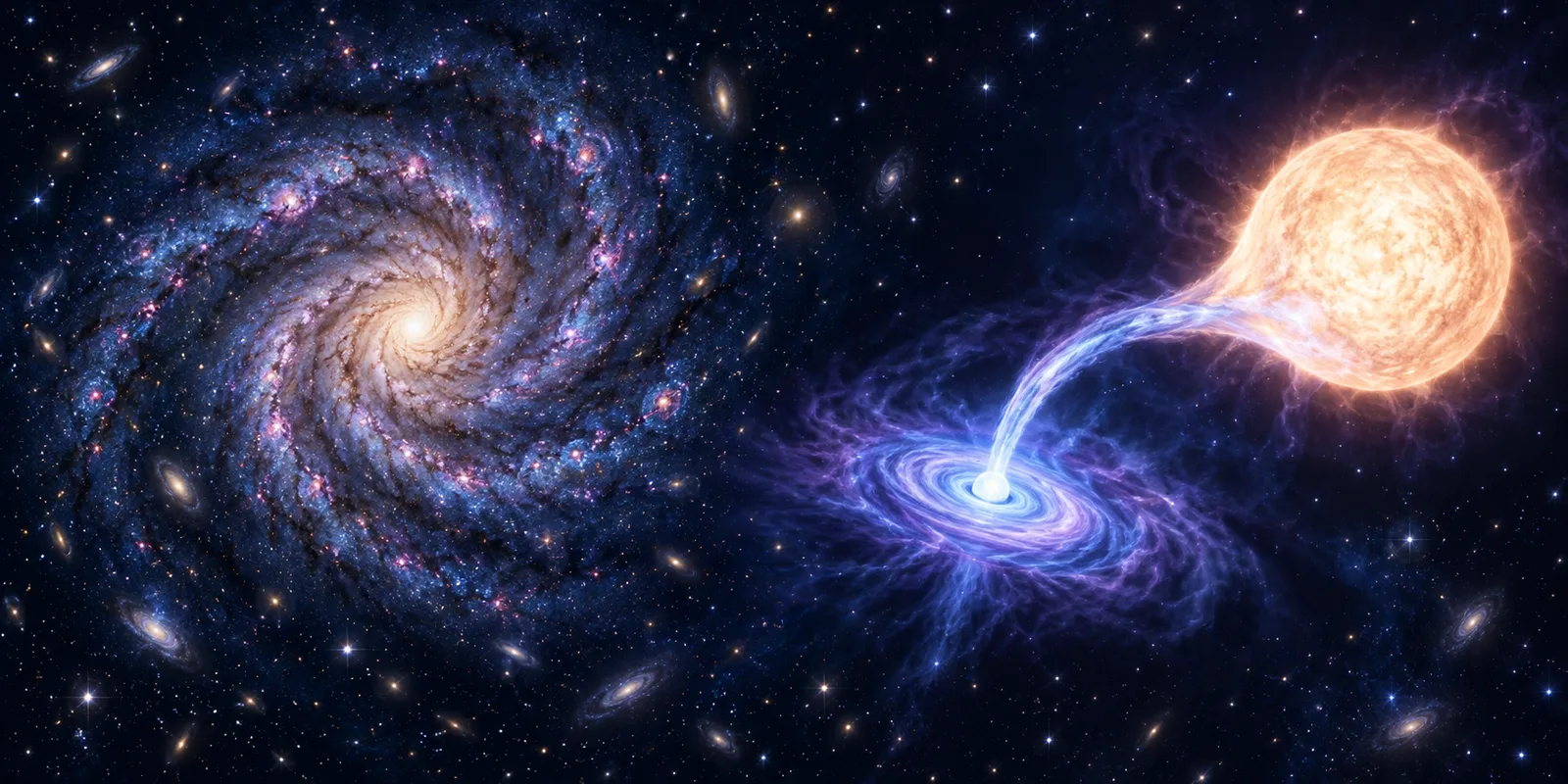
On September 9, 2026, NASA announced that the Chandra archive contained 84 "hypersoft" X-ray sources distributed across six galaxies. These become evident in low-energy X-rays; disappears in high energy images. Among the galaxies examined are Andromeda and the Pinwheel Galaxy. We present the finding to our readers today; The date of discovery is not October 3.
The boundary between observation and explanation
Researchers think that these sources, which produce intense ultraviolet radiation, may be binary systems containing a white dwarf, neutron star or black hole pulling material from a companion star. This is the possible explanation; It is not established that all resources are the same object type. Sources are seen both in star-forming regions and in older stellar groups.
Why is it important?
Candidate systems may shed light on the problem of finding precursors of Type Ia supernovae and the energy sources that contribute to interstellar gas losing electrons. However, it cannot be said that the study solved these two problems definitively. Low energy radiation is difficult to detect; interstellar hydrogen and helium can also absorb energetic ultraviolet light. Therefore, it is valuable to re-examine the archive with different energy ranges.
X-ray is also a type of light
The light our eyes see is a small part of the electromagnetic spectrum. Ultraviolet and X-rays have higher photon energies. Just because a source produces “soft” X-rays does not mean that it is weak in the everyday sense: it is the photon energy that is compared here. Luminance, total emitted energy, and flux reaching the observer are different quantities. Examining the same object in different spectral bands reveals information that a single color photograph cannot provide.
How do stellar remnants differ?
A white dwarf is the dense core left over from the evolution of Sun-like stars. A neutron star can be formed by the core collapse of a high-mass star; Matter reaches much higher densities here. A black hole is a region of space-time beyond the event horizon from which light cannot escape. Matter transfer in binary systems can produce hot gas and radiation around these objects. Therefore, observing a bright spot alone does not lead to the conclusion that "this is definitely a black hole". The object's mass, spectrum, and behavior over time are evaluated together.
Which part of the galaxy are we looking at?
The galaxy does not only consist of stars: it also contains gas, dust and various stellar debris. The regions where young stars are located do not have the same characteristics as old star groups. This environmental information provides clues to the formation story of a resource. However, instead of establishing a direct equation between environment and resource type, it is necessary to use different observations together.
What do we expect from the next observation?
Our editorial assessment: repeat observations at different times, examining whether the brightness changes regularly or irregularly, and comparing with other spectral bands may help distinguish candidate explanations. This is not a new result reported by the research, but rather a methodological description of how comparing observation with model can proceed. The name of the source does not indicate that its description is complete; sometimes the nomenclature merely describes the common behavior being measured.
Three check questions for the reader
When evaluating the news, ask: What is being measured? What is the suggested explanation? Which conclusion is still open? In this file, sources that differ according to energy include observational findings; The binary star system interpretation includes the physical explanation; The identity of individual sources remains an open research question. The interestingness of a new finding does not require describing it with certainty.
Kaynaklar
NASA — September 9, 2026 research announcement
NASA — September 22, 2026 visual summary