Established science · There are open questions
How did galaxies form?
Galaxies; They are dynamic systems consisting of stars, gas, dust, black holes and invisible dark matter halos.
Basic framework
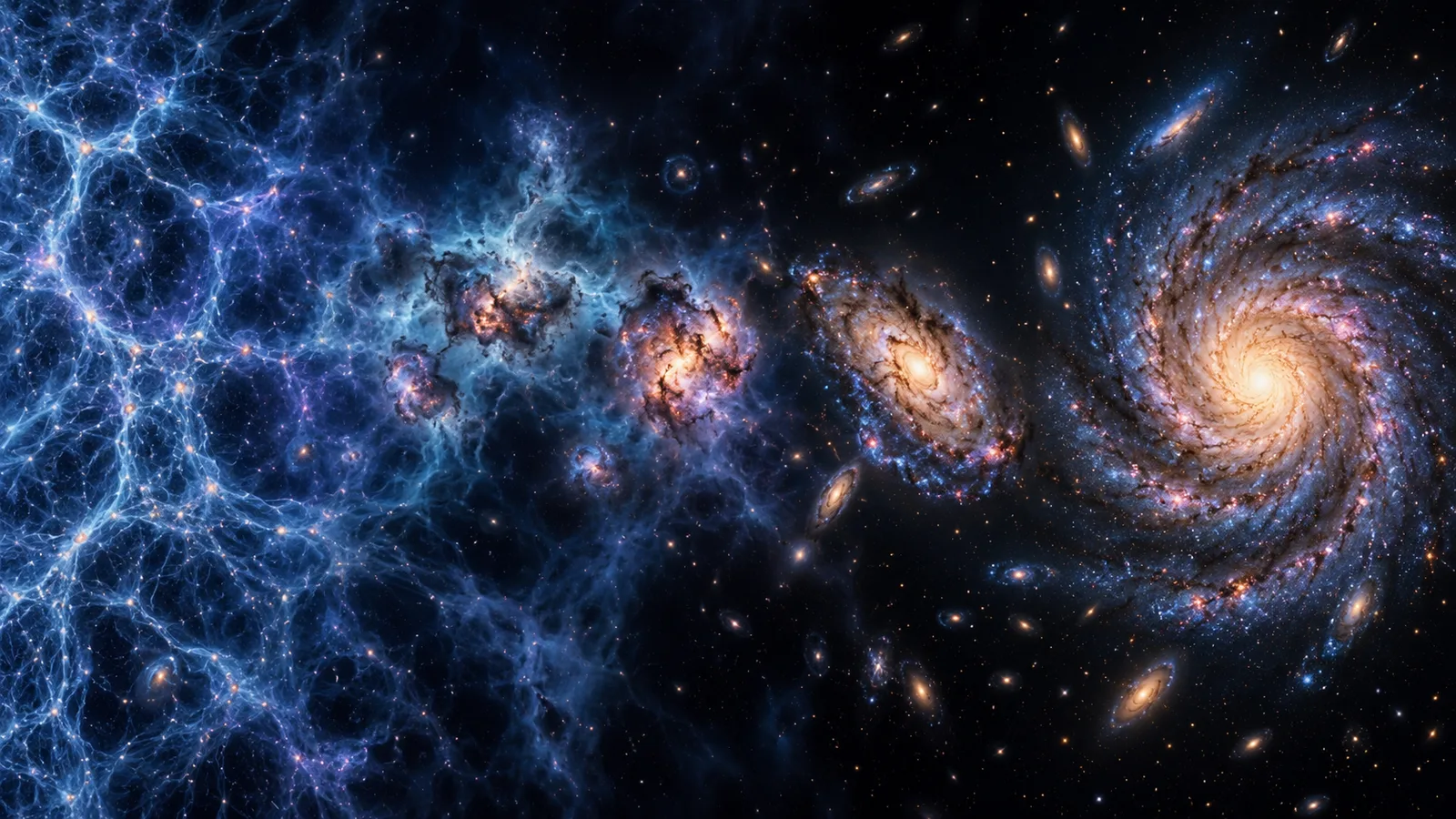
Small density differences in the early universe were magnified by gravity. Dark matter halos attracted gas; The first star clusters formed at the nodes of the cosmic web.
crux of the debate
While the rotation of gas supports the disks, violent mergers can confuse the orbits and lead to elliptical structures. The form depends not on a single event but on a long history of environment and gases.
Today's knowledge frontier
The Milky Way is also not stationary; interacts with satellite galaxies and approaches Andromeda.
Birth of cosmic structures
In the early universe, matter was not completely evenly distributed. The tiny density differences we see in the cosmic microwave background have grown under the influence of gravity over billions of years. Dark matter first formed large halos; Normal matter fell into these gravitational wells, cooled, condensed and formed the first stars. Star clusters merged to form young galaxies, and galaxies formed their present spiral and elliptical shapes through merger and gas flow processes.
Why do galaxies look different?
The shape of a galaxy depends not only on its age. The amount of gas it contains, its rotation speed, its encounters with nearby galaxies, its star formation tempo, and the activity of the black hole at its center all play a role. The dense gas in the spiral arms supports the birth of new stars. Large mergers can shuffle stellar orbits, creating more rounded elliptical systems. Irregular galaxies, on the other hand, may not have any apparent order due to their small mass or interactions with their neighbors.
The real physics of black holes
A black hole is not an ordinary hole opened by matter in space. It is a region where mass and energy curve space-time extremely. The event horizon is the boundary from which light carrying information outside can no longer escape. The surrounding gas can heat up before falling in, emitting strong X-rays. Black hole mergers produce gravitational waves in space-time. The concept of singularity is a mathematical boundary problem that suggests that general relativity is incomplete at the quantum scale.
How do we know?
Along with visible light, astronomers combine radio, infrared, ultraviolet, X-ray and gamma ray observations. Spectra show a galaxy's chemical composition, star formation rate, and motion relative to us. Gravitational lensing allows us to measure the distribution of invisible mass, and the orbits of stars and gas allow us to measure the total mass. Computer simulations are compared to these measurements; If the model does not fit the observation, it is changed.
Hâlâ neyi bilmiyoruz?
We don't yet know what particle dark matter consists of, how the first supermassive black holes grew so quickly, and all the details of the feedback processes in galaxy formation. The unknown points do not mean that the model is completely worthless; Indicates which measurement will make the next distinction.
Featured reviews
Vera Rubin — strengthened the evidence for dark matter with galaxy rotation curves.
Edwin Hubble — introduced the relationship between distance and speed of galaxies into cosmology.
Source: NASA Universe