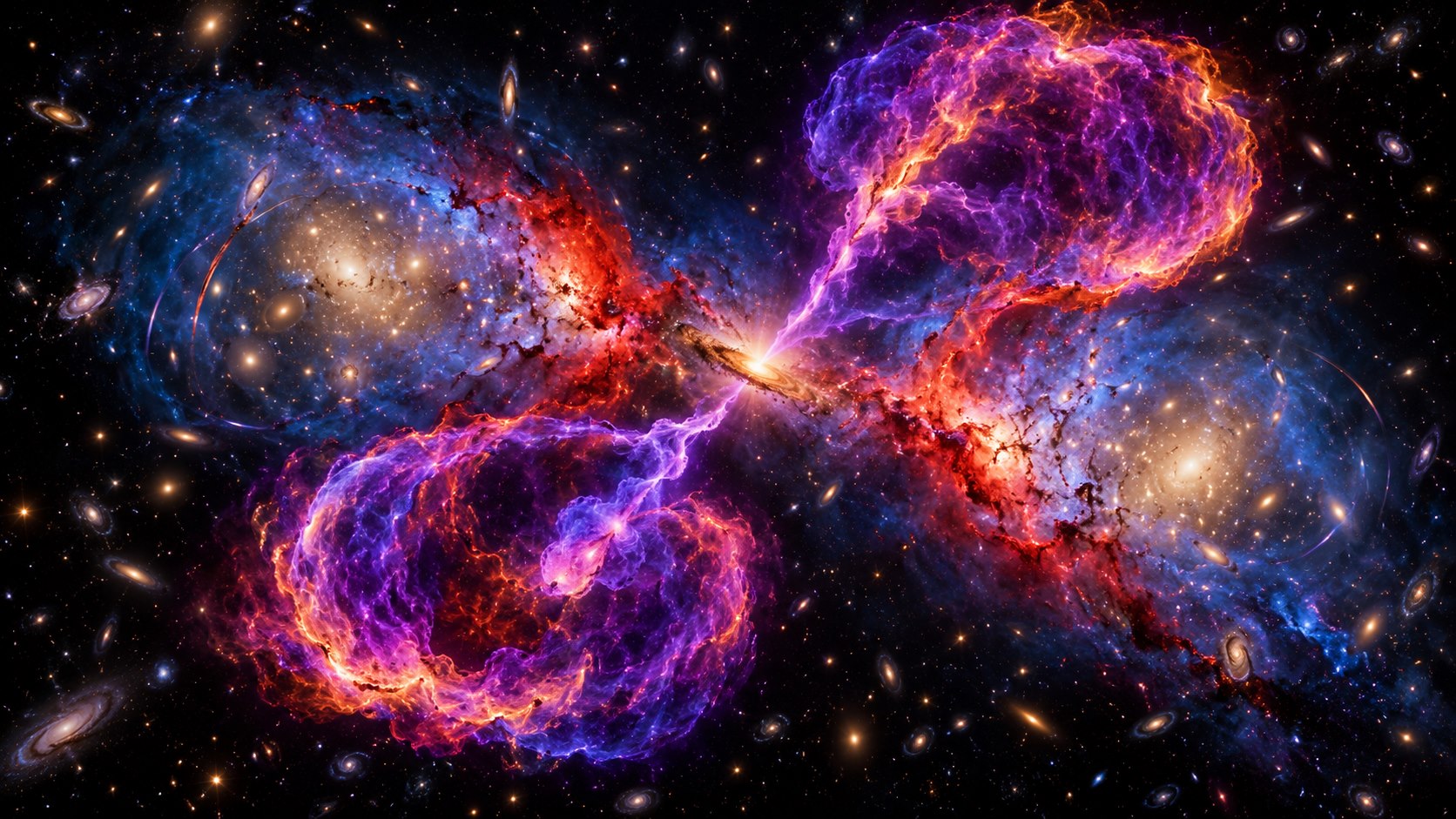
A fossil from a black-hole outburst
Long before the structure looked like a musical symbol, a supermassive black hole released jets of energetic particles. As those particles aged, they lost energy and the radio glow faded. The leftover plasma remained as a fossil in the space between galaxies.
Then two galaxy clusters collided
Galaxy clusters are among the largest gravitationally bound structures in the universe. When two clusters meet, their hot gas can drive enormous shock waves and turbulence. In this system, the later collision appears to have compressed and re-energized the old plasma.
Why several wavelengths matter
Radio telescopes trace the revived relativistic particles and magnetic fields. NASA’s Chandra X-ray Observatory maps extremely hot gas and the disturbances associated with the cluster merger. Optical data locate the galaxies. The “treble clef” is therefore not a photograph in ordinary visible light but a scientific composition of complementary measurements.
A laboratory that cannot be built on Earth
The structure lets astronomers study how weak shocks and turbulence revive aged particles across vast scales. It may help explain why some merging clusters contain diffuse radio arcs and filaments that would otherwise fade too quickly.
Image and reality
Scientific colour is a translation. The image makes invisible frequencies legible to human vision while preserving relationships in the data. Its beauty is real, but so is the chain of instruments, models and choices that produced it.
Discussion question
When an astronomical image combines invisible wavelengths and assigned colours, are we seeing the object itself or a faithful scientific translation?