Webb's panorama of IC 348: a new look at star birth
Observational astronomy · NASA's official science announcement
File: 4 October 2026 · September 15, 2026 · NASA announcement
What does the new observation say?
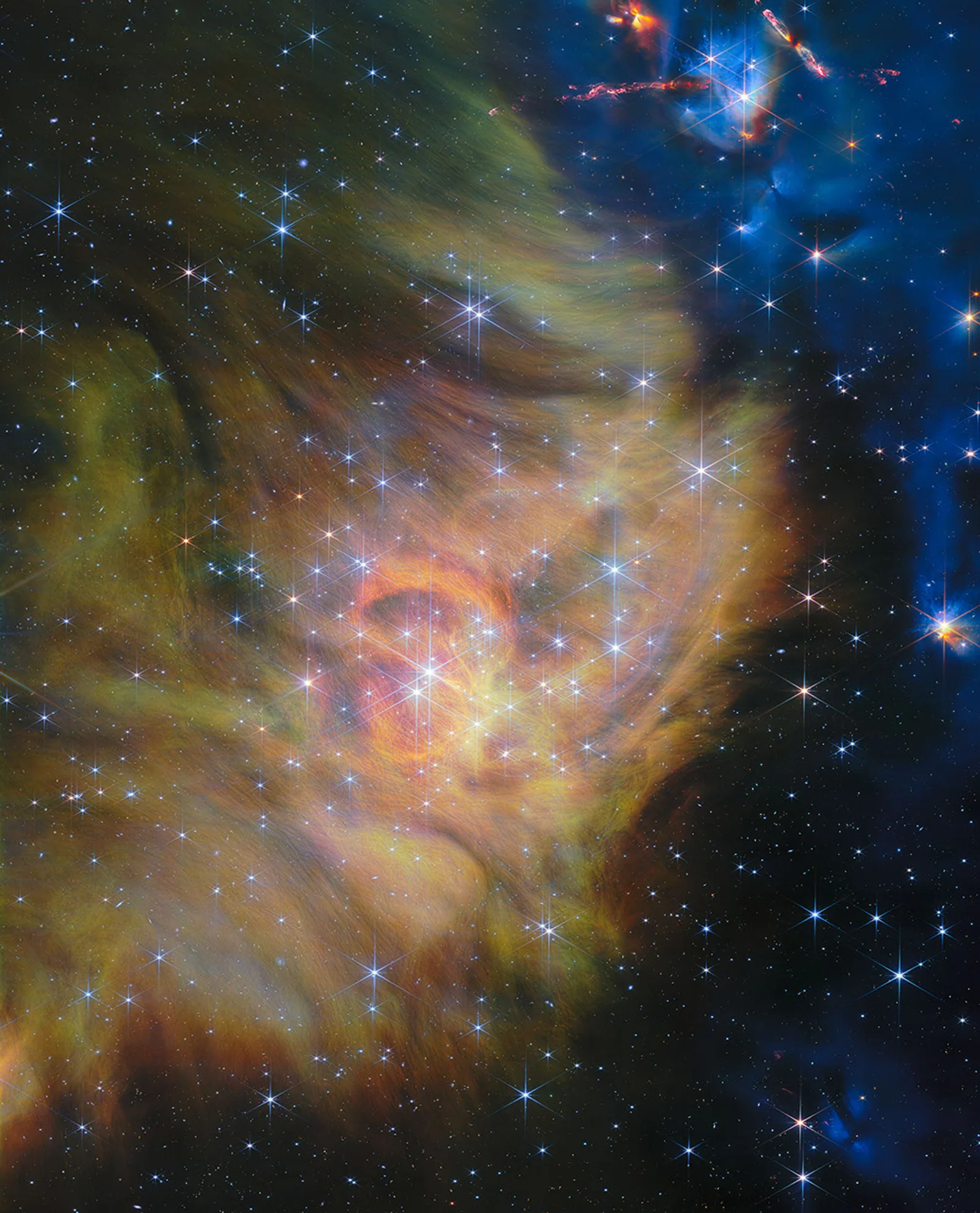
Nasa's 15 September 2026 announcement introduces Webb's view of the IC 348 star-forming region. The region, about 1,000 light-years away, is dominated by small brown dwarfs, with young stars interacting with gas and dust. Some objects are about twice the mass of Jupiter, the announcement said. They are not a single photograph that proves that every star in the universe is formed in the same way. Observations obtained in a certain region with certain measurement tools. Nasa's original announcement
How is a star born?
Basic physics framework: in a cold, dense gas cloud, there is a balance between gravity, pressure and the effects of the environment. The center heats up as sufficiently dense regions collapse. Matter often travels along a disc rather than falling directly onto the central object; Angular momentum is an important part of this process. If the appropriate temperature and density are eventually reached in the core, hydrogen fusion becomes a long-term energy source. Therefore, it is incomplete to think of star birth as just the turning on of a light: matter accumulation, energy transport and interaction with the environment must be considered together.
Are a brown dwarf and a planet the same thing?
Just because an object has a small mass does not in itself make it easier to classify. Brown dwarfs do not glow with hydrogen fusion for long periods of time like normal stars. The formation pathway and environmental context are also discussed in distinguishing between planet and small star-like object. These distinctions are sometimes ambiguous because the observer does not directly trace the entire history of the object. The phrase “failing star” in popular parlance, while intuitive, creates the impression that there is a purpose or criterion for failure. Nature produces different objects under different mass, temperature and developmental conditions.
What doesn't the image show us?
The colors, wavelengths, and processing method of an astronomy image must be described. It is also incorrect to assume that luminosity depends solely on mass; Temperature, distance and dust in between are important. The image here is the actual Webb/NIRCam observation; It is a visual representation of infrared data, it should not be read as a natural color photograph that the human eye would see in space. Image credits to NASA, ESA, CSA and the research team are provided below the cover. Image has been scaled down for the web. Such an observation helps us understand star formation; but it alone does not determine the past or future of every object.
Why are we pursuing this research?
Star birth is also the beginning of understanding the environments in which planets can form. However, seeing a disk in the star formation region does not indicate that there are habitable planets in that disk. Good research questions interrogate the conditions before the conclusion: how does the accumulation of matter vary at different masses, how do surrounding stars affect the gas, and what measurements can separate competing explanations? These questions offer a more lasting way to learn than a single captivating image.
keep thinking
How do you distinguish between what looks beautiful in an image and what is measured scientifically? Look at the source and write down one observation, one comment, and one question that has not yet been answered. Then try the same method on another astronomy news. You can share your answer with your justification in the member area below.