Published: 13 October 2026
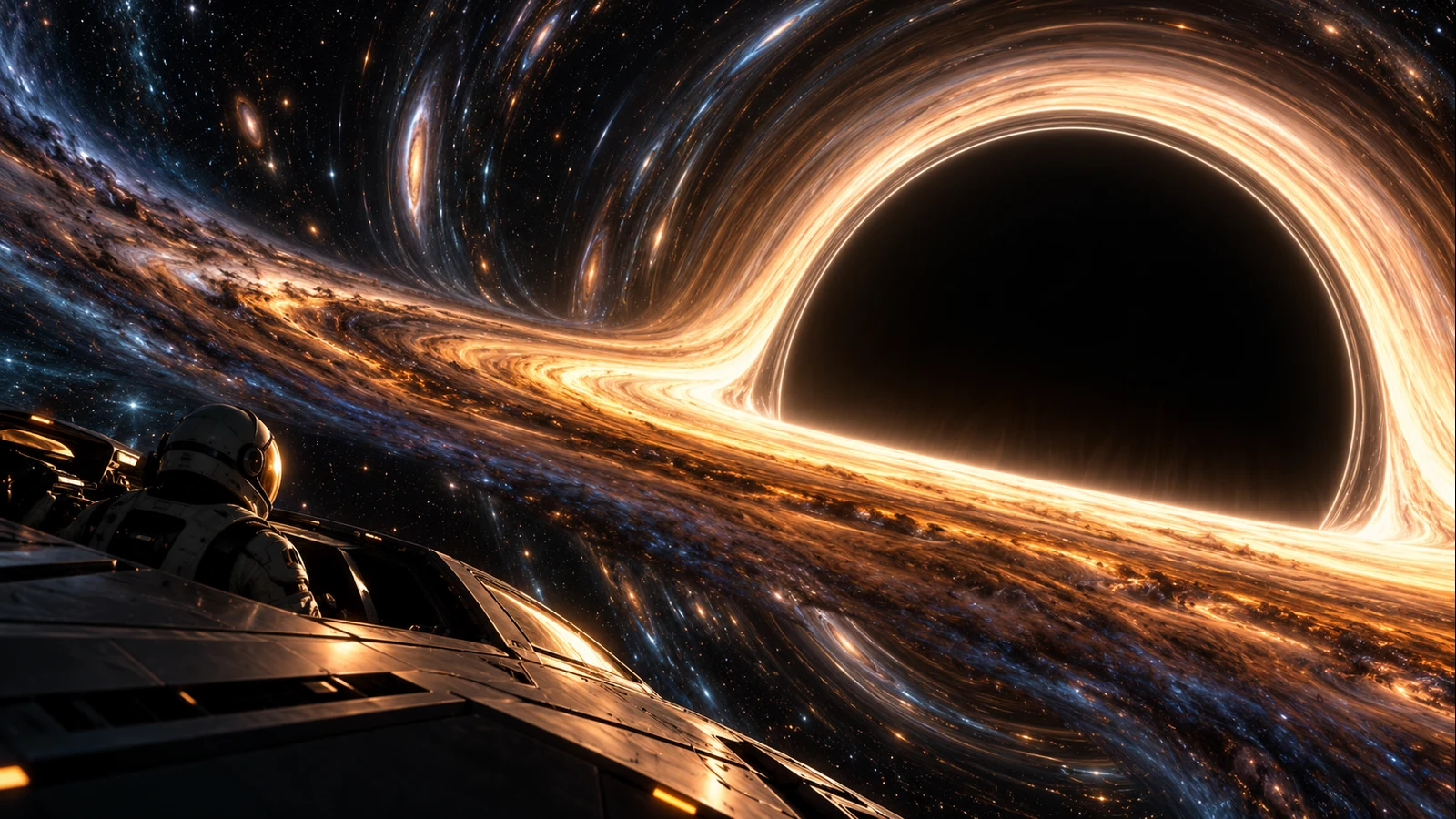
Two viewpoints, one event
A distant observer receives progressively redshifted and delayed light from a falling spacecraft. The craft appears to fade near the horizon. On board, however, the traveller reaches and crosses the horizon in a finite amount of proper time. These accounts are not contradictory. They are measurements made along different paths through curved spacetime, and no distant signal ever reports the moment after crossing.
The horizon is not a wall
An event horizon is a causal boundary, not a material surface. Near a sufficiently large black hole, a freely falling traveller would not meet a sudden barrier or local flash at the crossing predicted by classical general relativity. The scale matters. NASA visualizations use a black hole of roughly 4.3 million solar masses to show that tidal forces at its horizon can be much weaker than those near a stellar-mass black hole.
What the sky might look like
Gravitational lensing bends light into distorted arcs and multiple images. Aberration and Doppler effects change brightness and colour as the traveller accelerates. The external universe could appear compressed into a changing region of the sky, but popular images should be treated as calculations and visualizations, not camera footage. Exact appearance depends on trajectory, black-hole spin and surrounding matter.
No route back out
Inside the horizon of a simple non-rotating black hole, every future-directed path leads toward smaller radius. A rocket can change the traveller’s motion but cannot choose a future that crosses outward through the horizon. Deeper in, differences in gravity across the body grow. Stretching along one direction and compression along another produce the effect called spaghettification.
Where knowledge ends
Classical equations predict geodesic incompleteness, commonly represented by a singularity. This marks a limit of general relativity rather than a photographed object. Quantum gravity should become relevant, yet no experimentally confirmed theory describes the final interior. Statements about bounces, tunnels or new universes belong to speculative models. The honest account stops where tested physics stops.
Discussion question
If no signal can return from beyond the horizon, can a sufficiently precise exterior theory count as knowledge of the interior?
Sources and further reading
NASA — What happens when something gets too close to a black hole? ↗NASA — Visualization beyond the brink ↗NASA — Black hole FAQs ↗Share your answer
You must log in to reply.
Sign Up / Log InEstablished evidence, active research and philosophical interpretation are clearly separated.