How can entanglement measure light? 2026 quantum network experiment
Peer-reviewed experimental research · Nature, 25 February 2026
File: 3 October 2026 · Experiment published February 25, 2026; 3 October 2026 Turkish file
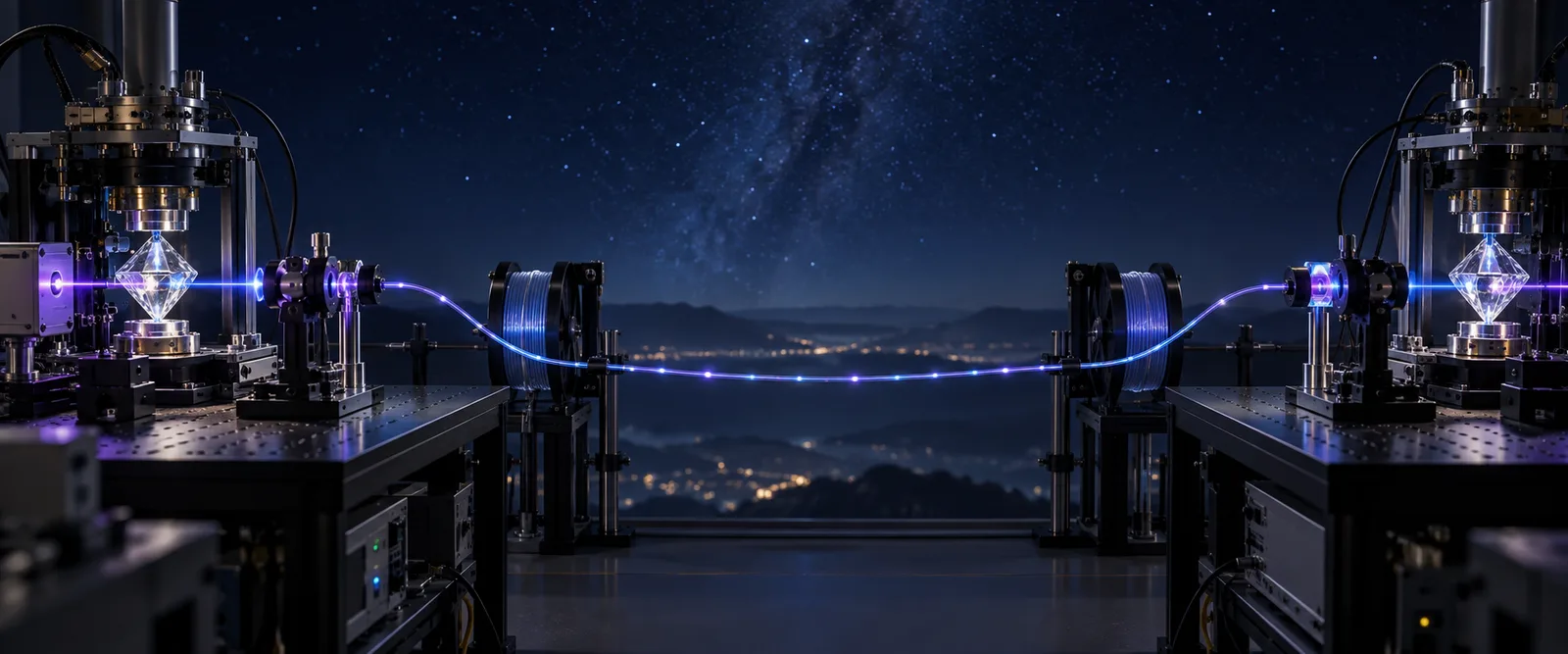
What was done in the 2026 experiment?
The research by P.-J. Stas and colleagues, published in Nature on February 25, 2026, presented proof of concept measuring the relative phase of weak light that arrives at separate stations with entangled quantum memories. Silicon-cavity centers in diamond were used in the memories. The line of sight separation of the stations was about six meters; the assembly was also operated with a fiber connection of up to 1.55 kilometers. These two distances should not be confused. The experiment does not mean that a new image is obtained from distant stars. Peer-Reviewed Paper.
Measured quantity: phase
The phase of a wave describes the phase in which it is oscillating. It can be used to access information such as the phase difference of the light reaching the two stations and the direction of the source. Interference is the evaluation of waves together; This is why waves become stronger in some areas and weaker in others. Two sounds amplifying each other in everyday life is a simple analogy, but it does not represent all the details of the optical experiment. In very low light, loss and measurement noise become important. Therefore, simply moving stations away is not enough to establish a better observation system.
Entanglement is a resource here
We cannot fully describe the common state of two entangled systems by giving an independent state for each. There may be relationships between measurement results that exceed the classical expectation of independence. In this experiment, the researchers treat entanglement not as a mystical bond, but as a physical resource consumed and prepared in the measurement protocol. Preset memory associations help process common information about light in discrete locations. The sentence “particles feel each other” alone does not explain how the experiment works; It is necessary to examine the steps of preparation, local operations and comparing the results.
Why is memory important?
Quantum memory attempts to preserve a suitable quantum state for use in a later process. It is not the same process as saving a classic file: interaction with the environment can break stored associations. The arrival of light does not always occur simultaneously with successful preparation in a network. Being able to maintain state is valuable for regulating the timing of transactions. However, storage time alone is not a sufficient criterion; Preparation speed, accuracy, reading success and losses are evaluated together. Just because laboratory components work well does not automatically mean that a large network is ready.
Possible meaning for astronomy
The work demonstrates a research path for quantum-assisted optical imaging and long-baseline interferometry. We must maintain the distinction between “possible application” and “ready-to-use telescope”. In larger systems there are issues such as stability, synchronizing different stations, generating entanglement at a sufficient rate, and separating weak signal from losses. Therefore, it is more accurate to read the news not as a technology promise, but as a step in which a certain method is tested. When evaluating upcoming studies, it is useful to ask about conditions of scale, measurement precision, and adaptation to real sky sources.
No messages exceeding the speed of light
Entanglement does not allow one party to select the measurement result as desired and send an instant message to the other party. Measurement records need to be compared appropriately to see common relationships; Classical communication boundaries do not disappear. Therefore, the experiment is not evidence for telepathy, transfer of data by thought, or transcendence of causality. The advantage of a quantum network is not that it solves every communication problem with unlimited speed, but that it can use different physical resources for specific information processing and measurement tasks.
How do you test a news story?
First separate the physical assembly from the future implementation. Then ask what the digital distance means: station distance as the crow flies or fiber length? Finally, compare the light used in the experiment with the actual astronomical observation. These three controls connect the headline excitement to the measured outcome. What would be the most important research step for you: longer connection, higher accuracy, faster state preparation, or measuring a real star source? Write your preference along with which problem you want to solve.